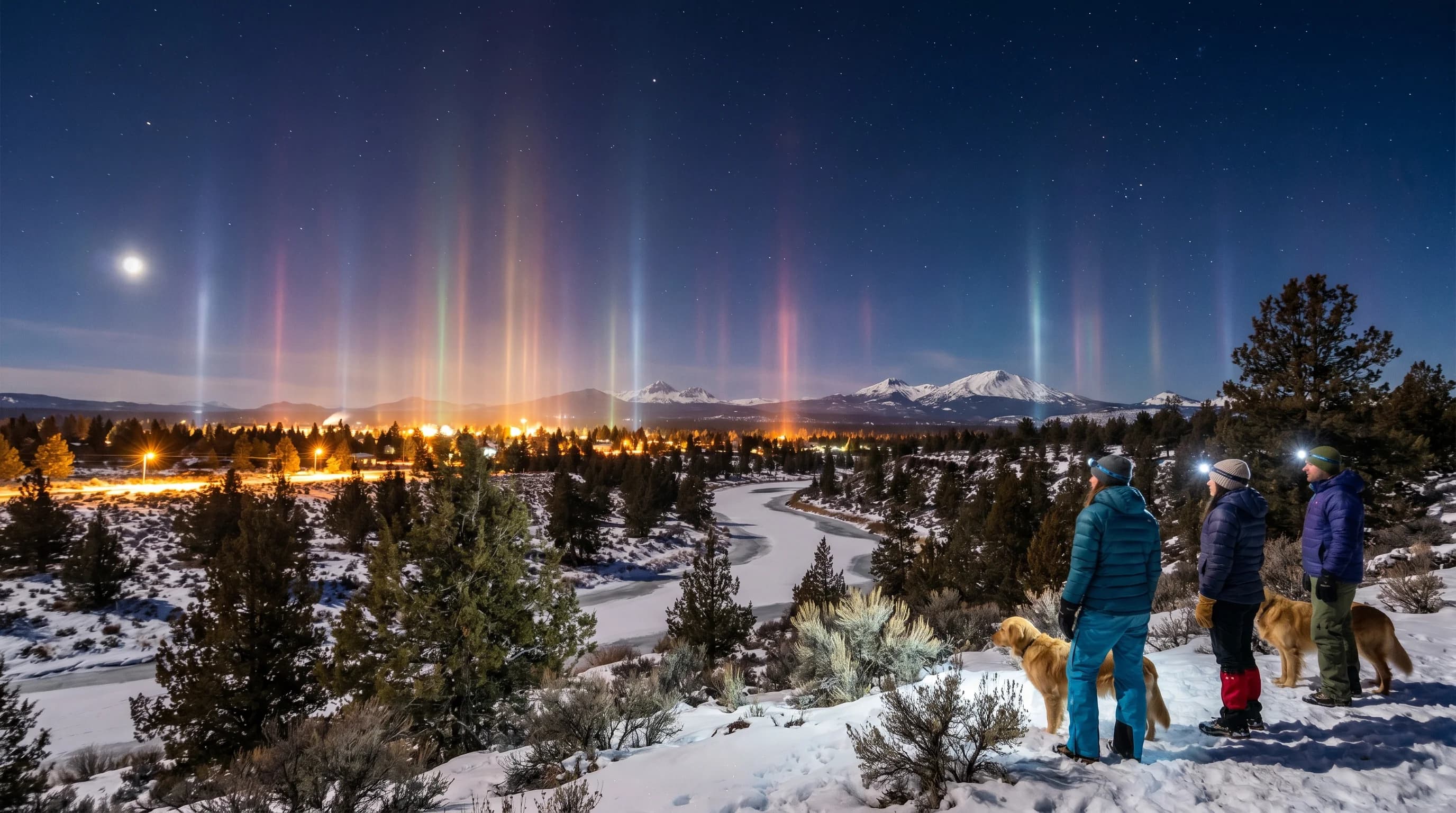
Light pillars are the vertical beams of light that appear to rise above bright sources on very cold nights, looking like columns of colored light standing over streetlights, car headlights, or the low sun. They are not searchlights or auroras; they form when light reflects off countless flat ice crystals drifting slowly in frigid air. On the coldest, calmest nights, the lights of Bend, Redmond, and Sunriver can sprout these eerie pillars, a striking and uniquely cold-weather sight in the high desert.
What Are Light Pillars?
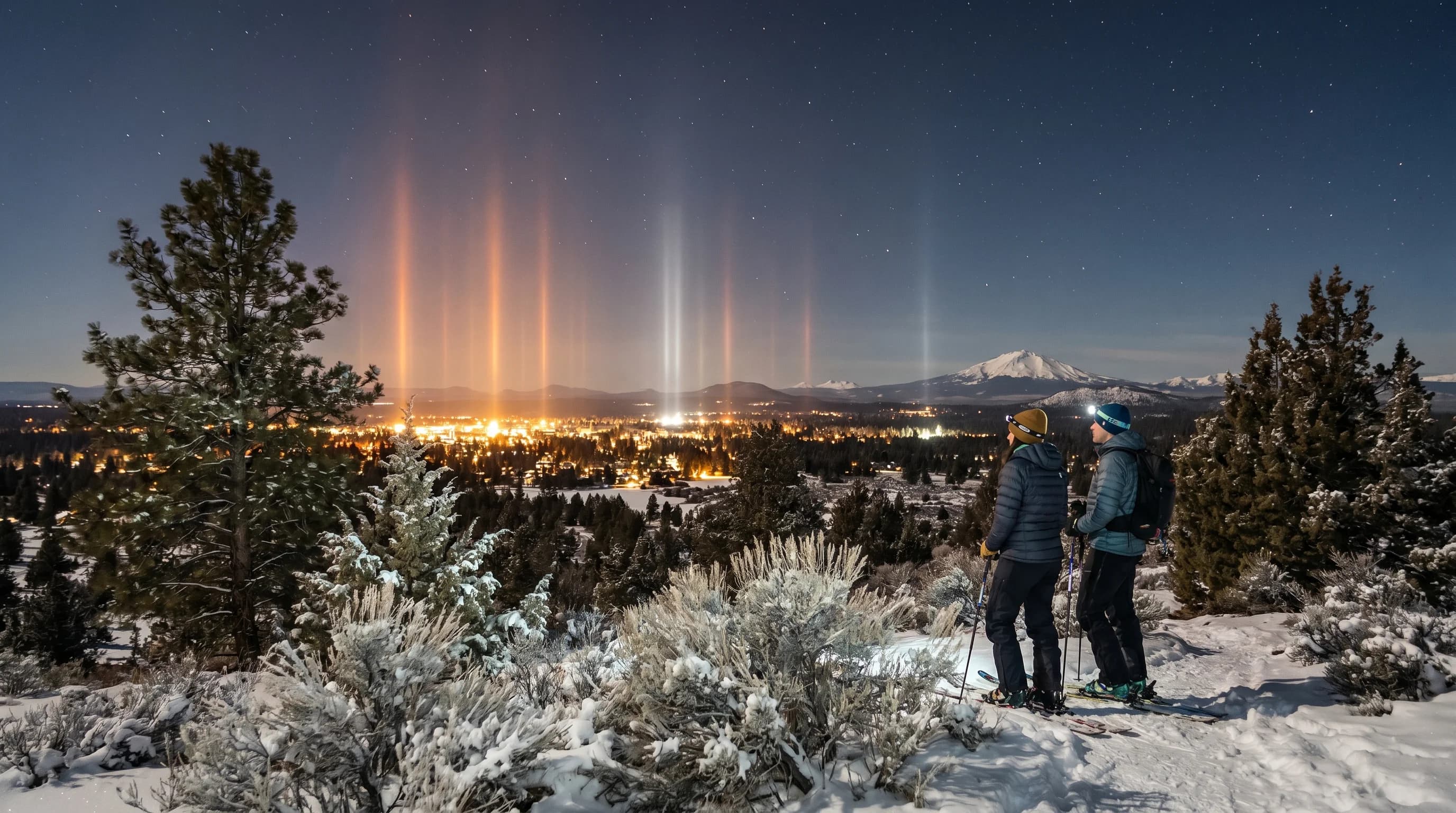
A light pillar is a vertical shaft of light that appears to extend straight up from, or sometimes down toward, a bright light source. Each pillar takes on the color of the light that makes it, so a town can light up with a row of white, orange, pink, and even blue columns reflecting its various streetlights and signs. The pillars seem to stand perfectly upright and still, fading at the top, and they can be tall enough to look genuinely otherworldly to anyone who has not seen them before.
When the source is the sun rather than artificial light, the same effect is called a sun pillar, a vertical beam above the low sun at sunrise or sunset. Light pillars are essentially the nighttime, artificial-light version of that phenomenon. Despite how dramatic they look, they are not beams projecting up into the sky at all; they are an optical illusion created by light bouncing off many ice crystals between you and the light source.
What Causes Light Pillars?
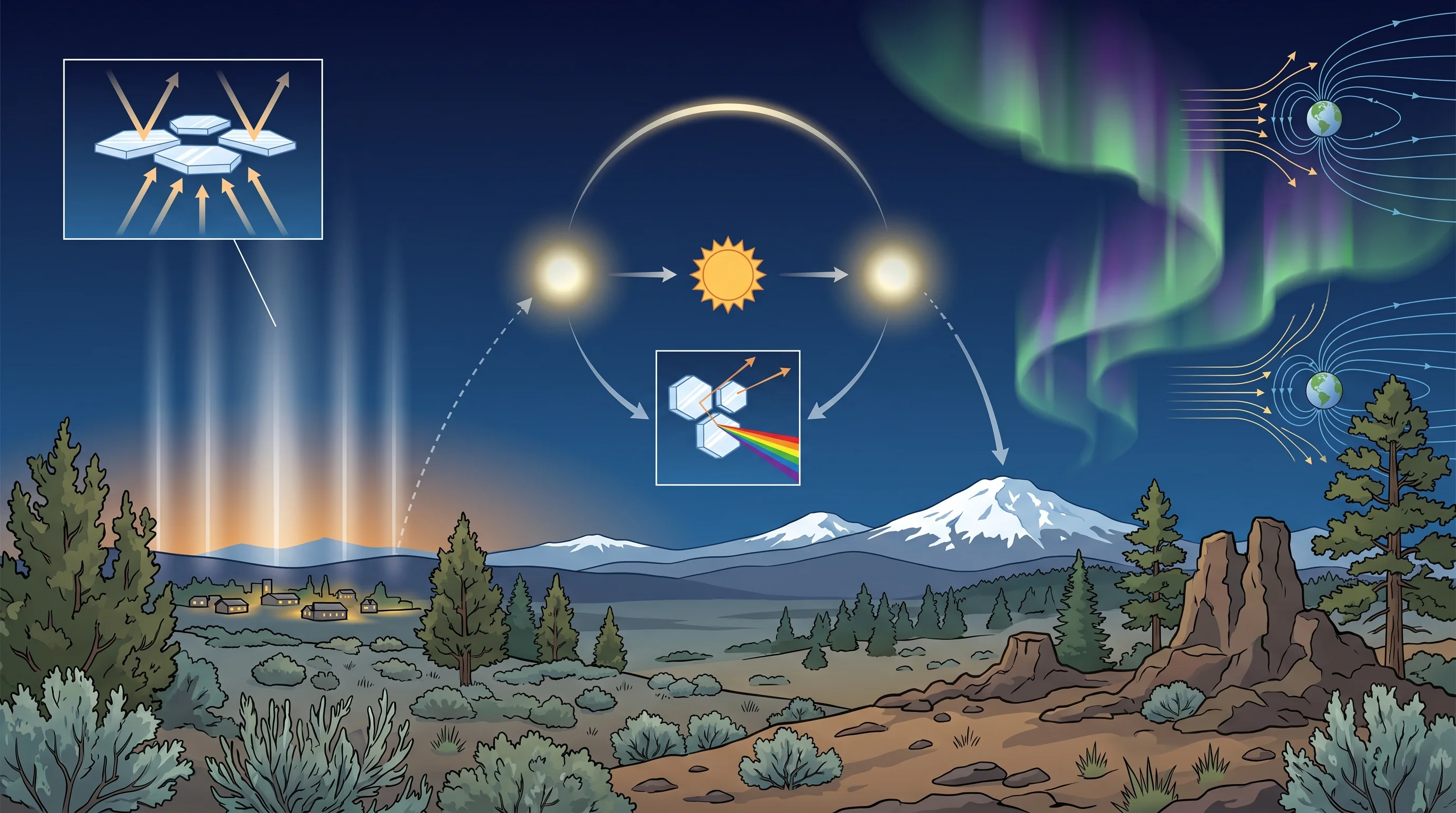
Light pillars are caused by light reflecting off the flat faces of tiny, plate-shaped ice crystals that float nearly horizontally in calm, frigid air. Each crystal acts like a tiny mirror, and when many of them hang at slightly different heights between you and a light, each one reflects a bit of that light toward your eye. Stacked together, those countless small reflections smear the single light source into a tall vertical column.
This is a reflection effect, which sets light pillars apart from sun dogs and halos, which are refraction effects where light bends as it passes through crystals. With a pillar, the light simply bounces off the flat crystal surfaces, so the column appears directly above the source rather than at a fixed angle to the side. The crystals responsible can form right near the ground in extreme cold, which is why pillars over town lights tend to show up only on the most bitterly cold, still nights, when ice crystals can hang suspended in the calm air.
The height of a pillar depends on how the crystals wobble. Falling plate crystals are not perfectly flat; they tilt slightly, and the more they tilt, the higher and lower the reflections reach, stretching the column taller. Larger, heavier crystals tend to align more flatly and produce shorter, more concentrated pillars, while a mix of tilts spreads the beam into a longer shaft. This is also why a pillar appears as a soft, glowing column rather than a sharp line: it is the blended glow of many crystals at many heights, each catching and returning a little of the light toward you.
When and Where Do You See Light Pillars?
Light pillars appear on the coldest, calmest, clearest nights, when ice crystals form in the air near the ground and there are bright light sources around to reflect. The cold is essential, since the crystals need to form and remain suspended, and calm air is needed so they hang nearly horizontal rather than being tumbled by wind. They are most common during hard cold snaps, often the same nights that produce heavy hoar frost by morning.
Central Oregon's frigid, clear high-desert nights make light pillars possible above the lights of Bend, Redmond, and Sunriver during deep cold snaps. Because they need both extreme cold and ice crystals suspended in the air, they are not an everyday sight, but when a hard freeze settles into the basin on a still night, it is worth looking up over the town lights. The same cold, clear, calm conditions that grow the pillars are the ones behind the region's coldest mornings and its other cold-air optics.
Is a Light Pillar the Same as a Sun Pillar?
A sun pillar is the same phenomenon driven by the sun instead of ground lights, appearing as a vertical beam above the low sun at sunrise or sunset in cold air. Both come from light reflecting off horizontally oriented ice crystals, and both stand vertically above their source. The only real difference is what is providing the light: the sun for a sun pillar, and streetlights, headlights, or other artificial sources for the nighttime light pillars.
During a single cold spell you might see a sun pillar above the setting sun in the evening and light pillars over town lights once it is fully dark, both produced by the same suspended ice crystals. Recognizing them as one family makes them easier to spot, since the conditions that create one create the other.
Two closely related daytime displays use the same plate-shaped ice crystals in different geometries: a sun halo forms a broad ring, while a sun dog appears as one or two bright spots beside the sun.
Are Light Pillars an Aurora?
Light pillars are often mistaken for the aurora, but they are completely different. Light pillars are an optical effect: ordinary light from the ground or the sun bouncing off nearby ice crystals, with the color coming from the light source itself. The aurora is produced high in the atmosphere when charged particles from the sun excite gases, and its light is generated up there, not reflected from the ground. Pillars stand straight up over specific lights; auroras glow and shift across the northern sky.
The two can even appear on the same kind of cold, clear night, which adds to the confusion, but the giveaway is the structure. If you see distinct vertical columns each sitting right above a streetlight or the horizon where the sun set, those are light pillars. If you see a diffuse, moving glow low on the northern horizon, that is the aurora, the subject of northern lights in Central Oregon. Both are rewards of getting outside on a frigid, clear high-desert night.