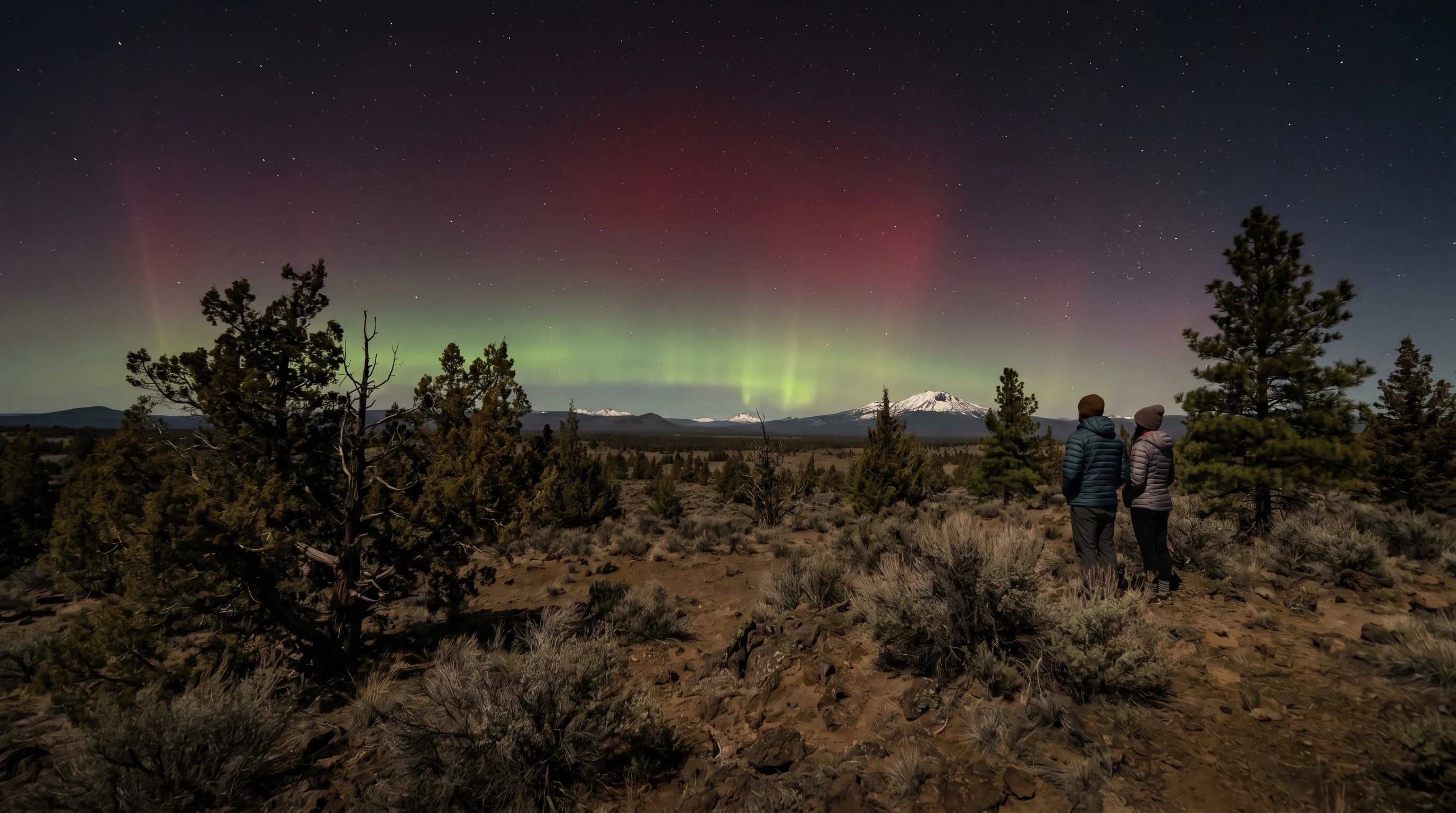
The northern lights are a rare but real treat in Central Oregon. The high desert sits too far south to see the aurora often, but during strong geomagnetic storms the glow can reach this far, and the region's dark skies, dry air, and high elevation make it one of the better places in Oregon to catch it when it does. Seeing the aurora here takes a strong solar event, a clear moonless night, and a dark northern horizon away from city lights, but when those line up, the northern sky can come alive with color. Knowing when and where to look turns a long shot into a real possibility.
Can You See the Northern Lights in Central Oregon?
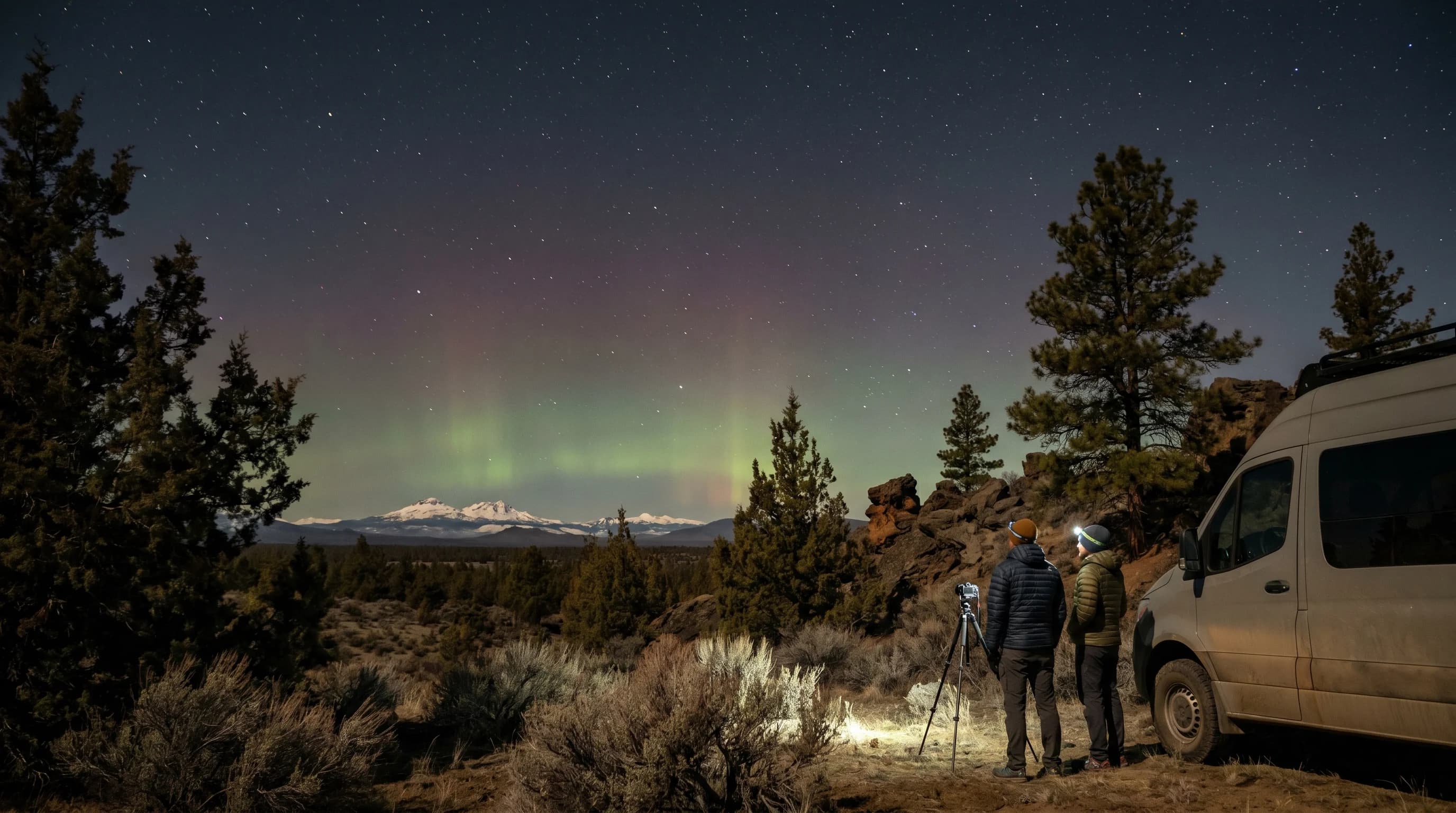
Yes, you can see the northern lights in Central Oregon, but only occasionally, during strong geomagnetic storms that push the aurora unusually far south. The aurora is normally confined to high latitudes near the poles, and Central Oregon's latitude is well south of the usual auroral zone, so most nights there is nothing to see. But when a powerful solar storm supercharges the aurora, its glow expands toward the equator and can become visible from the high desert, usually low on the northern horizon rather than overhead.
Because the aurora here appears near the horizon and is often faint, it is easy to miss and best seen with a dark, unobstructed view to the north. It frequently shows up better in long-exposure photographs than to the naked eye, since a camera can gather the faint color that the eye struggles to register. So even on a good night, the high-desert aurora may read as a soft glow or color on the horizon rather than the dramatic overhead curtains seen in the far north. It is a southern edge of the phenomenon, but a genuine one.
What Causes the Aurora?
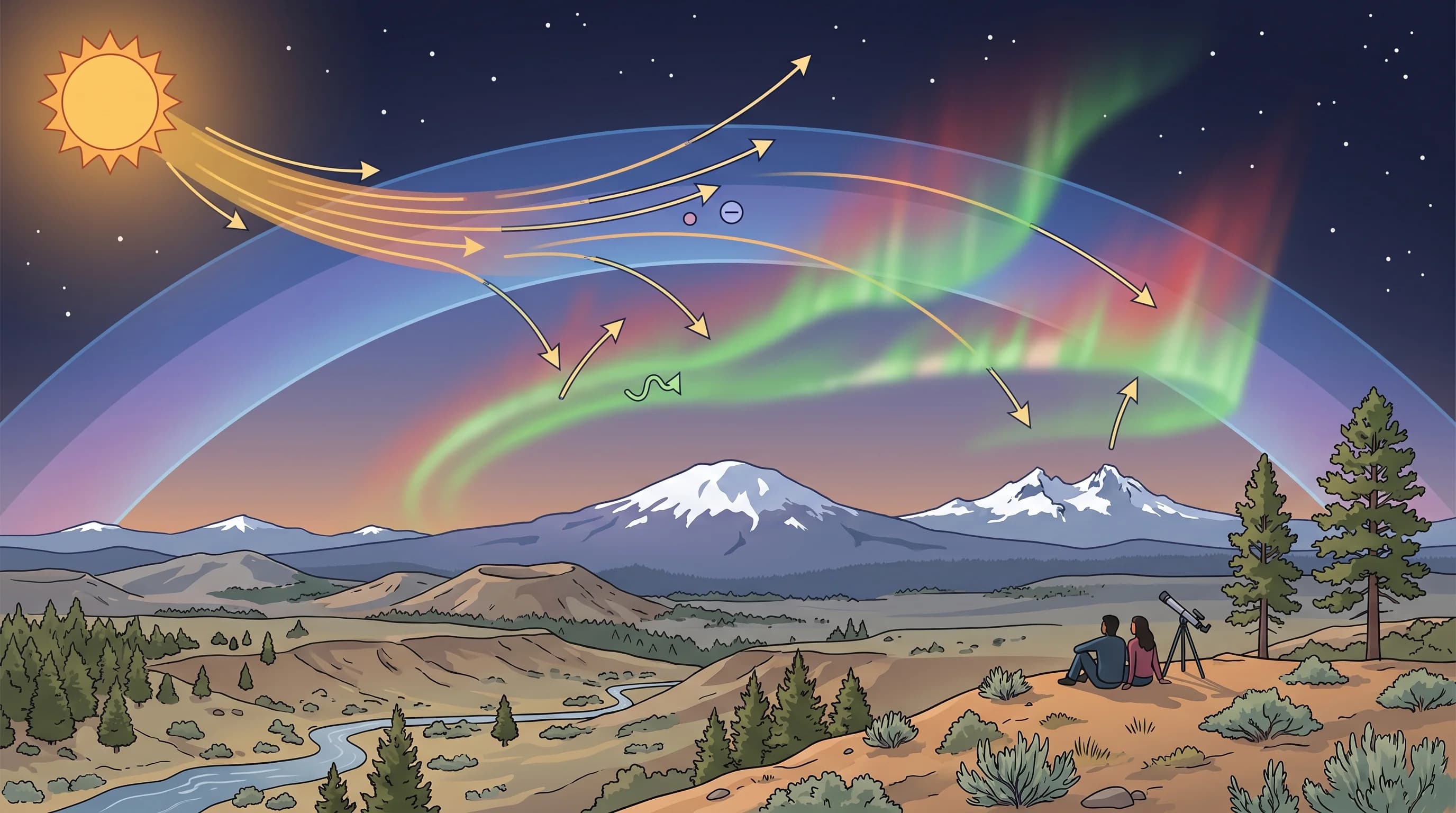
The aurora forms when charged particles from the sun strike the Earth's upper atmosphere and make its gases glow. The sun constantly streams out charged particles, and during solar storms, events like solar flares and coronal mass ejections, it hurls out far more. When that burst reaches Earth, the planet's magnetic field funnels the particles toward the poles, where they collide with atoms and molecules high in the atmosphere and energize them. As those excited gases release the energy, they emit light, the shimmering colors of the aurora.
The colors depend on which gas is glowing and at what altitude: oxygen produces the familiar green, and at very high altitudes a rarer red, while nitrogen can add blues and purples. The strength and reach of the aurora track the intensity of the solar storm, measured on a geomagnetic scale, and only the stronger storms push the glow south to Central Oregon's latitude. This is why aurora sightings here come in clusters around major solar events, and why they are more frequent near the peak of the sun's roughly eleven-year activity cycle.
Not every luminous high-desert sky display comes from space weather. A ring around the sun or the bright side spots called sun dogs are lower-atmosphere optical effects produced by sunlight passing through ice crystals.
When and Where to Look in Central Oregon
The best chance to see the aurora in Central Oregon is on a clear, dark, moonless night during a strong geomagnetic storm, looking north from a spot away from city lights. Timing is everything: watch space-weather forecasts and aurora alerts, which predict geomagnetic activity a day or two out, and head out when a strong storm, generally a high reading on the geomagnetic index, is expected. The hours around midnight are often best, though a strong display can appear anytime after dark.
Location matters just as much. You want a dark site with an open view to the north, away from the light domes of Bend, Redmond, and other towns, since even a faint aurora is easily washed out by light pollution and moonlight. The high desert's many dark, open spaces, away from town and with clear northern horizons, are ideal, and the region's dry, clear air and high elevation give it some of Oregon's best night skies. The same clear, dry conditions that make for big day-to-night temperature swings also deliver the transparent night skies that aurora viewing needs.
Why the High Desert Is Good for Night Skies
Central Oregon is one of Oregon's best regions for night-sky viewing, including the occasional aurora, thanks to its dark skies, dry clear air, and high elevation. With relatively little light pollution outside the towns and vast open country, the high desert offers genuinely dark skies, and the dry air means fewer clouds and less haze to obscure the stars. The elevation puts you above some of the lower atmosphere's moisture and murk, sharpening the view further.
These are the same qualities that make the region a draw for stargazing generally, from the Milky Way to meteor showers, and they give the high desert an edge whenever the aurora does reach this far south. So while the northern lights remain a rare event here, dependent on the sun's cooperation, Central Oregon is about as well-positioned as anywhere in Oregon to catch them when they come. Keep an eye on the space-weather forecasts, find a dark northern horizon, and the high desert may surprise you. For more on the region's distinctive skies, see the Central Oregon climate guide.