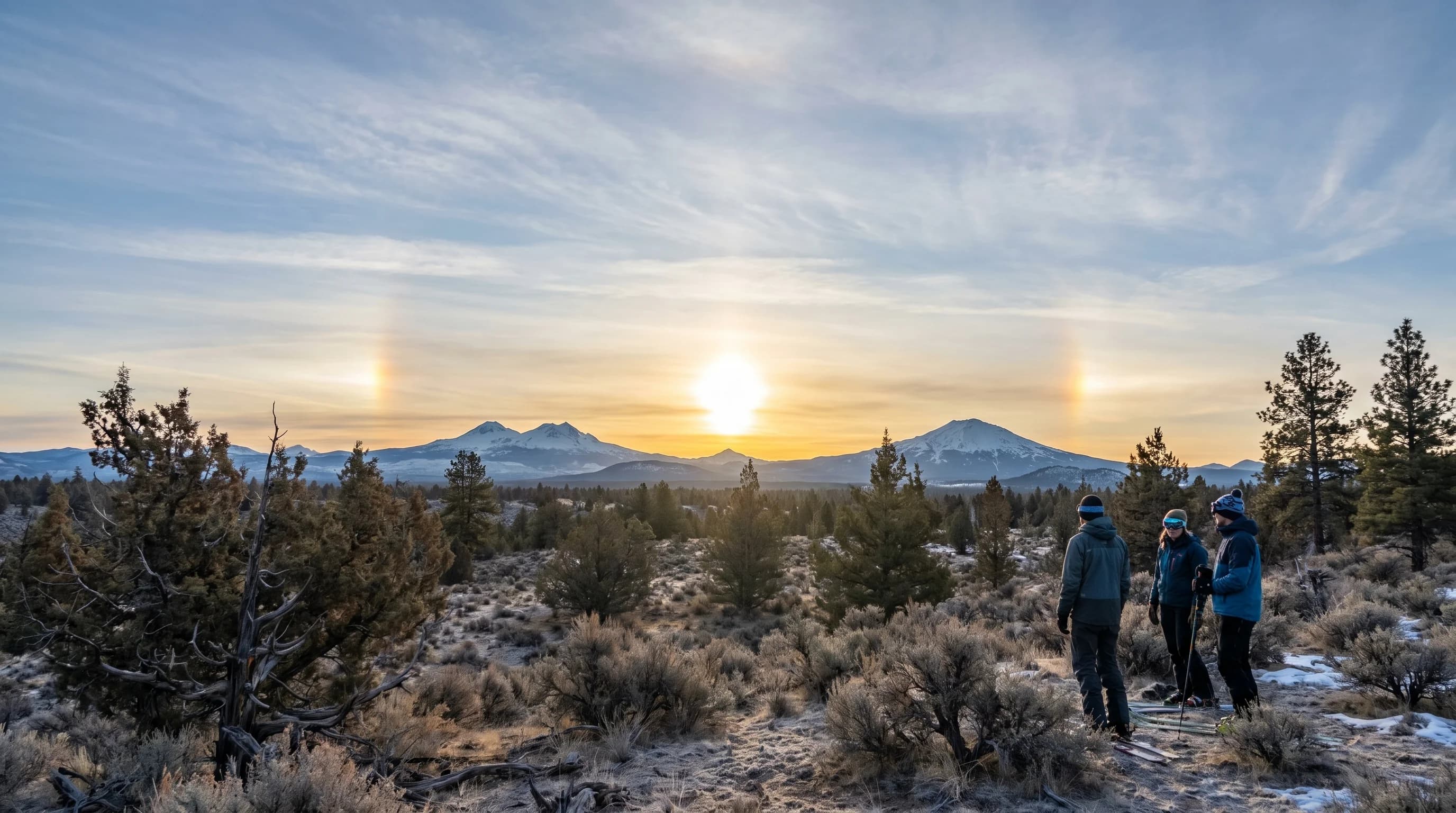
A sun dog is a bright, often rainbow-colored spot that appears to the left or right of the sun, formed when sunlight bends through tiny ice crystals in cold, high clouds. They usually appear in pairs, one on each side of the sun, sitting about 22 degrees away at the same height above the horizon. The scientific name is a parhelion, meaning beside the sun, and they are a common cold-weather sight over the clear, dry skies of the Central Oregon high desert, especially on frigid mornings when thin cirrus drifts overhead.
What Is a Sun Dog?
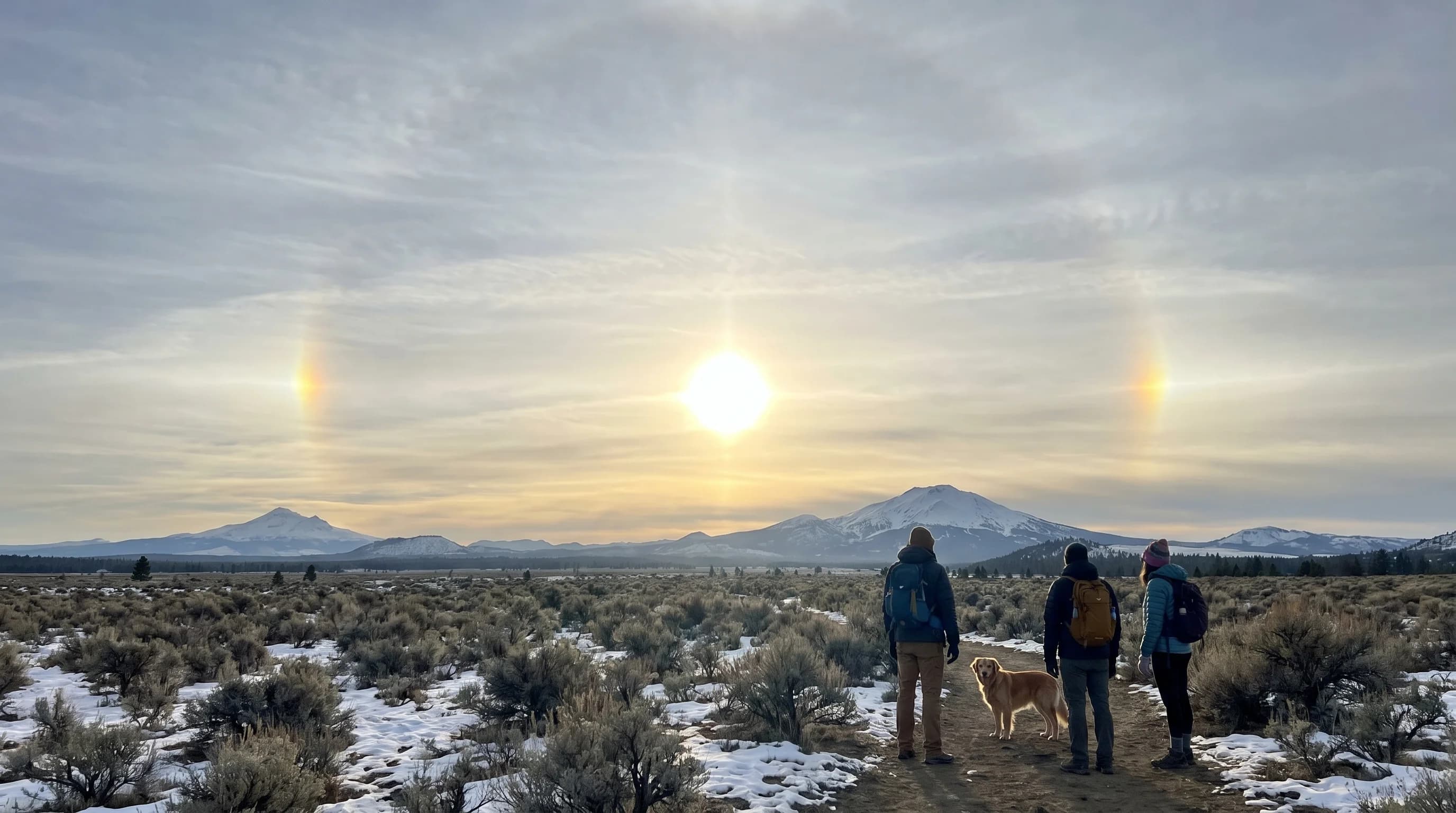
A sun dog is a concentrated patch of light that forms beside the sun, frequently tinged with color, red on the side nearest the sun and bluer on the outer edge. They come in pairs when conditions allow, flanking the sun at the same elevation, and they sit at a consistent angle of about 22 degrees, which is why a halo specialist can spot one instantly. The colors come from the same physics that makes a rainbow: sunlight being split into its component wavelengths as it bends.
Sun dogs are easiest to see when the sun is low, near sunrise and sunset, because that places them comfortably above the horizon where the relevant ice crystals can do their work. They are most common in cold weather, when high cirrus clouds full of ice crystals are present, and they can range from a faint, easily missed brightening to a vivid, unmistakable pair of colored spots. Once you know to look about a hand's width to either side of a low sun on a cold, thin-clouded day, you will start noticing them regularly.
What Causes Sun Dogs?
Sun dogs are caused by sunlight refracting through flat, plate-shaped ice crystals that drift slowly and lie nearly horizontal in cold, high cirrus clouds. As light passes through one of these hexagonal plates, it bends, or refracts, by a minimum of about 22 degrees, and because so many crystals are oriented the same flat way, their light concentrates into bright spots at that 22-degree angle to the side of the sun. The crystals act like millions of tiny prisms, and the prism effect is what splits the light into colors.
The horizontal orientation of the plate crystals is the key detail. Because they lie flat as they fall, they bend light predominantly to the sides of the sun rather than all the way around it, which is what produces distinct spots rather than a full ring. When the crystals are more randomly oriented, the same refraction produces a complete sun halo instead, and you will often see sun dogs sitting on the sides of a faint halo, both made by the same cirrus crystals in different orientations.
The 22-degree angle and the colors are both built into the geometry of a six-sided ice crystal. The hexagonal shape bends light by a minimum of 22 degrees, and light cannot easily concentrate at any smaller angle, which is why the spot sits right at that distance and the inner edge is sharply defined. Because different colors bend by slightly different amounts, red light, which bends least, ends up on the inner side nearest the sun, and blue on the outer side, giving a well-formed sun dog its characteristic red-to-blue tint. When the sun climbs higher in the sky, the crystals bend the light less cleanly, the colors wash out, and the sun dogs fade, which is why they are mainly a low-sun phenomenon.
What Is the Difference Between a Sun Dog and a Sun Halo?

A sun dog is a pair of bright spots beside the sun, while a sun halo is a complete ring of light encircling it, but both come from light bending through the same kind of cirrus ice crystals. The difference is crystal orientation: sun dogs need flat, horizontally aligned plate crystals to concentrate the light into spots, while a halo forms when the crystals are randomly oriented and bend light evenly all the way around at the same 22-degree radius.
Both are different from a rainbow, which is made by raindrops, not ice, and appears in the opposite part of the sky from the sun rather than right beside it. Sun dogs and halos are cold-weather, ice-crystal phenomena that appear around the sun itself; a rainbow is a warm-weather, water-drop phenomenon that appears away from it. You will often see sun dogs and a halo together on the same cold morning, since one set of clouds can contain crystals in both orientations.
Where Do You See Sun Dogs in Central Oregon?
Sun dogs are common wherever cold air and high cirrus clouds meet, which makes Central Oregon's clear high desert a reliable place to catch them. On cold winter mornings around Bend, Redmond, and Sunriver, when thin cirrus drifts in ahead of a weather system and the sun sits low, the conditions for sun dogs come together often. The wide, open high-desert skies make them easy to spot, and the cold, dry air that defines the region is exactly what keeps cirrus crystals frozen and well-formed.
They share the cold-air-optics family with the region's other ice-crystal displays, from sun halos by day to light pillars on frigid nights, and they often accompany the hoar-frost mornings that mark a clear, cold, still high-desert night. If you are out early on a cold, lightly clouded day, the low sun is the place to look.
Do Sun Dogs Mean a Weather Change Is Coming?
Sun dogs can hint at approaching weather, because the high cirrus clouds that produce them often arrive ahead of a storm system. Cirrus is frequently the leading edge of an incoming front, streaming out far in advance of the rain or snow, so a sky full of sun dogs and halos can be an early sign that a change is on the way over the next day or so. The old weather saying that a ring around the sun means rain is coming has some truth for exactly this reason.
That said, sun dogs are not a guarantee of anything. Cirrus can drift through without a storm following, and plenty of sun dogs appear on cold, settled days that stay clear. They are best understood as a beautiful marker of cold, high, ice-filled air rather than a reliable forecast tool. Either way, they are one of the small rewards of paying attention to the high-desert sky, a quick, free light show waiting beside the low winter sun.