
Bend gets close to 300 days a year with at least some sunshine, which is why it is widely called one of the sunniest places in Oregon. The catch is that "sunny day" usually means a day with measurable sun rather than a fully cloudless one, so the count of truly clear days is lower, but by any fair comparison Bend is far sunnier than the gray Willamette Valley. The reason is the Cascade rain shadow, which strips the clouds and rain out of Pacific air before it reaches the high desert, and the same dryness that brings the sun also brings cold nights and intense UV.
How Many Sunny Days Does Bend, Oregon Get?

Bend's roughly 300 sunny days a year is the figure most often cited, and Redmond just to the north is a touch sunnier and drier still. Summer is dependably clear for weeks at a time, and even in winter, cold high-pressure spells deliver bright, blue-sky days between storms. Compared with the persistent overcast that settles over western Oregon for much of the cool season, the difference is dramatic and is one of the main reasons people relocate east over the mountains.
It is worth being precise about what that number measures, because it is easy to overstate. It counts days with at least some measurable sunshine, not days that are cloudless from dawn to dusk, so the count of truly clear days is meaningfully lower, and Bend absolutely has its storms, inversions, and smoky stretches. But by the standard yardstick used to compare cities, days with meaningful sun, Bend genuinely ranks near the top of Oregon, and the gap over the valley is real, not marketing.
The sunshine is also unevenly distributed through the year, which shapes how it feels to live here. Summer is the standout, with long, reliably clear stretches that make the season feel almost Mediterranean, dry and bright day after day. Winter sun is more broken, arriving in bright cold spells between storms and occasionally blocked for days by a valley inversion or, in late summer, by wildfire smoke. So the headline number is an annual average that masks a sunny-summer, variable-winter rhythm, but even Bend's cloudier stretches are sunnier than the valley's baseline.
Why Is Bend So Sunny?
Bend is so sunny because it sits in the Cascade rain shadow, where the mountains wring the rain out of Pacific storms before they reach the high desert, leaving dry, clear, descending air. Storms climbing the west side of the Cascades drop their moisture as rain and snow on the windward slopes and crest, and the air that descends toward Bend has been wrung out and warms as it sinks, which actively discourages clouds from forming. Most of the gray valley weather simply stops at the crest.
Low humidity reinforces the effect, since dry air does not sustain the kind of persistent cloud deck that blankets the valley. The result is abundant sunshine year-round, the mechanism explained in the Oregon Cascades rain shadow and orographic lift guides. The sunshine and the dryness are two sides of the same geographic coin.
What Does "300 Sunny Days" Actually Mean?
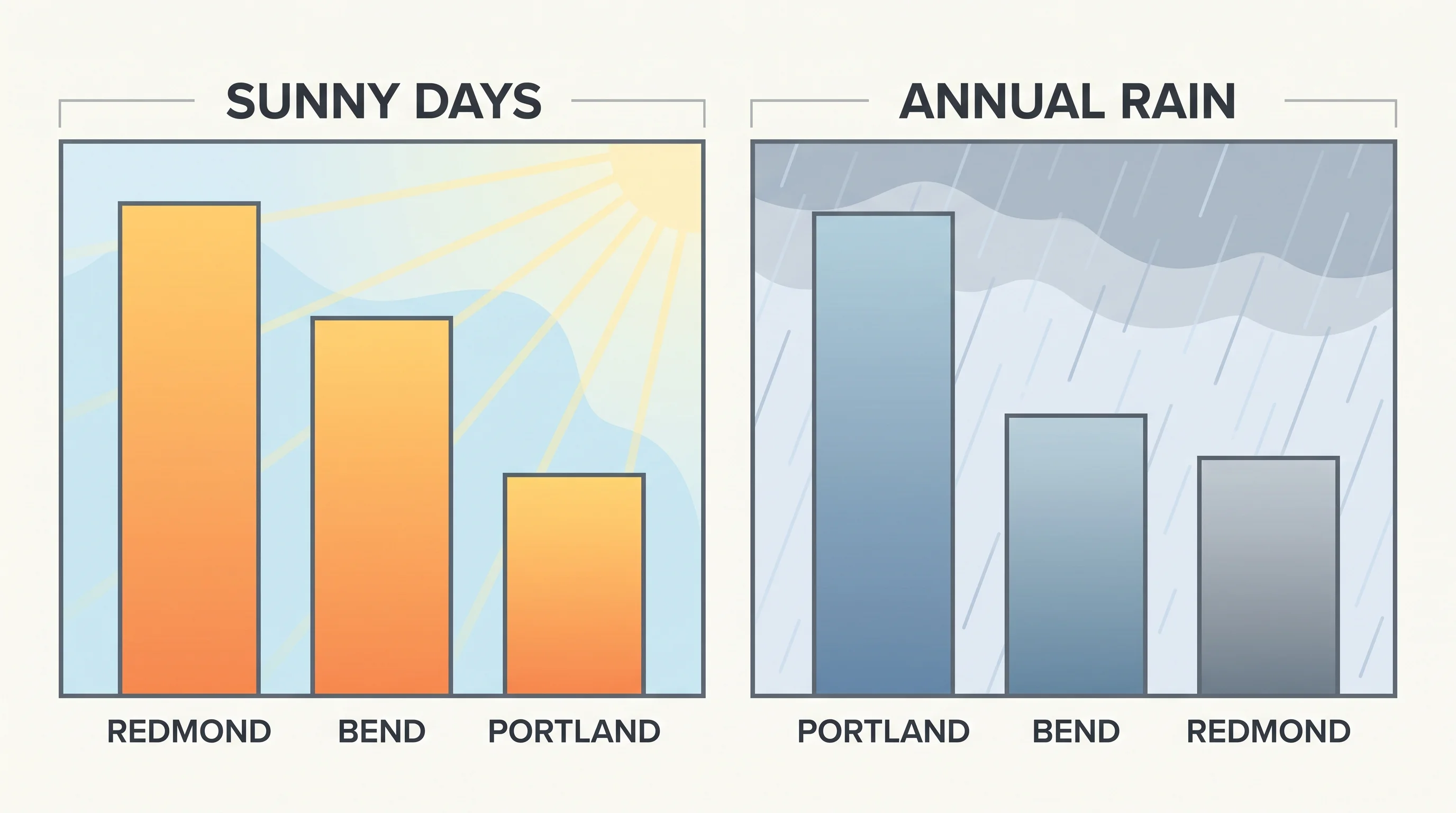
The "300 sunny days" figure counts days with any measurable sunshine, so it includes partly cloudy days, not 300 cloudless ones. Different sources define a sunny day differently, some counting clear and partly cloudy days together, which is how the number climbs near 300, so it is best read as shorthand for "very sunny" rather than as a literal cloudless count. The truly clear-sky days are fewer but still plentiful, and they are spread across every season.
Even with the caveat, the comparison is striking. Bend gets roughly twice as many sunny days as Portland and a fraction of the rain, a difference big enough to change daily life and mood. Winter still delivers bright, cold bluebird days between storms, which is part of why even Bend's winter feels sunnier than the valley's. The exact totals and the city-by-city comparison are worth understanding before taking the round number at face value.
Is Bend the Sunniest Place in Oregon?
Bend and Redmond are among the sunniest places in Oregon, rivaled mainly by other high-desert and southern Oregon spots, and far sunnier than the Willamette Valley. Redmond often edges out Bend slightly on dryness and sunshine because it is a little lower and deeper into the rain shadow, but the whole high desert east of the Cascades shares the advantage. The exact "sunniest" ranking depends on how you measure it, but Central Oregon is consistently near the top.
For practical purposes, the point is not the precise ranking but the clear reality: this is one of the sunniest corners of a state famous for rain. That reputation draws visitors and new residents alike, and it is well earned, the rare part of Oregon where you can count on the sun far more often than not. The dryness behind it is detailed in Bend rainfall.
How Does Bend's Sunshine Compare to Portland?
Bend gets roughly twice as many sunny days as Portland and a fraction of the rain, the single biggest weather difference between Central and western Oregon. Portland sits west of the Cascades, close to the Pacific and directly under the marine clouds and storm track, while Bend sits in the dry rain shadow behind the mountains. Portland's long gray season, the persistent overcast from late fall into spring, barely reaches Bend at all.
That contrast drives a lot of the relocation interest in Bend, and it is the heart of the comparison covered in why Bend is sunnier than Portland and the Willamette Valley. One honest caveat worth repeating: sunnier does not mean warmer. The same dry, clear air that lets the sun through also loses heat fast after dark, so Bend is often sunnier and colder at night than the milder, cloudier valley.