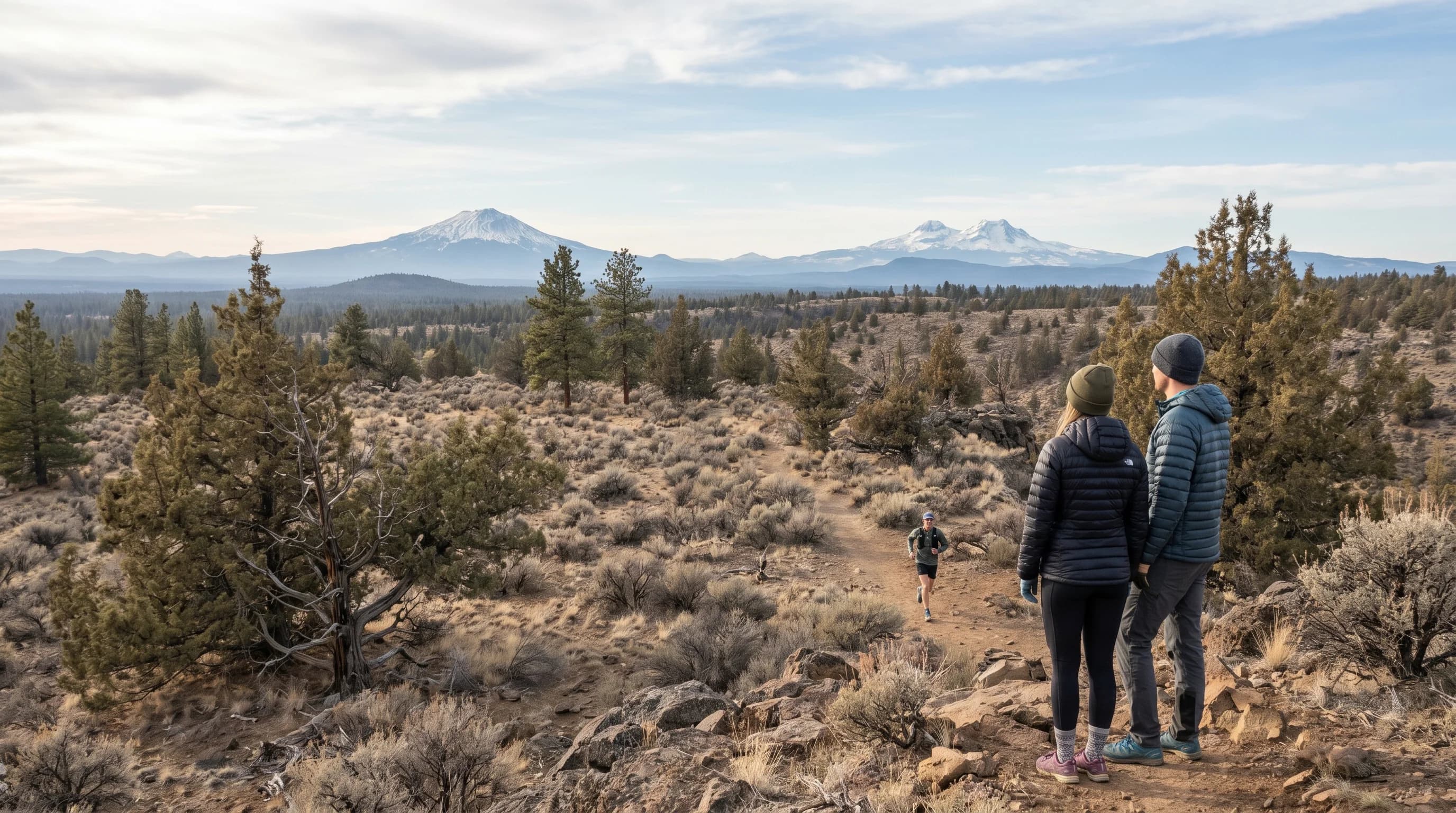
Bend, Oregon gets only about 11 to 12 inches of rain a year, less than a third of what Portland receives, which puts the high desert firmly in dry, near-semi-arid territory despite being in famously rainy Oregon. The reason is the Cascade rain shadow: the mountains force Pacific storms to drop their moisture on the western slopes before the air descends, dry and wrung out, onto Bend. That dryness shapes nearly everything about the region, from the abundant sun to the big day-to-night temperature swings to the wildfire risk of late summer.
How Much Rain Does Bend, Oregon Get?
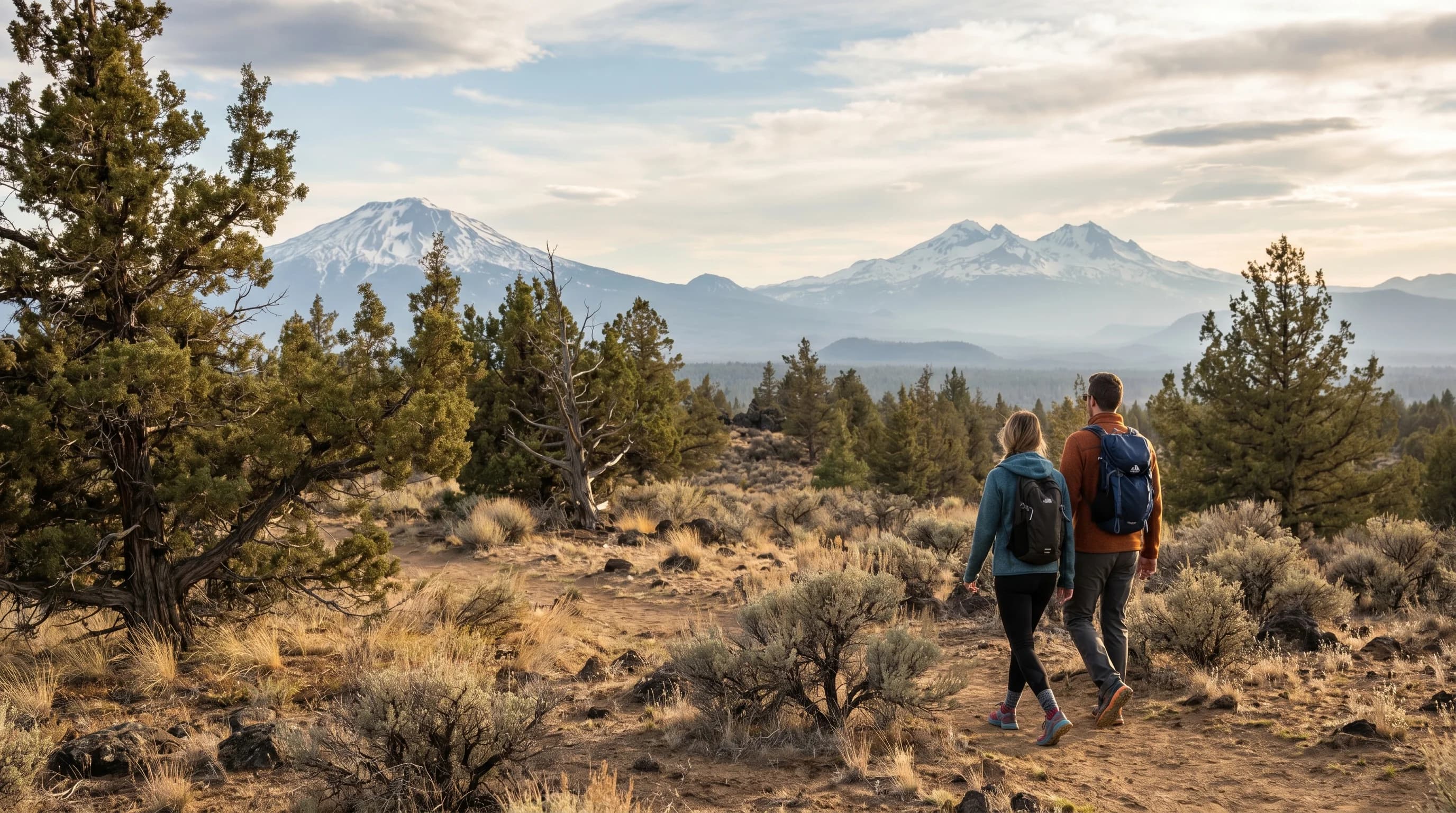
Bend's annual precipitation of roughly 11 to 12 inches is genuinely low, comparable to semi-arid regions and a world apart from the 36 inches Portland sees or the 40-plus inches in Eugene. Most of Bend's moisture arrives as winter snow and spring showers rather than steady rain, and summers are exceptionally dry, often passing weeks with no measurable precipitation at all. Redmond, lower and deeper in the rain shadow, is drier still, closer to 8 or 9 inches.
Counting all forms of precipitation together, rain plus the water content of snow, Central Oregon is one of the driest inhabited parts of the state. That number is the foundation of the high-desert label: enough moisture to support juniper and sagebrush and a real winter, but little enough that the landscape, the vegetation, and daily life all reflect aridity. It is the same dryness that produces the region's famous sunshine, covered in Bend's sunny days.
The low rainfall total also hides how the moisture arrives, which matters for how the region actually feels. Rather than the frequent, light, gray drizzle of the valley, Bend's precipitation tends to come in discrete events, a snowstorm, a spring shower, a brief thunderstorm, separated by long dry, sunny stretches. So even the modest annual total falls on relatively few days, which is the flip side of all those sunny days. The water that keeps the region's rivers running through the dry summer comes less from local rain than from the deep Cascade snowpack melting slowly through the warm months, which is why a good mountain snow year matters as much as local rainfall.
Why Is Bend So Dry?
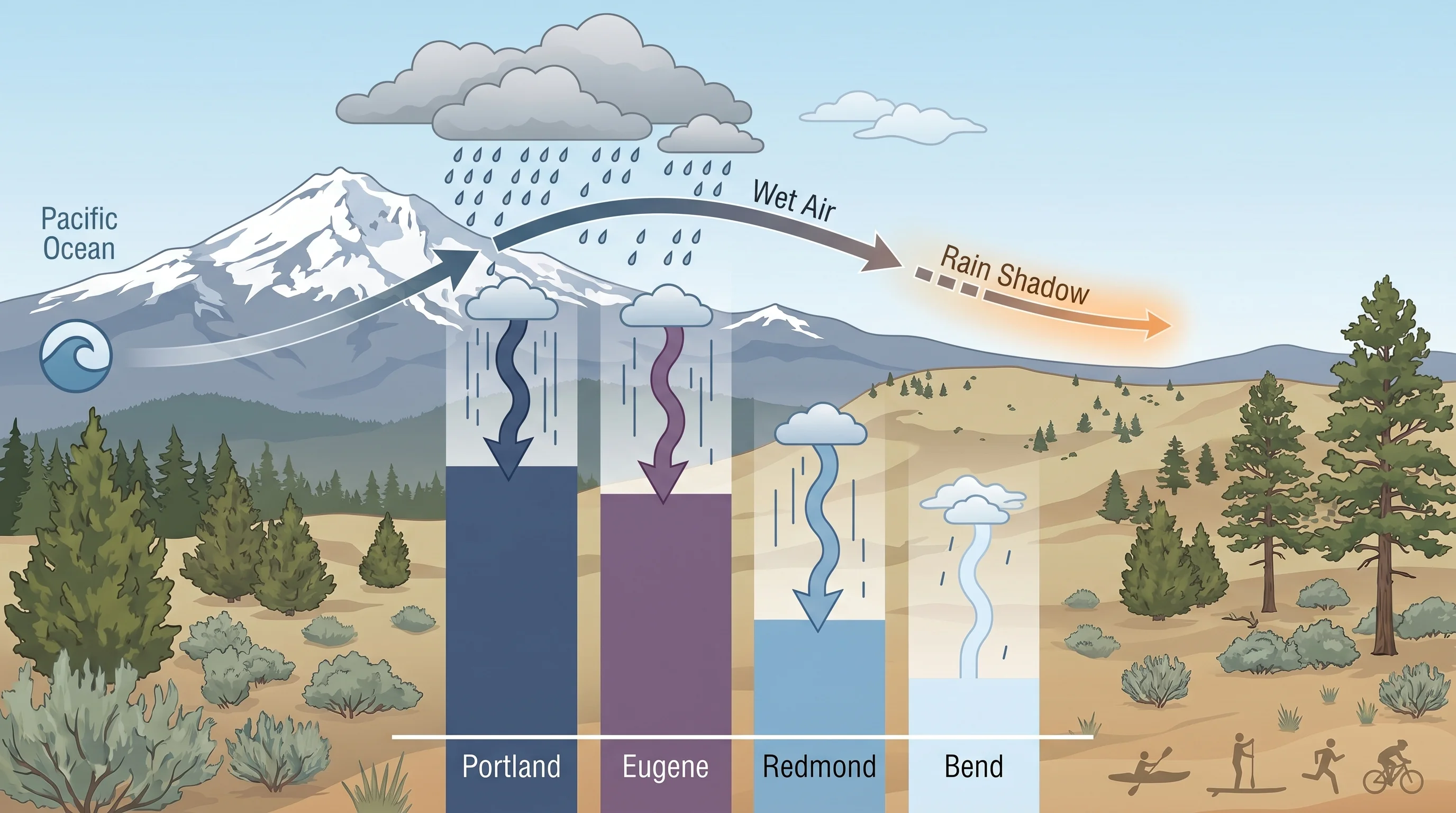
Bend is so dry because it sits in the Cascade rain shadow, where the mountains force Pacific air up, wring out the rain on the windward side, and leave dry, descending air over the high desert. As moist air climbs the western slopes it cools and drops its moisture as rain and snow, and as it descends the eastern side it warms and dries, which suppresses cloud and precipitation. The wet Willamette Valley side soaks up the storms, and Bend gets the leftovers.
The contrast is stark: the west slopes of the Cascades can collect well over a hundred inches of precipitation a year while Bend gets barely a tenth of that, just a short distance east. This is the textbook rain-shadow effect, and the full mechanism is explained in orographic lift and the Oregon Cascades rain shadow. Bend's dryness is not a quirk; it is the predictable result of where it sits relative to the mountains.
When Does It Rain Most in Bend?
Bend's wettest stretch is late fall through spring, when Pacific storms occasionally push enough moisture over the Cascades to bring rain or snow to the high desert. Even then, the totals are modest, and much of the cool-season moisture falls as snow rather than rain. Spring brings scattered showers, and the occasional thunderstorm can deliver a quick burst, but the steady, soaking rain that defines western Oregon is rare here.
Summer is the dry extreme. July and August often see almost no rain, with weeks of clear, hot, bone-dry weather broken only by the occasional afternoon thunderstorm, which itself may produce more lightning and wind than actual rain at the surface. That long summer dry spell is what cures the vegetation and sets the stage for wildfire season, the connection behind the region's smoke season.
Is Bend a Desert?
Bend sits in Oregon's high desert and is dry enough to feel like one, though it gets a bit more moisture than a true desert because of its winter snow. The vegetation tells the story: juniper, sagebrush, and bunchgrass are classic high-desert plants, adapted to long dry spells and big temperature swings. The technical climate classification sits at the boundary of semi-arid, but in everyday terms, dry, sunny, sparse, and sage-scented, Bend reads as high desert.
The aridity also drives the region's other signature trait, its huge day-to-night temperature swings, because dry air holds little heat and releases it fast after sunset. That link between dryness and the temperature swing is explored in why Central Oregon has such big temperature swings. Dryness is the thread that ties together the sun, the cold nights, and the fire risk.
What Does Bend's Dryness Mean for Visitors and Gardeners?
Bend's dryness means low humidity, intense sun, fast-drying trails, and a short, careful growing season, so visitors should plan for sun protection and hydration and gardeners for water-wise choices. The dry air makes hot days feel cooler in the shade and cold nights feel colder, and it makes the high-desert UV especially strong, the subject of the Bend UV guide. Trails dry out quickly after rain or snow, which is a bonus for recreation.
For gardeners, the combination of low rainfall, a short frost-free window, and big temperature swings makes for a challenging but rewarding growing environment that rewards drought-tolerant plants and frost awareness. And for everyone, the dry summer means real fire risk, so the same aridity that makes Bend pleasant and sunny also demands respect during fire season. Understanding Bend's rainfall, or lack of it, is really understanding the high desert itself.