Lava River Cave, a mile-long lava tube south of Bend, stays near 42°F year-round because cold winter air sinks into it and stays trapped. Crack-in-the-Ground near Christmas Valley can be up to about 20°F cooler than the surface, and Arnold Ice Cave once supplied ice to early Bend. Bring a warm layer even in July.
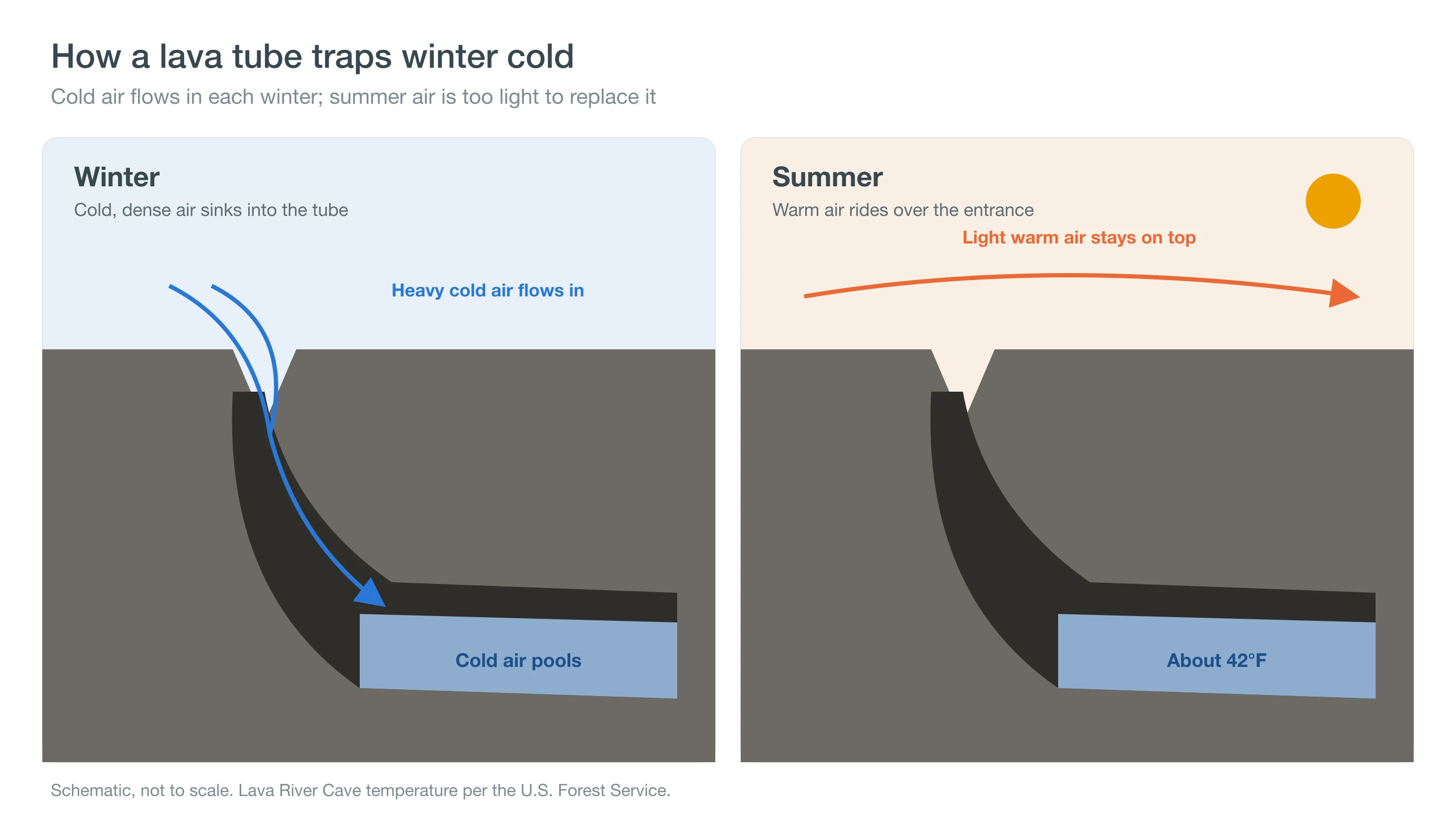
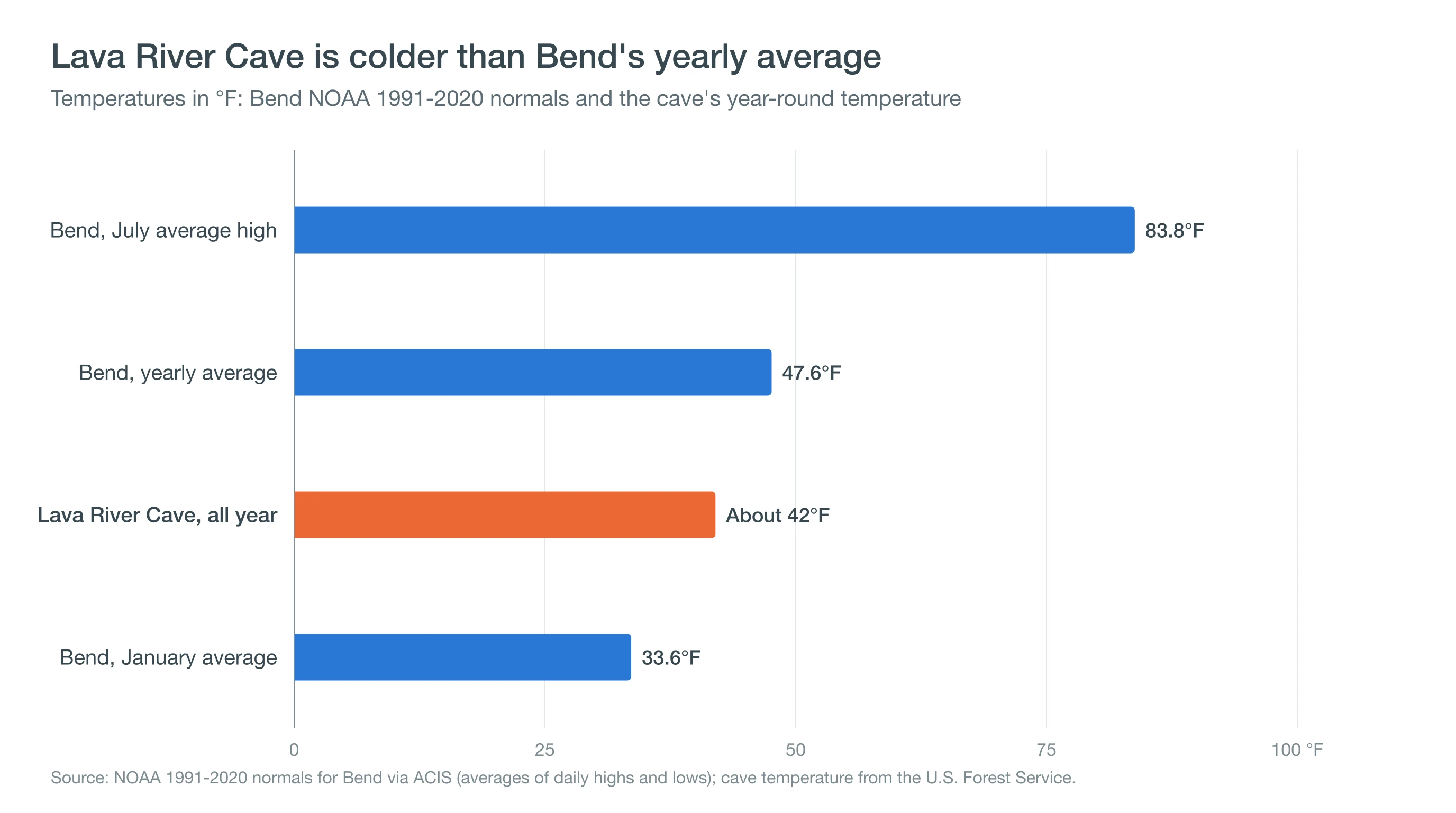
Bend's July afternoons average 83.8°F (NOAA 1991-2020), yet a short drive south, the air inside Lava River Cave sits near 42°F, colder than Bend's yearly average. Central Oregon's lava tubes and fissures are natural refrigerators, and they all work the same way: cold air is heavy. In winter it pours into caves and cracks and stays there, and summer's warm air floats over the top without replacing it.
Why Are Central Oregon's Caves So Cold?
Central Oregon's caves are cold because they are cold traps. A cave or crack whose entrance opens downward into it lets dense winter air sink in, while lighter summer air cannot. Over many years, the rock and air inside settle below the yearly average, closer to winter's chill.
| Site | Type | How cold | Season | Managed by |
|---|---|---|---|---|
| Lava River Cave | Lava tube, about 1 mile | About 42°F all year | Late spring to early fall; timed reservations | U.S. Forest Service |
| Crack-in-the-Ground | Volcanic fissure, 2+ miles, up to 70 ft deep | Up to about 20°F cooler than the surface | Year-round | Bureau of Land Management |
| Arnold Ice Cave | Lava tube with year-round ice | Cold enough to keep ice | Not open for visits | U.S. Forest Service |
Sources: U.S. Forest Service, Deschutes National Forest; Bureau of Land Management. Seasons and rules change; check before you go.
The best-known example is a short drive from Bend.
How Cold Is Lava River Cave?
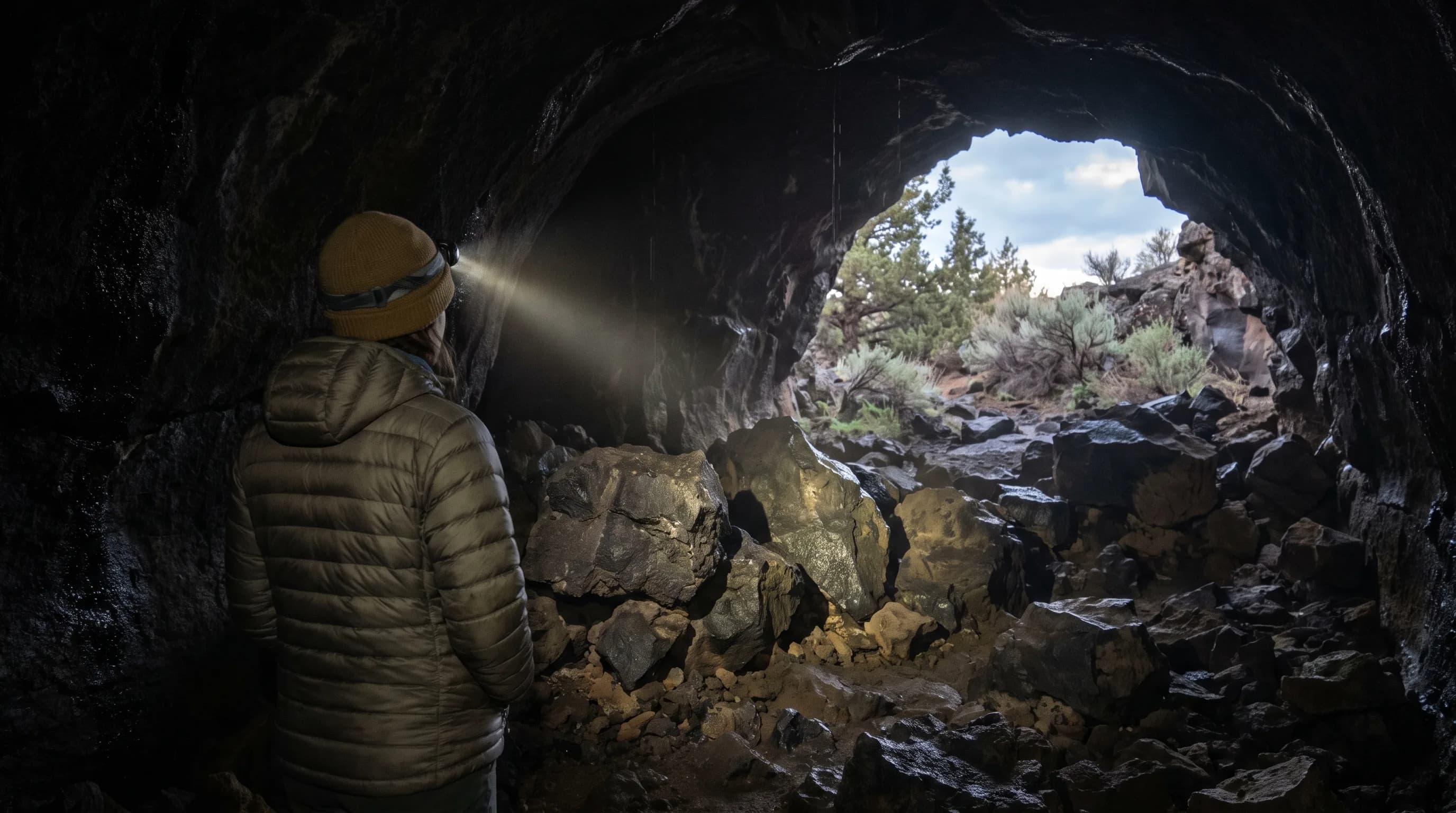
Lava River Cave stays near 42°F year-round, according to the U.S. Forest Service. The tube runs about a mile through the lava flows of Newberry National Volcanic Monument, roughly 12 miles south of Bend on the way to La Pine, and it is completely dark beyond the entrance.
On a hot July afternoon, stepping into the cave drops the temperature by about 40 degrees within a few minutes. The floor is uneven rock and sand, the ceiling drips in places, and your breath may fog. Most visitors spend an hour or more walking to the end and back. See Lava River Cave and Newberry National Volcanic Monument conditions before you go.
Lava tubes like this one form when the surface of a lava flow cools and crusts over while molten lava keeps flowing underneath. When the eruption ends, the lava drains out and leaves a hollow tunnel with a rounded ceiling, sometimes with lava "bathtub rings" on the walls. A tube's steady temperature also means it would feel warm compared with outside on a January day, when Bend averages 33.6°F, but by then the cave is closed. The cave is not open all year, for a reason.
Why Is Lava River Cave Closed in Winter?
Lava River Cave closes in the cold season to protect bats that hibernate in it. Waking hibernating bats burns the fat they need to survive the winter, so the Forest Service limits access to the warmer months, roughly late spring to early fall.
During the open season, visits use free timed-entry tickets on Recreation.gov, which charges a small service fee. To help stop the spread of white-nose syndrome, a disease deadly to bats, do not bring clothing, shoes or gear that have been in another cave or mine. Season dates, hours and closures change from year to year, so check Recreation.gov and the Deschutes National Forest first. Some caves get cold enough to hold ice.
What Is an Ice Cave, and Is Arnold Ice Cave Open?
An ice cave is a cave that keeps ice through the summer. It forms where the cold-trap geometry is strongest: winter air chills the cave below freezing, water seeping in freezes, and summer air cannot reach it to melt it.
Arnold Ice Cave, part of the Arnold Lava Tube System south of Bend, is Central Oregon's best-known example. In Bend's early years, before electric refrigeration, people cut ice from the cave, hauled it out and sold it in town, where it was stored in sawdust-packed sheds; hundreds of tons had been harvested by about 1910. Today ice fills much of the cave, and it is not open for visits. A crack in the desert works the same way, in the open.
How Much Cooler Is Crack-in-the-Ground?
The Bureau of Land Management says the floor of Crack-in-the-Ground can be as much as 20°F cooler than the surface. The volcanic fissure runs more than 2 miles and reaches up to 70 feet deep near Christmas Valley, about two hours' drive southeast of Bend, and it is open year-round.
The crack stays cool for two reasons: its narrow walls shade the floor from the high-desert sun, and cold air that settles into it on clear nights drains to the bottom and lingers. On a summer visit, go in the morning, carry plenty of water for the hot drive and walk above, and expect the temperature to drop as you descend. In winter, snow and ice can make the floor slippery. Check Crack-in-the-Ground and nearby Fort Rock before the trip. All of this means packing for two climates.
What Should You Bring to a Central Oregon Cave in Summer?
- A warm layer: a fleece or jacket, long pants and a hat, even when it is 90°F outside.
- Two light sources: a headlamp plus a backup flashlight with fresh batteries.
- Sturdy shoes and gloves: lava rock is sharp, and floors can be uneven or slick.
- Sun and heat protection for the walk back: the high-desert sun is strong; see Bend's UV index.
On a hot day, caves make a good escape. See Bend weather in July for the heat they offer relief from.
Deep Dive: How Does a Cave Trap Winter Cold?
A cave traps winter cold through three pieces of physics: cold air is denser than warm air, rock changes temperature very slowly, and melting ice takes a great deal of energy.
How Much Heavier Is Cold Air?
At the same pressure, air density scales inversely with absolute temperature. Cave air at 42°F (about 279 kelvins) is about 9% denser than 85°F summer air (about 303 kelvins). In a tube whose entrance slopes down into it, that dense air behaves like water in a bowl: winter air pours in and pools, while summer air, being lighter, slides over the top. The cave "breathes" in only one season.
That density difference is small, but it is enough. A 9% difference means a column of cold cave air 30 feet tall weighs as much as about 33 feet of warm summer air above it, so the warm air cannot push down into the cave. Only wind or a change of season, when the outside air becomes colder and heavier than the cave air, can start air moving in again.
Why Does the Rock Not Warm the Cave?
Basalt conducts heat slowly. The yearly swing of surface temperature fades quickly with depth; by about 10 to 15 meters into solid rock, it is barely noticeable. So the walls of a deep cave settle toward the long-term temperature of whatever air reaches them. In an ordinary cave, that is roughly the local yearly average; in a cold trap, where only winter air gets in, the walls settle below it, which is why Lava River Cave sits several degrees colder than Bend's 47.6°F yearly mean.
The numbers behind that are simple heat physics. Basalt has a thermal diffusivity of roughly one millionth of a square meter per second. For a yearly temperature cycle, that gives a damping depth of about 3 meters: every 3 meters into the rock, the yearly swing shrinks to about a third of its size above. By about 10 meters, it has fallen to around 5% of the surface swing. Daily swings fade even faster, within about 15 centimeters, which is why the cave feels the same at noon and midnight.
How Does Ice Survive Summer?
Melting ice takes about 334 joules per gram, a large energy bill, and in a cold trap there is little warm air to pay it. The cold rock and stagnant air let ice that formed in winter last through summer and build up over decades. Researchers who study ice caves, such as Aurel Perşoiu and Bogdan Onac, note that these ice deposits are sensitive to changes in climate and to disturbance of the cave's airflow, which is one reason ice caves are protected.
How Should You Plan a Cave Visit on a Hot Day?
Remember that cold air is heavy, so the deepest, lowest parts of a cave stay coldest. On a hot day, compare the forecast high on the Lava River Cave page with the cave's 42°F, pack for both, and check Recreation.gov for tickets before you drive. For more on cold air pooling, see inversions in Central Oregon.