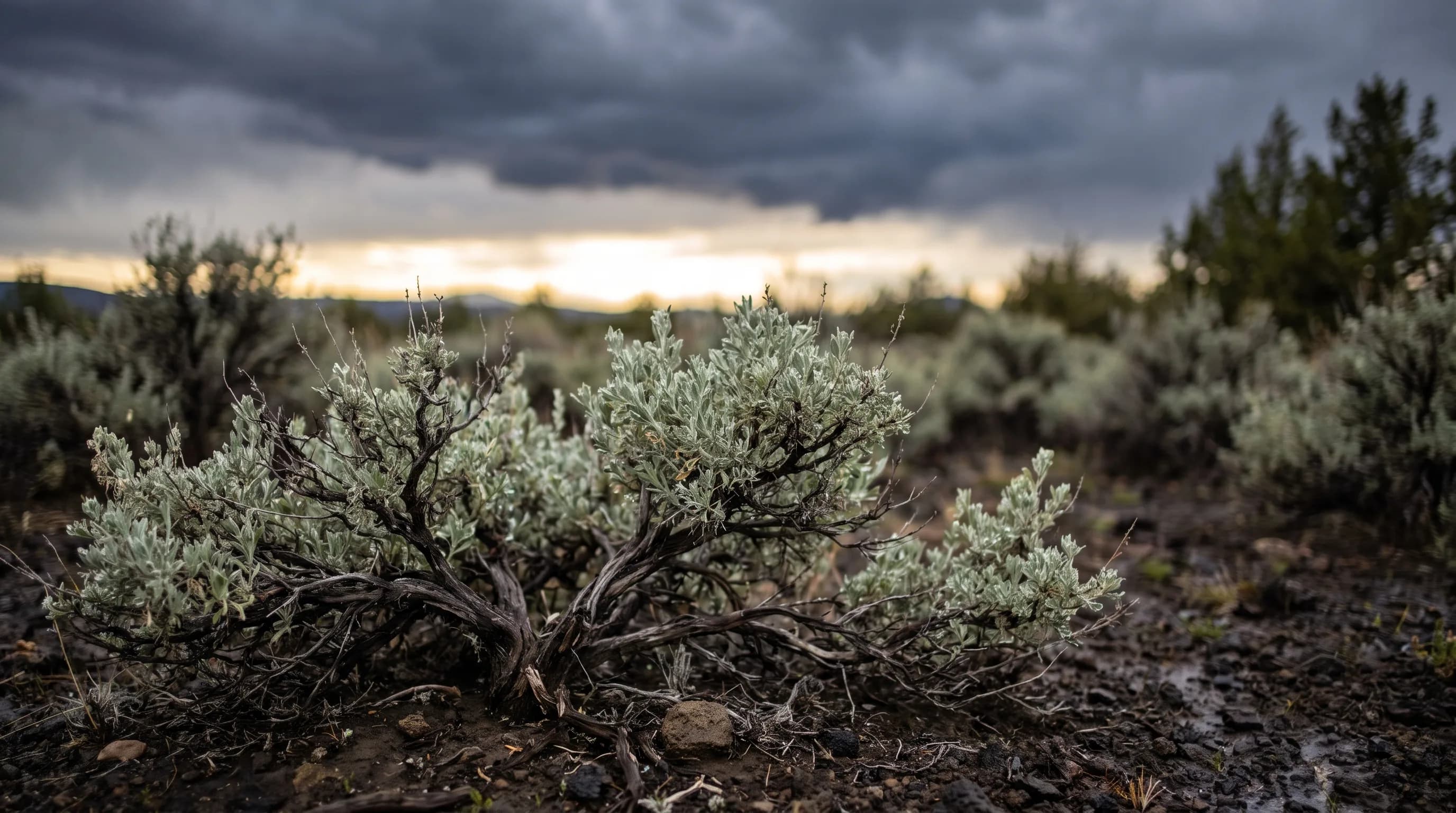
Petrichor is the earthy smell of rain falling on dry ground. It comes from plant oils that collect on soil and rocks during dry weather and from geosmin, a compound made by soil bacteria, which raindrops launch into the air. In Central Oregon, long summer dry spells and sagebrush make the first rain unusually fragrant.
In 2018, Redmond Airport went 99 days in summer without measurable rain, a stretch that ended on September 28. When the first storm finally arrives after a wait like that, the high desert smells like nowhere else. The longer the wait, the stronger the smell. This guide follows a summer dry spell to its end: compounds build up on dry ground and plants, a light rain launches them into the air, and the high desert's plants add their own scent.
What Is Petrichor?
Petrichor is the name for the pleasant, earthy smell that rises when rain falls after a dry spell. Two Australian scientists, Isabel Bear and Richard Thomas of CSIRO, coined the word in a 1964 paper in the journal Nature. They joined the Greek petra, stone, with ichor, the fluid said to flow in the veins of the gods, to describe an oily substance they extracted from dry rocks and clay.
Bear and Thomas found that plants release oils during dry weather that soak into rocks and soil. When rain arrives, those oils, along with other compounds, are released into the air. Several ingredients make up the smell.
Why Does Rain Smell the Way It Does?
Rain smells the way it does because raindrops release scent compounds that have been building up on dry ground. The main players are plant oils and geosmin, an earthy-smelling compound made by soil bacteria, plus a few local extras.
| Part of the smell | Where it comes from | When it is strongest |
|---|---|---|
| Petrichor oils | Plant oils that collect on dry soil and rock | First rain after a long dry spell |
| Geosmin | Soil bacteria such as Streptomyces | Light rain on dry soil |
| Ozone (a sharp, clean note) | Lightning, carried ahead of storms by downdrafts | Just before a thunderstorm |
| Sagebrush and juniper | Aromatic oils in high-desert plants | When rain wets the leaves |
Sources: Bear and Thomas (1964, Nature); Joung and Buie (2015, Nature Communications); Becher and others (2020, Nature Microbiology). The sagebrush row describes a commonly reported effect.
One answer to how the scent gets into the air came in 2015, when researchers at MIT filmed raindrops with high-speed cameras. They found that a drop landing on dry, porous ground traps tiny air bubbles, which rise through the drop and burst out of its top, firing a fine mist of aerosols into the air.
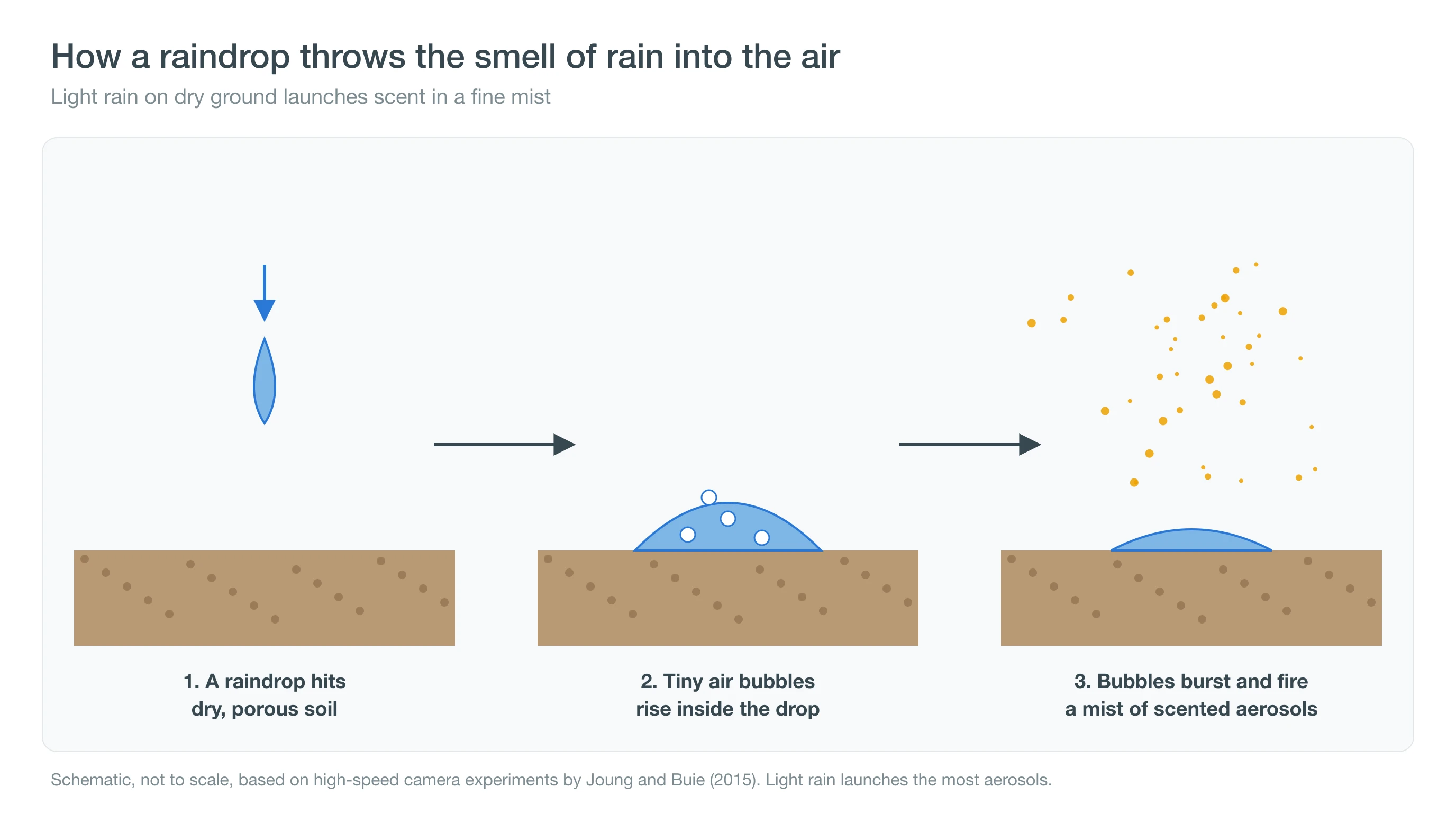
Those aerosols can carry the scent compounds, and wind spreads them across the landscape. Light and moderate rain produced the most aerosols in the experiments; heavy rain produced far fewer. Part of the answer, though, is in our noses.
Why Are Humans So Sensitive to the Smell of Rain?
Humans are remarkably sensitive to geosmin. In drinking water, most people can detect it at around 5 to 15 parts per trillion, which is why water utilities track it as an earthy taste-and-odor problem. That sensitivity means even small amounts released by a passing shower are easy to notice.
Why our noses evolved to be so sensitive is not settled. One hypothesis is that detecting the smell of wet earth helped our ancestors find water; another is that it helped them avoid water or food spoiled by bacteria. Both remain hypotheses. Sensitive noses explain why we notice the smell; the climate explains why it is stronger here.
Why Does Rain Smell Stronger in the High Desert?
Rain smells stronger in the high desert because long dry spells give scent compounds more time to build up before the first storm washes them loose. Central Oregon's summers are long and dry: Bend averages only about 2 days with measurable rain in each of July, August and September.
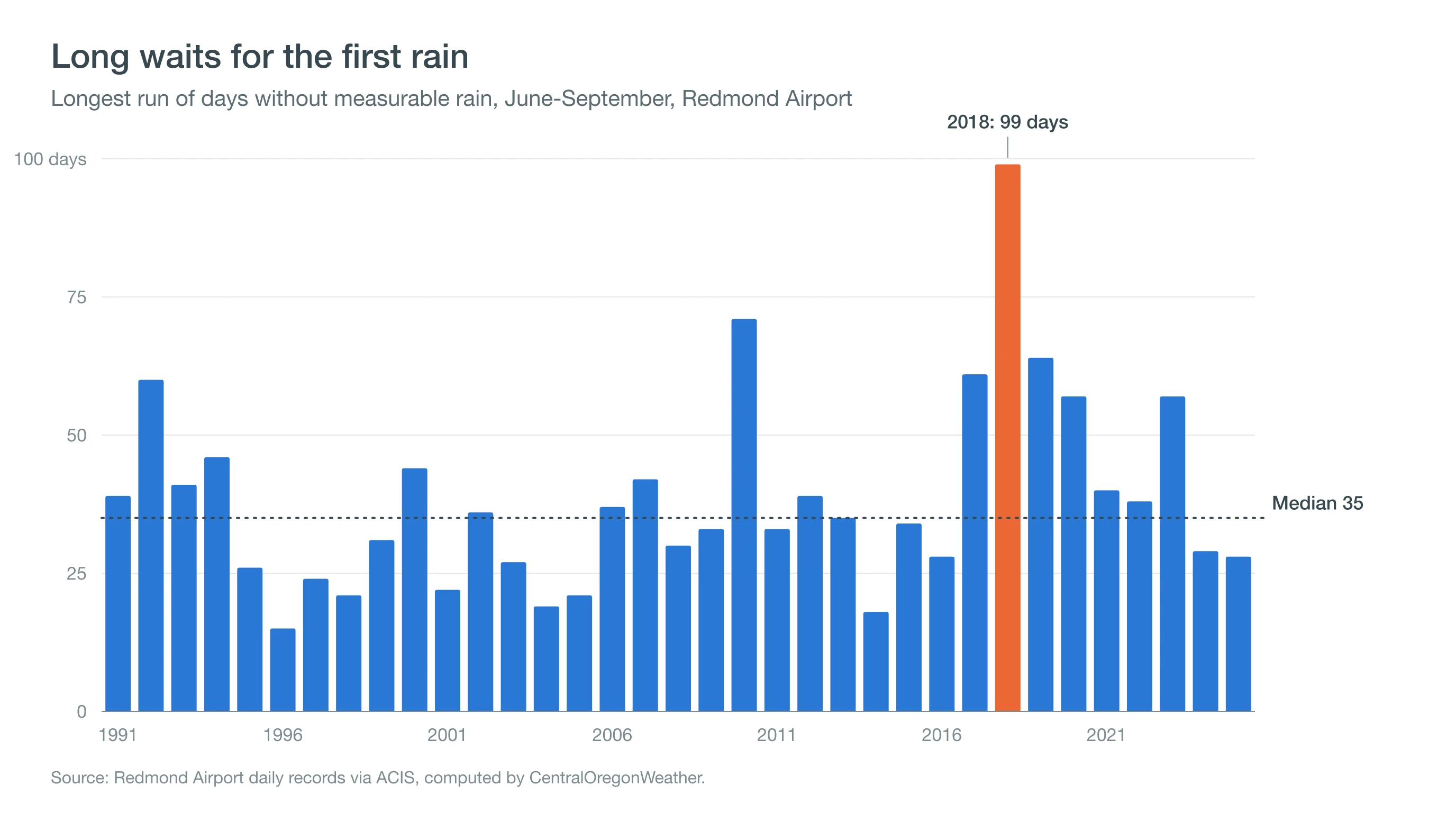
At Redmond Airport, the longest run of days without measurable rain between June 1 and September 30 has a median of 35 days, based on our analysis of daily records from 1991 to 2025. Some summers go much longer: 99 days in 2018, 71 in 2010, 64 in 2019 and 61 in 2017. By the end of such a stretch, plant oils and geosmin have had weeks to accumulate. Our guides to Bend rainfall, Redmond's weather by month and the Cascade rain shadow explain why summers are so dry. Central Oregon also has its own signature plants.
Why Does Central Oregon Rain Smell Like Sagebrush?
Central Oregon rain often smells like sagebrush and juniper because both plants carry aromatic oils in their leaves. Sagebrush leaves contain camphor and other terpenes, the compounds behind its sharp, herbal scent, and many people notice that scent bloom when rain wets the leaves.
Thunderstorms can add another note before the rain arrives. Lightning produces ozone, and a storm's cool downdraft can carry a sharp, clean smell, along with scent from rain falling miles away, ahead of the storm. That is why you can sometimes smell a storm coming, even while its distant flashes still look like heat lightning. See why Central Oregon gets sudden summer thunderstorms. So when is the best time to catch it?
When Can You Smell the First Rain of the Season?
The strongest rain smell usually comes with the first storms after the long summer dry spell, most often in September or October. Bend averages about 2 days with measurable rain in September and about 4 in October, when Pacific storms begin to return.
Summer thunderstorms can bring the smell too, especially when they drop only light rain on hot, dry ground. Even a storm that produces little rain at the surface can send scented air ahead of it on its downdraft, as with virga, rain that evaporates before it lands. See Bend weather in September for the turn of the season. That first storm is what the whole dry season builds toward, and the Deep Dive shows the moment at the scale of one raindrop.
Deep Dive: How Does a Raindrop Throw Smell Into the Air?
A raindrop throws smell into the air by trapping air bubbles from dry soil and bursting them at its surface, and the longer the soil has been dry, the more scent those bubbles have to carry.
What Did High-Speed Cameras Reveal?
Youngsoo Joung and Cullen Buie at MIT ran about 600 experiments on 28 surfaces, 12 engineered materials and 16 soils, filming each drop impact at high speed (Nature Communications, 2015). On porous, dry surfaces, the drop trapped tiny pockets of air at the point of contact. The bubbles rose through the drop and burst, like the fizz in a glass of soda, flinging aerosols upward. Light and moderate rain produced the most; heavy rain, with faster, larger drops, produced far fewer. The researchers suggested this mechanism may explain how the scent of petrichor reaches our noses.
What Is Geosmin, and Who Makes It?
Geosmin, whose name means "earth smell," is made by soil bacteria such as Streptomyces. Research led by Paul Becher and published in Nature Microbiology in 2020 found that geosmin attracts springtails, tiny soil animals that eat the bacteria and carry their spores to new places. The smell we enjoy after rain may be, in part, a bacterial signal meant for them.
Geosmin is the same compound that gives beets their earthy taste and that water utilities work to remove when it shows up in reservoirs after algal blooms. People can detect it at about 5 to 15 parts per trillion in water, less than a single drop in an Olympic-size swimming pool. That extraordinary sensitivity is why a few minutes of light rain on dry ground is enough to change how a whole neighborhood smells.
Why Do Dry Spells Make a Stronger Smell?
During dry weather, plant oils and geosmin collect on soil and rock surfaces with nothing to wash them away. The first light rain after weeks without water has the largest store to release, and dry, porous soil is exactly the surface that traps the most bubbles. That is why Redmond's long summer dry spells, a median of 35 days at their longest, set up such a strong smell when the first storm arrives.
Long waits are common here. In 7 of the 35 summers from 1991 to 2025, Redmond Airport's longest summer stretch without measurable rain reached 57 days or more: 1992, 2010, 2017, 2018, 2019, 2020 and 2023. The 2018 run of 99 days lasted from late June until September 28. Those are the summers when the first storm should bring the strongest smell, though no instrument at the airport measures scent.
How Can You Catch the Smell of the First Rain?
The longer the wait, the stronger the smell, so watch for the first rain after a long dry spell, often in September or October, or a light summer shower on hot ground. Check the Bend forecast for the first chance of rain, and when it starts, step outside on a trail such as the Oregon Badlands or Smith Rock, where sagebrush and juniper add their own scent.
Good places to notice it include open sagebrush flats east of Bend, the juniper woodlands around Redmond and Cline Buttes, and rimrock trails above the Crooked River, where wet basalt, dust and plants all add to the mix. The smell usually fades once steady rain has soaked the ground, because wet soil traps fewer bubbles and the stored compounds have been released, so the first few minutes of a storm are the best time to catch it.