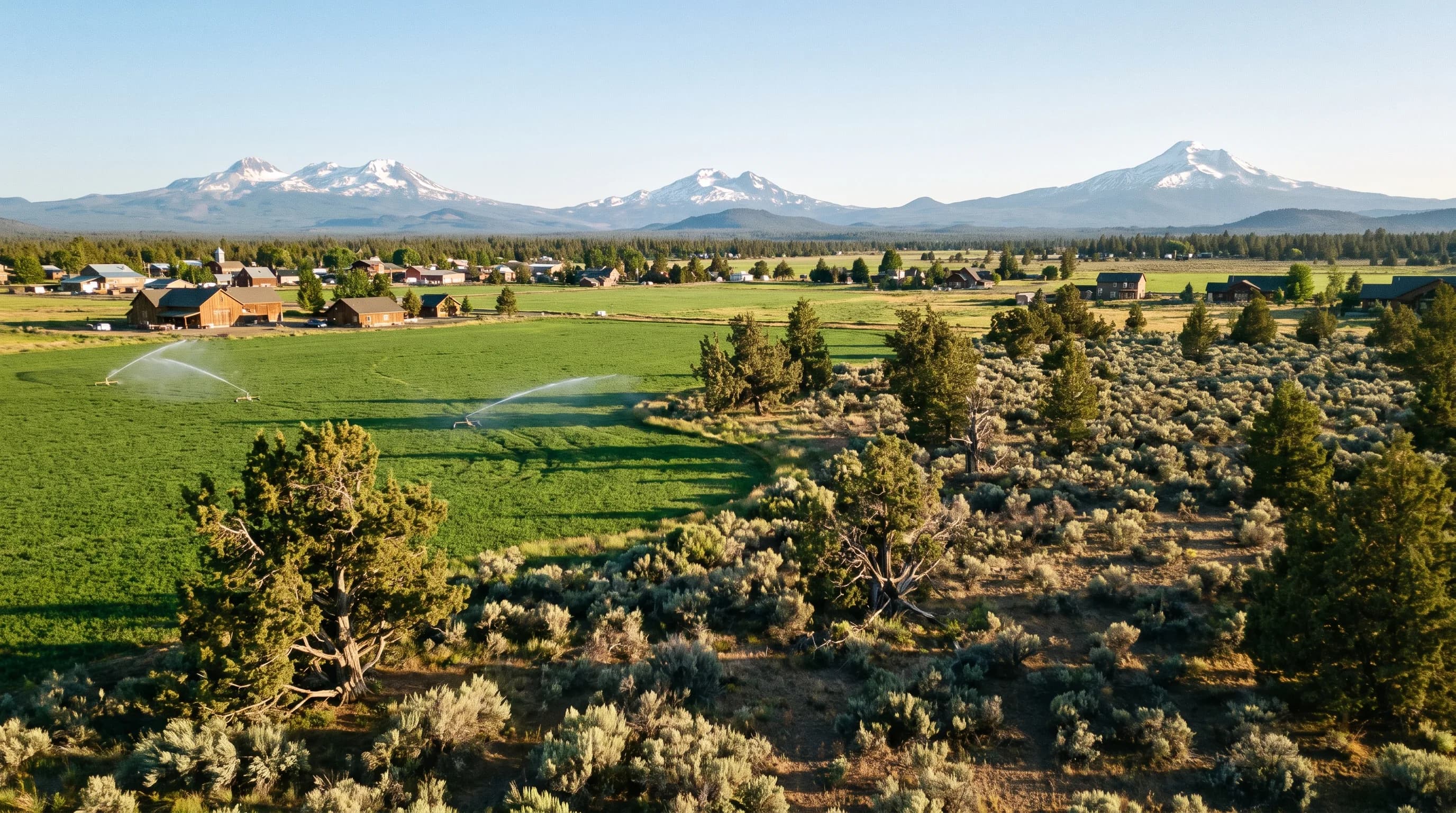
Redmond, Oregon has a dry high-desert climate: hot, sunny summers with July highs near 87.5°F and cold winters with December lows near 23°F, according to NOAA's 1991-2020 normals for Redmond Airport. The town gets about 8.5 inches of precipitation and roughly 12 inches of snow a year, less than Bend, and averages 13 days of 90°F heat in July.
Redmond sits about 16 miles north of Bend and roughly 600 feet lower, and the difference shows up in almost every month. Think of Redmond as Central Oregon with the volume turned toward desert: a little hotter, drier and less snowy than Bend, with nights that are just as cold. This guide walks through the year season by season, with the numbers that matter for planning a trip or a move.
What Is the Weather Like in Redmond, Oregon?
Redmond's weather swings widely between day and night and between seasons. Summer afternoons reach the upper 80s while nights fall into the 40s, and winter afternoons in the low 40s give way to mornings in the low to mid 20s. Precipitation is light in every month, and no month averages more than 1.2 inches.
| Month | Average high | Average low | Precipitation | Snowfall | Days 90°F+ |
|---|---|---|---|---|---|
| January | 44.2°F | 25.3°F | 0.98 in | 4.7 in | 0 |
| February | 48.0°F | 25.3°F | 0.66 in | 2.7 in | 0 |
| March | 54.9°F | 27.7°F | 0.58 in | 0.8 in | 0 |
| April | 60.2°F | 30.7°F | 0.71 in | 0.1 in | 0 |
| May | 69.1°F | 37.8°F | 1.20 in | 0 | 0.6 |
| June | 77.2°F | 42.8°F | 0.64 in | 0 | 2.8 |
| July | 87.5°F | 48.5°F | 0.40 in | 0 | 13.4 |
| August | 86.5°F | 47.2°F | 0.46 in | 0 | 11.3 |
| September | 78.6°F | 40.6°F | 0.37 in | 0 | 3.6 |
| October | 64.5°F | 32.7°F | 0.68 in | 0.1 in | 0.1 |
| November | 50.8°F | 27.5°F | 0.81 in | 0.6 in | 0 |
| December | 42.3°F | 23.3°F | 0.97 in | 3.5 in | 0 |
Highs, lows and precipitation are NOAA 1991-2020 normals for Redmond Airport (3,049 ft). Snowfall and days of 90°F or hotter are computed by CentralOregonWeather from the airport's daily records, 1991-2020; snowfall was not recorded in some years, so those values are averages of the years with complete records.
December is the coldest month, with January close behind, and July is the hottest. May is the wettest month, when spring thunderstorms add to the last Pacific storms of the season. The quickest way to understand Redmond's numbers is to put them next to Bend's.
How Is Redmond's Weather Different From Bend's?
Redmond is warmer than Bend in the afternoon, drier overall, especially in winter, and much less snowy, but its nights are just as cold. The airport weather station sits 611 feet below the Bend station, and Redmond lies farther east of the Cascades, deeper in their rain shadow.
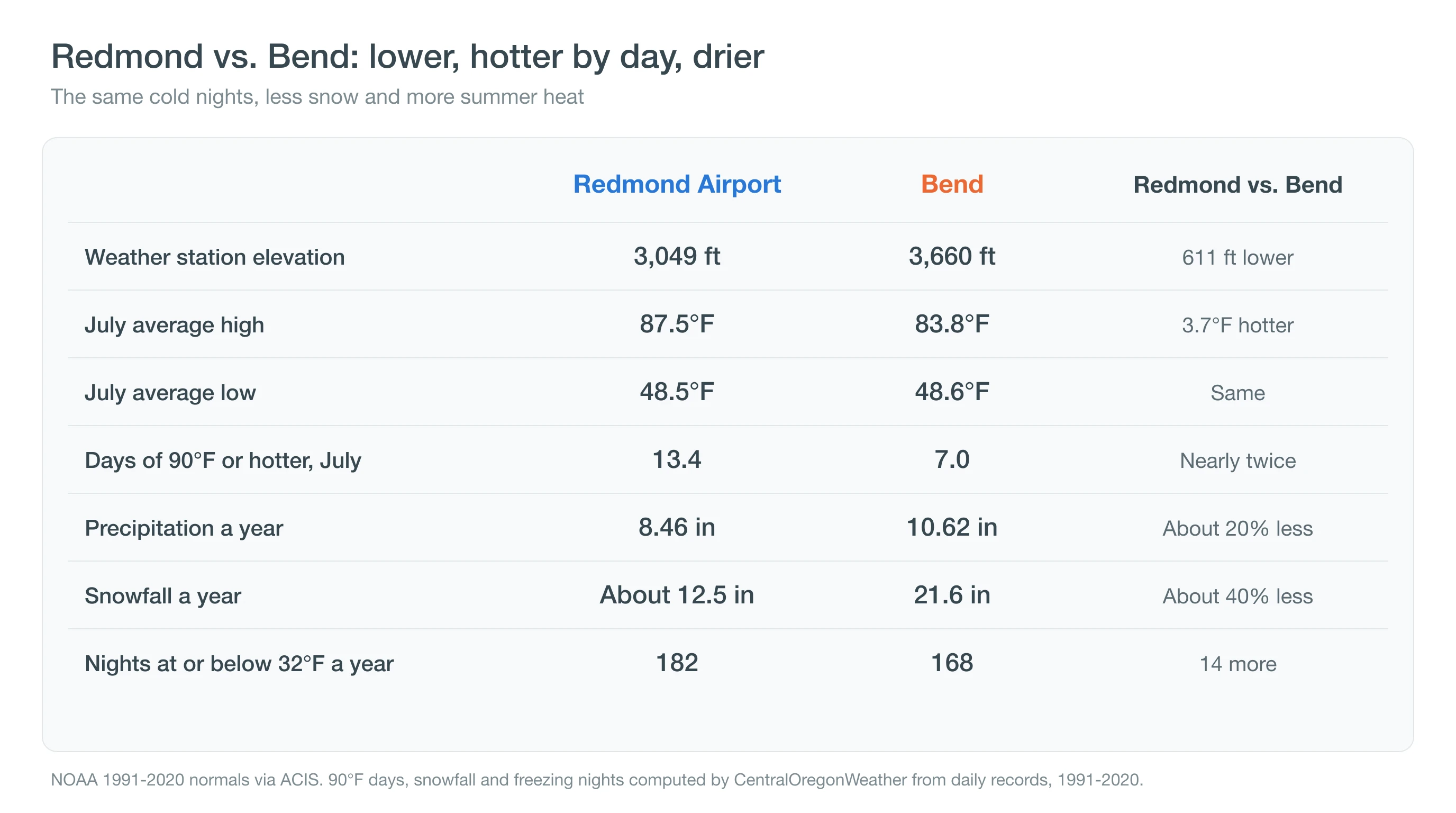
The July average high is 87.5°F at Redmond Airport and 83.8°F in Bend, yet the July average low is 48.5°F at both. Redmond gets 8.46 inches of precipitation a year to Bend's 10.62, and about 12.5 inches of snow to Bend's 21.6. The surprise is frost: the airport records about 182 nights a year at or below freezing, 14 more than Bend, because its open plateau loses heat quickly on clear nights. The Bend weather by month guide has the matching numbers for Bend. Those differences matter most in winter.
What Are Winters Like in Redmond?
Redmond winters are cold and fairly dry. December lows average 23.3°F, and about 27 nights in December fall to freezing or below. Afternoons usually climb above freezing, into the low 40s, and about one morning in an average December or January drops to 0°F or lower.
Snow falls often but lightly. The airport reports falling snow on about 7 days in an average December and 6 in January, yet monthly totals average only 3.5 and 4.7 inches, and snow covers the ground on only about 4 days in each of those months. A big storm can still bury the town: the deepest snow in the station's record, 19 inches, came after a 14.9-inch snowfall on November 5, 1973.
Fog is the hazard that surprises visitors. Redmond Airport reports freezing fog on an average of 4.6 days in December and 3.8 in January, when supercooled droplets glaze roads, runways and windshields without any precipitation at all. Our guides to freezing fog in Central Oregon and RDM airport weather delays explain what it does to roads and flights. Spring is when Redmond turns from frost to sun.
When Does Spring Arrive in Redmond?
Spring arrives in Redmond in the afternoons first. March highs average about 55°F and April highs about 60°F, but frost still forms on about 21 nights in April and 10 in May. Gardeners in Redmond usually wait until late May or early June before setting out tender plants.
May is the wettest month of the year at the airport, averaging 1.20 inches, and it brings the first thunderstorms. The airport reports lightning on about 3 days in an average May, and storms can bring brief downpours, small hail and gusty winds to an otherwise dry afternoon. Our explainer on why Central Oregon gets sudden summer thunderstorms covers how they build. Then summer brings the heat Redmond is known for.
How Hot Does Redmond Get in Summer?
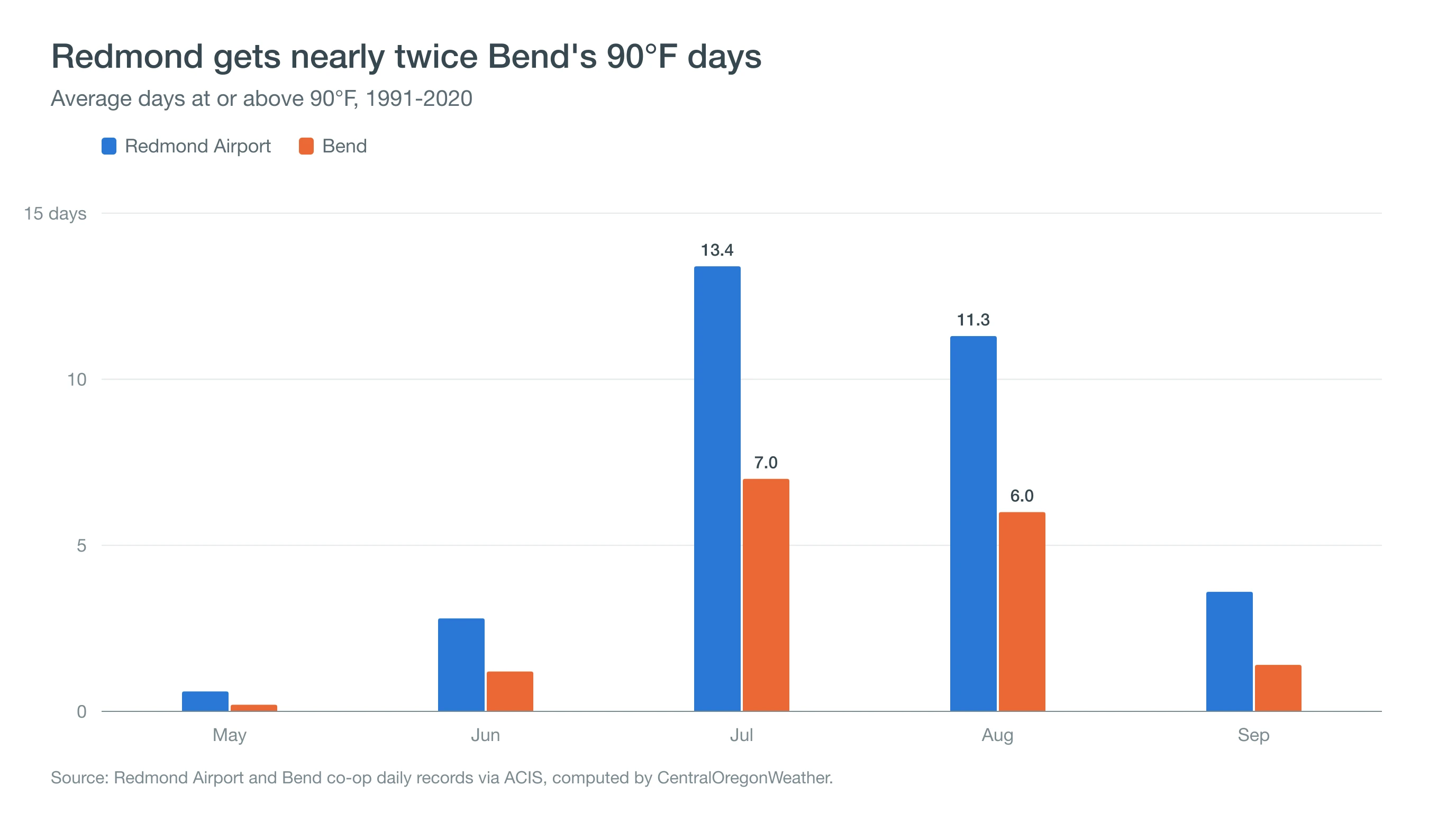
Redmond summers are hot by day and cool by night. The July average high is 87.5°F, the highest of any month, and the airport averages 13.4 days of 90°F or hotter in July and 11.3 in August, about 32 a year in all. Bend averages about 16.
Extreme heat is rare but real. During the June 2021 heat dome, Redmond Airport reached 108°F on June 27, 110°F on June 28 and 112°F on June 29, the hottest reading in the station's record, though still 7°F short of Oregon's all-time record. Even in July, though, the average low is 48.5°F, so mornings start cool and evenings call for a layer. Read more about heat domes and how they trap heat. On a hot afternoon, Lava River Cave, south of Bend, stays near 42°F. Late summer adds a second hazard.
When Is Wildfire Smoke Worst in Redmond?
Wildfire smoke is most likely in Redmond in August and September. From 2000 to 2025, Redmond Airport reported smoke on an average of 5.8 days in August, 3.3 in September and 1.6 in July, and almost never in other months. The worst seasons bring weeks of haze, while some summers stay nearly clear.
Smoke reaching Redmond often comes from fires in the Cascades, southern Oregon or Northern California, carried on the prevailing winds. Check the Central Oregon smoke forecast before outdoor plans in late summer, and see why air quality gets bad and when it clears. For health guidance on smoky days, follow AirNow and the Oregon Health Authority. Put it all together and the best months stand out.
When Is the Best Time to Visit Redmond?
Late May through June and most of September are the best times to visit Redmond for weather. June brings highs near 77°F, cool nights and a low chance of smoke. September cools to about 79°F by day and 41°F by night, with smoke odds falling as the month goes on.
- For climbing and hiking at Smith Rock: April-May and late September-October, when highs sit in the 60s and 70s. See Smith Rock weather by month and the Smith Rock forecast.
- For heat lovers: July and the first half of August, with the hottest afternoons and the clearest nights. Plan outdoor activity for mornings.
- For a winter base: December-February, when Redmond often has less snow on the ground than Bend, with Mt. Bachelor about an hour away.
Deep Dive: Why Is Redmond Hotter Than Bend by Day but Not at Night?
Redmond is hotter than Bend by day because well-mixed afternoon air warms as elevation drops, but at night the mixing stops and each town's low depends on its own ground and terrain rather than its height.
What Does 600 Feet Buy in the Afternoon?
On a sunny afternoon, heating from the ground stirs the lowest mile or so of the atmosphere into a well-mixed layer. Air in that layer cools close to the dry adiabatic rate, about 5.4°F per 1,000 feet, as it rises. Redmond Airport (3,049 feet) sits 611 feet below the Bend co-op (3,660 feet), which predicts that Redmond should be about 3.3°F warmer in the afternoon. The July normal highs differ by 3.7°F, 87.5°F against 83.8°F. The close match is consistent with the explanation, though other factors also play a part. Our guide to Central Oregon elevations puts every town on the same ladder.
Why Do the Nights Come Out Even?
After sunset the mixing stops. The ground radiates heat to a clear, dry sky, the air touching it cools, and a shallow inversion forms, with colder air at the surface than above it. Each site's low then depends on how open its ground is to the sky and on cold air draining from nearby slopes, not on elevation. Redmond's broad, open plateau radiates efficiently, so July lows come out at 48.5°F against Bend's 48.6°F, December lows at 23.3°F in both towns, and the airport records more freezing nights in a year than Bend.
The difference shows up at both ends of the growing season. The airport averages about 5 nights at or below freezing in September and 18 in October, against about 3 and 14 in Bend. In spring, Redmond still records freezing nights on about 21 April nights and 10 May nights. So the town with hotter summer afternoons can have a shorter frost-free season than Bend, which surprises gardeners who move north expecting the opposite.
Why Is Redmond Drier?
Redmond sits about 35 miles east of the Cascade crest, deeper in the rain shadow than Bend. Air descending the east slopes warms and dries, and each extra mile from the crest leaves less moisture to fall, which is why Redmond averages 8.46 inches a year to Bend's 10.62. Drier ground also sends more of the sun's energy into heating the air rather than evaporating water, a higher Bowen ratio in meteorologists' terms, adding a little to Redmond's afternoon heat. The Cascade rain shadow explainer covers the mechanism in detail.
The gradient shows across the whole region. Precipitation falls from about 15 inches a year at Sisters, close to the crest, to 10.6 in Bend and 8.5 at Redmond Airport, a drop of more than 40% across about 20 miles. Snow falls off even faster, from about 30 inches at Sisters to 21.6 in Bend and about 12.5 at Redmond, because Redmond also sits lower and runs a little warmer during storms.
How Should You Plan Around Redmond's Weather?
Plan for Redmond as a hotter, drier Bend with the same cold nights. Bring layers in every season, start summer outings early, watch for freezing fog on winter mornings and check smoke before late-summer plans. Check today's Redmond forecast and comfort score on the Redmond destination page and the outlook on the Central Oregon smoke forecast.