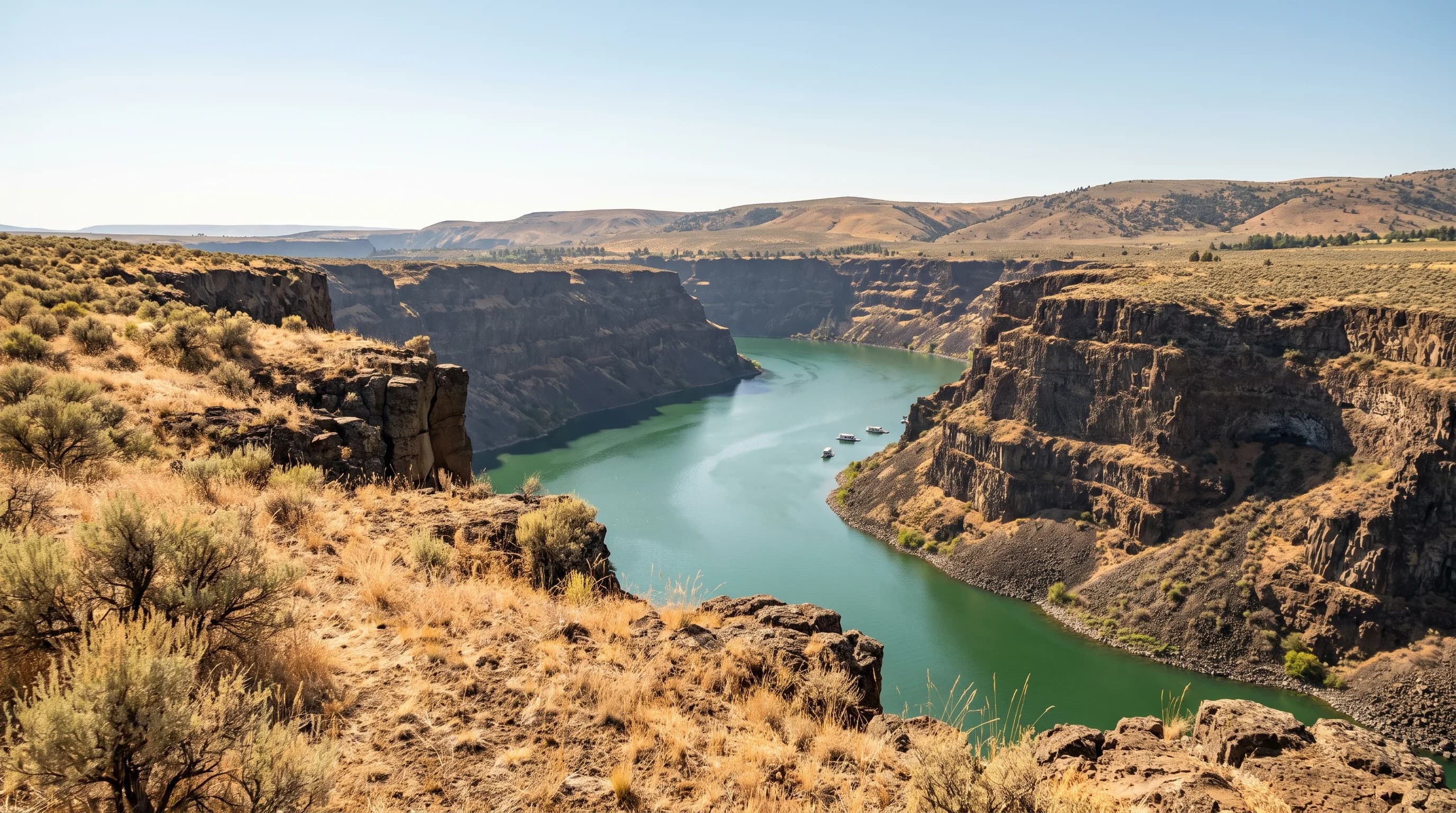
Madras, Oregon has hot, dry summers and cold, mostly dry winters. NOAA's 1991-2020 normals for the Madras station give July highs of 85.8°F, December lows of 21.3°F and 9.4 inches of precipitation a year, with only about 5 inches of snow. The canyon lakes below town, including Lake Billy Chinook, run hotter still.
Madras is the lowest of Central Oregon's larger towns, at about 2,240 feet, and the Deschutes and Crooked River canyons below it drop lower still. On June 29, 2021, the thermometer at Pelton Dam, about 8 miles northwest of town, reached 119°F, tying Oregon's all-time record, according to NOAA's State Climate Extremes Committee. In Madras, going down means getting hotter, and each section below pairs the town on the plateau with the canyon beneath it.
What Is the Weather Like in Madras, Oregon?
Madras has a sunny, dry high-desert climate with big day-to-night swings. July days average 85.8°F and nights 45.3°F. Winters are cold at night but light on snow, and no month averages more than about 1.15 inches of precipitation. The table adds Pelton Dam's average highs so you can see the canyon difference month by month.
| Month | Madras high | Madras low | Precipitation | Snowfall | Pelton Dam high |
|---|---|---|---|---|---|
| January | 41.9°F | 22.5°F | 0.87 in | 2.1 in | 43.4°F |
| February | 45.6°F | 23.2°F | 1.00 in | 1.0 in | 48.8°F |
| March | 53.4°F | 26.2°F | 0.71 in | 0.1 in | 57.2°F |
| April | 59.6°F | 28.8°F | 0.90 in | 0.1 in | 63.7°F |
| May | 68.4°F | 35.9°F | 1.12 in | 0 | 73.4°F |
| June | 75.2°F | 40.8°F | 0.67 in | 0 | 80.8°F |
| July | 85.8°F | 45.3°F | 0.37 in | 0 | 91.9°F |
| August | 85.4°F | 44.3°F | 0.25 in | 0 | 91.1°F |
| September | 76.9°F | 37.5°F | 0.37 in | 0 | 82.3°F |
| October | 62.8°F | 29.8°F | 0.94 in | 0 | 67.2°F |
| November | 48.9°F | 25.5°F | 1.01 in | 0.3 in | 51.2°F |
| December | 40.7°F | 21.3°F | 1.15 in | 1.0 in | 42.1°F |
Highs, lows and precipitation are NOAA 1991-2020 normals for the Madras co-op station (2,285 ft) and the Pelton Dam co-op station (1,484 ft) in the Deschutes canyon. Madras snowfall is computed by CentralOregonWeather from the station's daily records, 1991-2020, using years with complete records.
July is the hottest month and December the coldest. Pelton Dam runs warmer than town in every month, by about 6°F in midsummer. The biggest surprise is how hot those canyons get.
Why Is the Madras Area the Warmest Part of Central Oregon?
The Madras area is the warmest part of Central Oregon by day because the canyons below town are the lowest ground in the region and trap afternoon heat. The town itself runs a little cooler than Redmond in summer, with a July high of 85.8°F to Redmond's 87.5°F. The Madras station sits about 1,400 feet below the Bend station, and Pelton Dam sits another 800 feet lower.
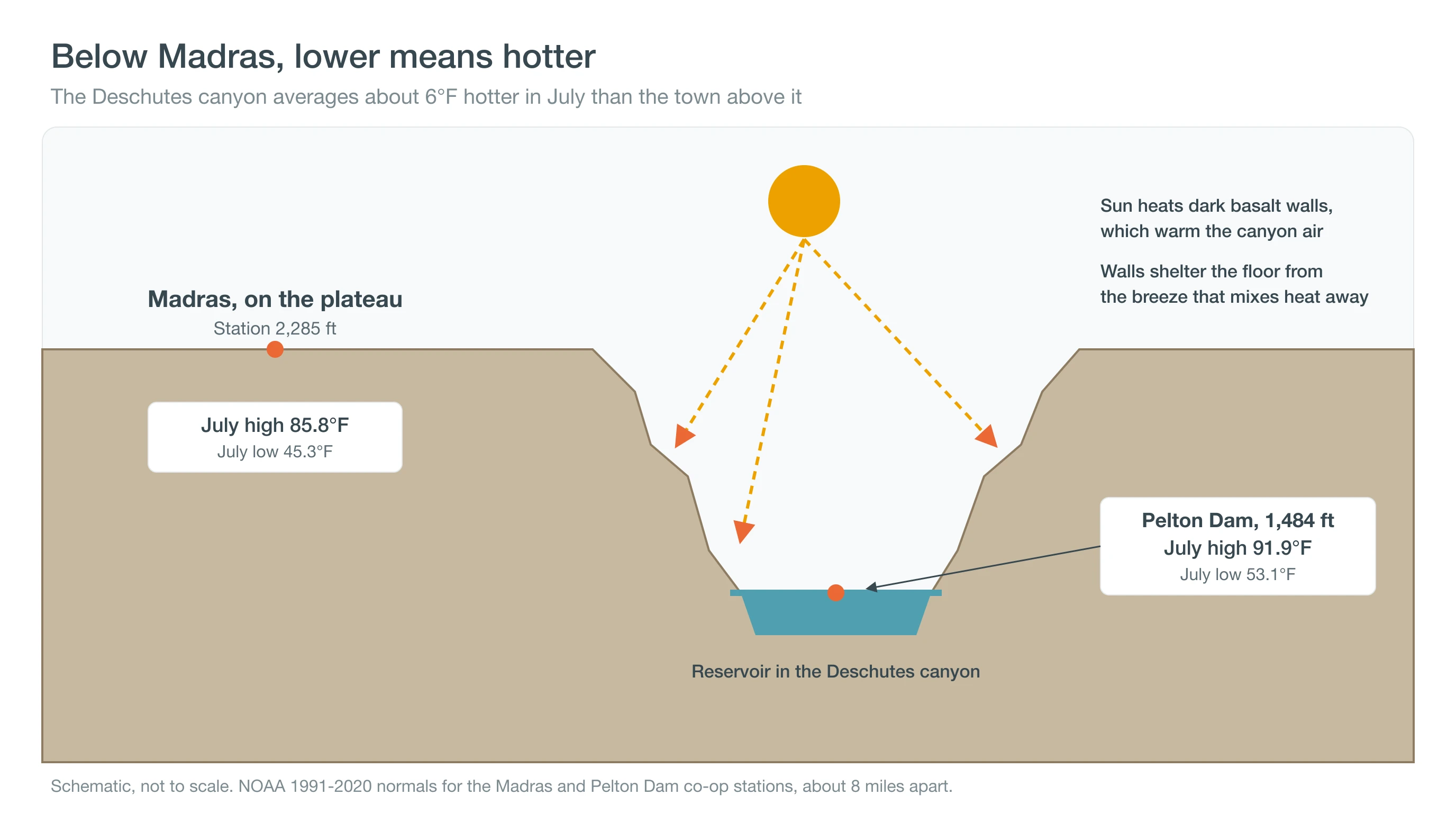
The plateau and the canyon behave differently at night. Madras's December lows average 21.3°F, colder than Bend's 23.3°F despite the lower elevation, because cold air settles on the open plateau on clear nights. Pelton Dam's December lows average 26.6°F, the mildest of these stations. Our guide to Central Oregon elevations shows where Madras sits on the regional ladder. The record proves how hot the canyon can get.
How Hot Does Lake Billy Chinook Get?
The canyons around Lake Billy Chinook and Lake Simtustus are Central Oregon's hot spot. Pelton Dam, on Lake Simtustus just downstream of Lake Billy Chinook, averages a July high of 91.9°F and about 22 days of 90°F or hotter in both July and August, about 66 a year.
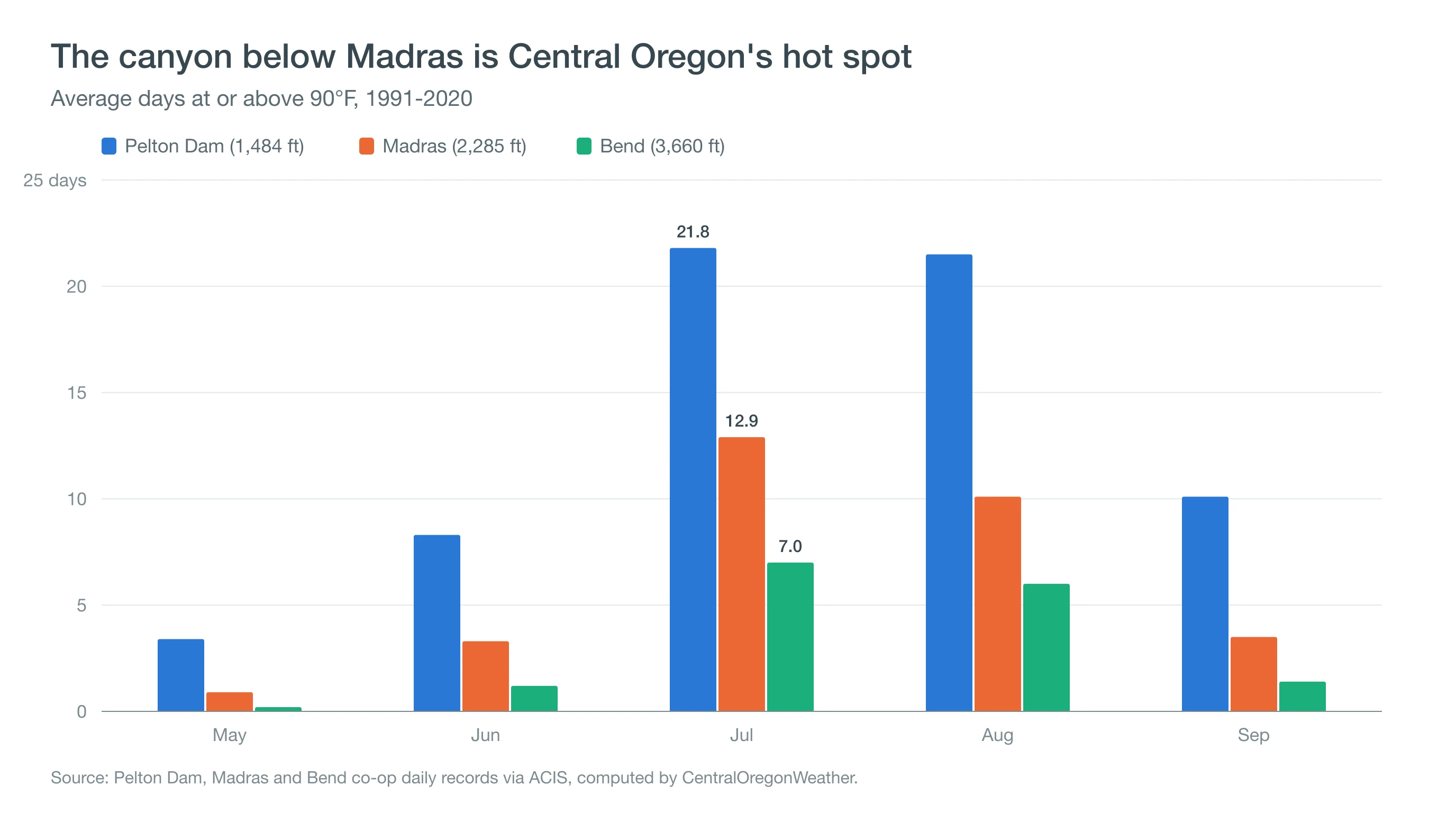
On June 29, 2021, during the Pacific Northwest heat dome, Pelton Dam and the Moody Farms AgriMet station both reached 119°F, tying the 119°F readings at Prineville and Pendleton in 1898 as Oregon's hottest temperature on record. The Madras station's own record is 112°F, set on July 25, 1928. See how heat domes trap heat and Prineville's place in the record, or all of Oregon's weather records.
On a lake day in July or August, plan for heat: bring shade and plenty of water, and watch for heat advisories from the National Weather Service in Pendleton. Winter tells the opposite story from Bend.
Does Madras, Oregon Get Snow?
Yes, but not much. Madras averages about 5 inches of snow a year, computed from the station's 1991-2020 records, with January the snowiest month at about 2 inches. Snow usually melts quickly. Big storms still happen: the January 2017 storms left 18 inches of snow on the ground at the Madras station on January 9.
Winter cold matters more than snow. December nights average 21.3°F, about 26 nights in December and 25 in January drop to freezing, and a couple of mornings a winter fall to 0°F or below. The station's coldest reading was -40°F on January 21, 1930. Cold, calm mornings can bring freezing fog and black ice on US 97 and US 26, so check ODOT TripCheck before driving. Read about black ice and where it snows in Oregon.
Madras's precipitation is spread thinly through the year. December is the wettest month, at 1.15 inches, with May close behind at 1.12, when spring thunderstorms add showers. August is the driest month, averaging only a quarter inch. Between the extremes are the best months.
When Is the Best Time to Visit Madras and the Lakes?
May, June and September are the best months to visit Madras and the canyon lakes. Highs on the plateau run from about 68°F to 77°F, the canyon is warm but not yet baking, and smoke is less likely than in August.
- Spring (May-June): good for hiking the canyon rims and boating before peak heat. Afternoon thunderstorms are possible.
- High summer (July-August): for heat lovers and houseboats, with the hottest afternoons in Central Oregon. Go out early, rest midday, and watch the Central Oregon smoke forecast.
- September: warm water, cooler nights and thinning crowds, though smoke can linger into the month.
- October: highs near 63°F and crisp nights near 30°F, good for hiking and fishing once the heat and smoke have passed.
Check the forecast for The Cove Palisades State Park before a camping trip. One more Madras advantage is the sky.
Why Are Madras Skies So Clear in Late Summer?
Madras skies are clear in late summer because dry air from the interior and a stable atmosphere suppress clouds through most of July and August. At Redmond Airport, the nearest airport station, about 25 miles south, sensors reported no clouds below 12,000 feet on 82% of August nights from 2000 to 2025. Those sensors cannot see higher clouds, so the true clear-sky share is a little lower.
That clear-sky record is a big reason Madras became one of the best-known viewing hubs for the total solar eclipse of August 21, 2017, drawing large crowds to the area. On summer nights, the same skies make the Madras area good for stargazing, as long as wildfire smoke stays away. See aurora nights in Central Oregon for another reason to look up.
Deep Dive: Why Do the Canyons Below Madras Run So Hot?
The canyons below Madras run hot because they are lower, sheltered from the wind and lined with dark rock, and those effects add up to more heat than elevation alone explains.
How Much Does 800 Feet Explain?
Pelton Dam (1,484 feet) sits about 800 feet below the Madras station (2,285 feet). On a sunny summer afternoon, well-mixed air cools at about 5.4°F per 1,000 feet as it rises, the dry adiabatic rate, which predicts that the canyon should run about 4.3°F warmer than town. The July normal highs differ by 6.1°F, 91.9°F against 85.8°F. Something adds roughly another 2°F.
What Adds the Extra Heat?
The leading explanations are the canyon's shape and surfaces. Steep basalt walls absorb strong summer sunlight and warm the air beside them, and the canyon catches sunlight on slopes facing many directions through the day. The walls also shelter the canyon floor from the afternoon breeze that mixes heat away on the open plateau. Dry rock and sparse vegetation put most of the sun's energy into heating the air rather than evaporating water. These are physical reasons that fit the data rather than a measured energy budget for this canyon.
Winter numbers support that explanation. In December, when the sun is low and weak, Pelton Dam's average high is 42.1°F, only 1.4°F warmer than Madras at 40.7°F, much less than the roughly 3 to 4°F that the elevation difference alone would predict. When there is less sunlight to heat the rock and air in the canyon, the canyon's extra warmth almost disappears, which points to sunshine, not just elevation, as the main driver.
Why Are Canyon Nights So Much Warmer?
Low ground usually collects cold air at night, so the canyon's warm nights stand out: Pelton's July lows average 53.1°F against 45.3°F in Madras. Two explanations are likely. Rock walls that soaked up heat all day give it back after sunset, and the large reservoirs store heat and release it slowly overnight. The Deschutes canyon also slopes downstream, so some cold air may drain away along the river instead of pooling at the dam. Up on the open plateau, nothing slows the cooling, which is why Madras's nights run cooler than the canyon's and its December lows run colder than Bend's.
The canyon's mild nights show up all year. Pelton Dam records about 129 nights a year at or below freezing, against about 171 in Madras, and its December lows average 26.6°F, more than 5°F milder than the town's 21.3°F, the mildest winter nights of any station in this guide.
How Should You Plan Around Madras's Weather?
Remember the Madras rule: down is hotter. The plateau town is warm, dry and light on snow, and the canyon lakes below it run hotter still in summer and milder at night. Check today's heat on the Madras destination page and at Lake Billy Chinook before a summer lake day, and compare with Redmond's weather by month, the next town south.