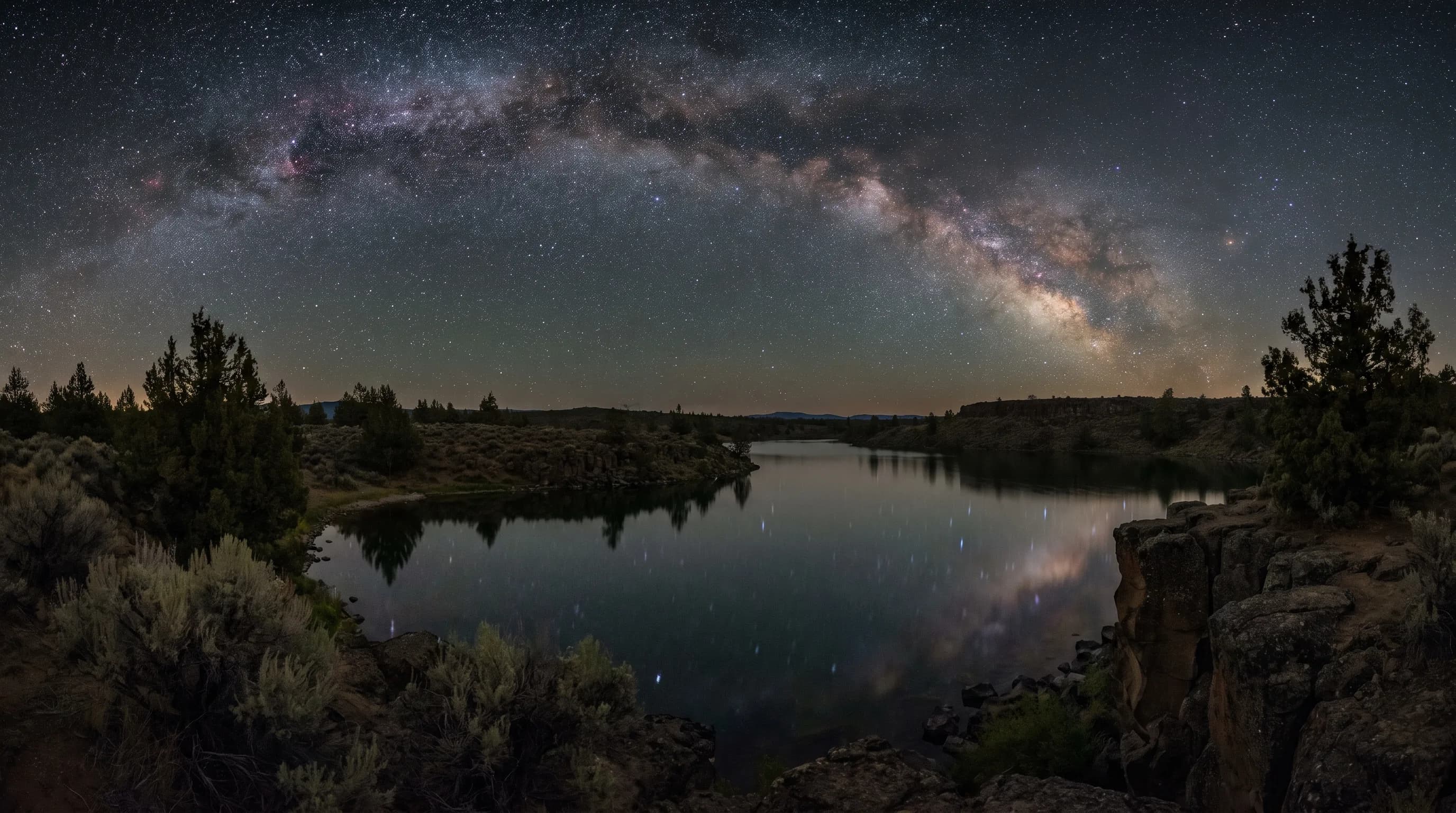
The best time to stargaze in Central Oregon is July through September, when most nights are clear. ERA5 model data show about 78% of July nights near Bend mostly clear, against about 15% in January. Prineville Reservoir State Park, an International Dark Sky Park since 2021, and Pine Mountain Observatory offer some of the region's darkest skies. Pick nights near the new moon.
Central Oregon has dark skies, observatories and Oregon's first International Dark Sky Park, but on any given night the deciding factor is cloud. In an average July, about three of four nights near Bend are mostly clear from 10 p.m. to 3 a.m.; in January, fewer than one in six are. The high desert's best stargazing season is set by the same dry summer air that brings heat and smoke. This guide moves from why summer nights are clear, to where to go, to which nights to pick, and ends with what can still spoil a clear night.
When Is the Best Time for Stargazing in Central Oregon?
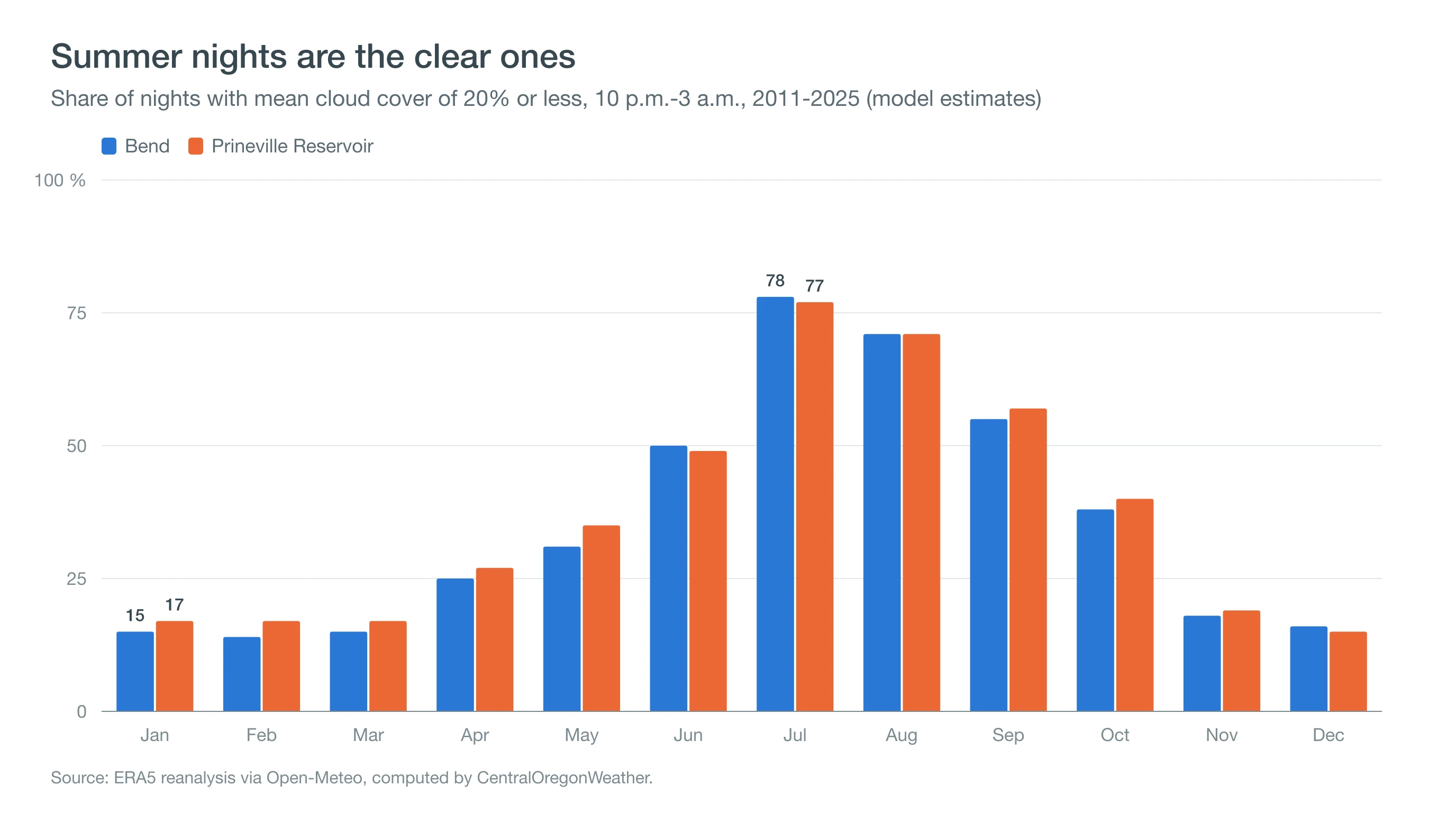
July and August are the clearest months, with September close behind. June, when summer is just settling in, is a coin flip, and from November through March only about one night in six is mostly clear.
| Month | Near Bend | Prineville Reservoir | Pine Mountain |
|---|---|---|---|
| January | 15% | 17% | 15% |
| February | 14% | 17% | 16% |
| March | 15% | 17% | 18% |
| April | 25% | 27% | 25% |
| May | 31% | 35% | 34% |
| June | 50% | 49% | 50% |
| July | 78% | 77% | 76% |
| August | 71% | 71% | 70% |
| September | 55% | 57% | 55% |
| October | 38% | 40% | 38% |
| November | 18% | 19% | 18% |
| December | 16% | 15% | 15% |
Share of nights with mean cloud cover of 20% or less from 10 p.m. to 3 a.m., 2011-2025, from ERA5 reanalysis via Open-Meteo, computed by CentralOregonWeather. These are model estimates, not observations.
The three sites track each other closely, because the same weather systems cover the whole region. Why are summer nights so much clearer?
Why Are Central Oregon Summer Nights So Clear?
Summer nights are clear because high pressure dominates the Pacific Northwest from July into September, steering storms north and pushing sinking, drying air over the region. Central Oregon also sits in the rain shadow of the Cascades, so even when moist air arrives from the Pacific, much of it is wrung out over the mountains first.
Winter is the opposite: Pacific storms, low clouds and inversion fog keep the sky covered for long stretches. Afternoon thunderstorms can cloud up summer evenings, but they usually fade after sunset as the ground cools. Read why Bend is so sunny and how the Cascade rain shadow dries the air. Clear air helps most where the ground is dark.
Where Are the Darkest Skies Near Bend?
The darkest skies near Bend are well away from town lights, to the east and southeast. Bend's own glow washes out fainter stars across much of the sky, so a 30- to 60-minute drive makes a big difference.
- Prineville Reservoir State Park: Oregon's first International Dark Sky Park, designated in 2021, with campgrounds on the water. See Prineville Reservoir State Park.
- Pine Mountain: about 34 miles southeast of Bend at 6,300 feet, home to the University of Oregon's observatory. See Pine Mountain Observatory.
- Fort Rock and the high desert: very little artificial light; see Fort Rock.
- Cascade Lakes: spots like Sparks Lake add reflections and a mountain horizon, though Bend's glow shows to the east.
Wherever you go, give your eyes time. Full dark adaptation takes about 20 to 30 minutes, and a single glance at a bright phone screen resets much of it. Use a red light for maps and gear, turn screen brightness all the way down, and look slightly to the side of faint objects, which brings the eye's more sensitive cells into play. A reclining chair or a pad on the ground makes a long session comfortable, and binoculars show far more of the Milky Way than the naked eye. Two places add telescopes and guides.
Can You Visit Pine Mountain Observatory or the Sunriver Observatory?
Yes, in season. Pine Mountain Observatory typically opens to the public on two weekends a month, Friday and Saturday nights, from late May through September, with telescopes and volunteers to explain what you are seeing. Reservations are not taken, a small donation is suggested, and it closes when clouds or rain make observing impossible. Check the observatory's posted schedule before you drive up.
The Sunriver Nature Center and Observatory also runs evening stargazing programs; check its schedule and booking rules. Whichever you choose, bring warm layers: at 6,300 feet on Pine Mountain, summer nights turn chilly even after a hot afternoon in Bend. See why high-desert nights cool so fast. Then pick the night.
Which Nights Are Best: New Moon, Meteor Showers and the Milky Way?
The best nights fall within a few days of the new moon, when moonlight does not wash out faint stars. In 2027, new moons fall on April 6, May 6, June 4, July 3, August 2 and 31, and September 29 (Pacific time, U.S. Naval Observatory).
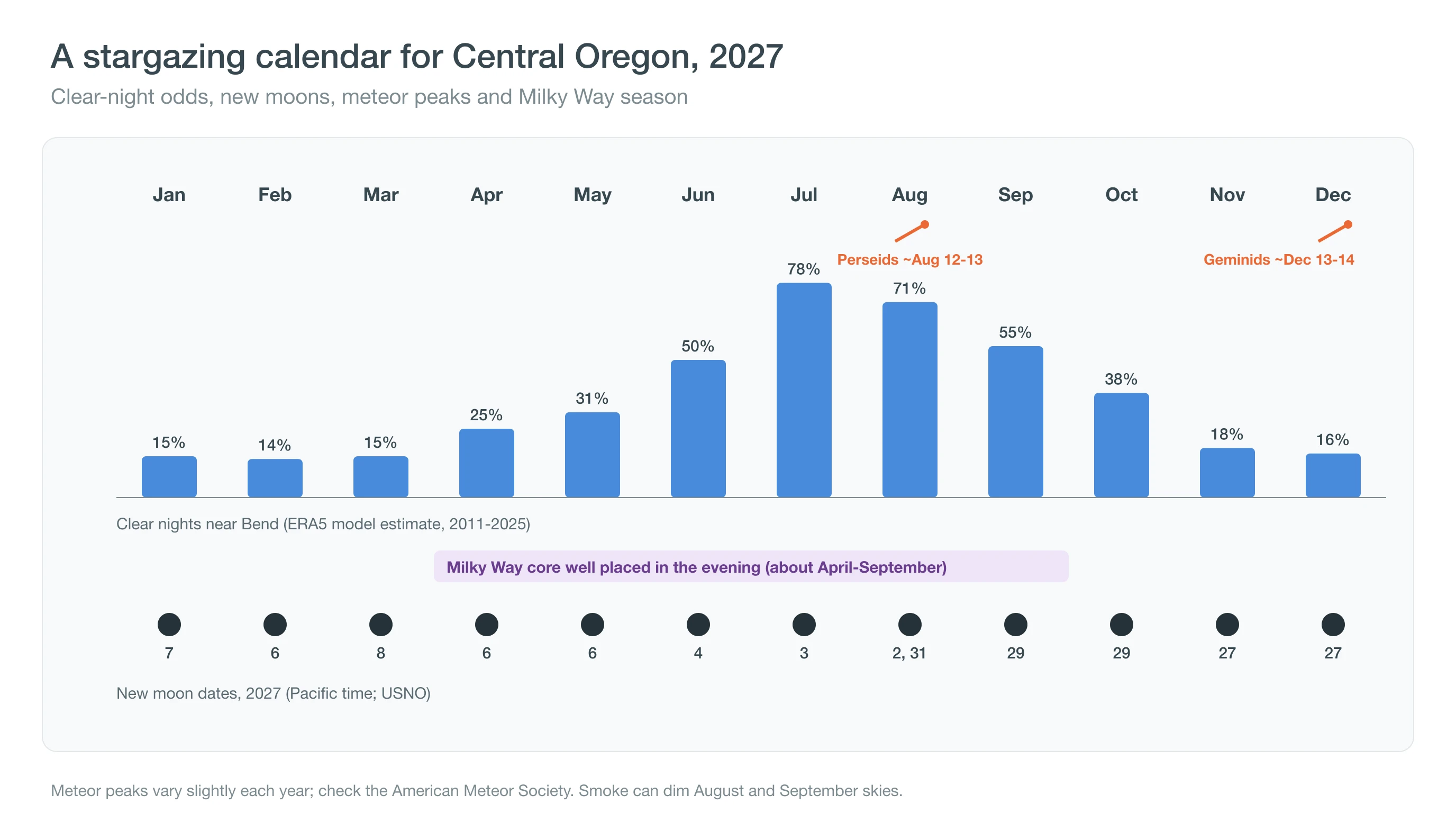
The Perseid meteor shower peaks around August 12-13, usually under clear skies here, and the Geminids around December 13-14, when clouds are more likely. The bright core of the Milky Way is best seen in the evening sky in summer, rising earlier each month from spring. Check the American Meteor Society each year for exact peaks. Even a clear summer night has one common spoiler.
How Does Wildfire Smoke Affect Stargazing?
Wildfire smoke can dim or hide the stars even on a night with no clouds, and it is most common in August and September, the same months that are otherwise clearest. Redmond Airport reported smoke on an average of 5.8 days in August and 3.3 in September from 2000 to 2025.
Smoke turns the moon and stars orange near the horizon and erases the Milky Way first. Check the Central Oregon smoke forecast before driving out, and see why the moon looks orange on smoky nights. For another reason to look up, read about northern lights in Central Oregon.
Deep Dive: What Makes a Night Sky Dark and Clear?
A night sky looks dark and clear when little artificial light reaches it, when the air holds little haze or water vapor, and when there is less air overhead to scatter starlight.
How Is Sky Darkness Measured?
Astronomers measure sky brightness in magnitudes per square arcsecond, often with a handheld Sky Quality Meter. The scale runs backward: higher numbers mean darker skies, and readings near 22 approach natural darkness. The Bortle scale, published by John Bortle in Sky & Telescope in 2001, ranks skies from class 1, pristine, to class 9, inner city. Dark-sky park designations require sites to show an exceptional quality of starry nights and commitments to limit light pollution.
The magnitude scale is logarithmic: every 5 magnitudes means a factor of 100 in brightness, so each single step is about 2.5 times. A sky reading 18 magnitudes per square arcsecond, typical of a lit suburb, is about 40 times brighter than a sky reading 22, near natural darkness. That brighter background drowns out faint stars, which is why the Milky Way disappears in town even on a perfectly clear night.
What Is the Difference Between Transparency and Seeing?
Transparency is how clear the air is: water vapor, smoke and dust dim faint stars and galaxies. Seeing is how steady the air is: turbulence makes stars twinkle and blurs views through a telescope. Central Oregon's dry summer air gives excellent transparency, while seeing varies with the wind, sometimes rougher when strong winds blow over the Cascades.
The clear-night numbers in this guide measure only cloud cover, not haze. Smoke and dust matter too, and they peak in the same late-summer weeks. A useful habit is to check the clear-night forecast for cloud and then the smoke forecast for haze; a night that is clear on both counts in late July or early September is about as good as stargazing gets in the region.
Why Does Elevation Help?
At Pine Mountain's 6,300 feet, air pressure is about 79% of sea level, so there is roughly 20% less air overhead to scatter and absorb starlight. Much of the atmosphere's water vapor and haze also lies below that height on a typical summer night. Starlight passes through less material on its way to your eye, so faint objects stand out more.
How Should You Plan a Stargazing Night?
Dry summer air makes the stars, so aim for July through September, near a new moon, away from town. On your chosen night, check cloud cover on the CentralOregonWeather map and the smoke forecast, see the Prineville weather guide for camping at the reservoir, and bring a warm layer.