Sisters, Oregon has warm, dry summers and snowy, cold winters. NOAA's 1991-2020 normals for the Sisters station give July highs of 85.6°F, December lows of 19.8°F and 15.2 inches of precipitation a year. Snowfall averages about 30 inches, more than Bend, because Sisters sits closer to the Cascade crest.
Sisters is only 20 miles from Bend, yet its weather swings further in both directions: hotter summer afternoons, colder winter nights and half again as much precipitation. The town gets the mountains' moisture and the desert's sunshine, and each month shows which side is winning. Cascade storms and snow rule from November to March, desert heat and smoke from July to September, and two short shoulder seasons bring the town's best event weekends.
What Is the Weather Like in Sisters, Oregon?
Sisters has a four-season mountain-desert climate with some of the biggest day-to-night swings in Central Oregon. A July day averages 85.6°F in the afternoon and 43.4°F at dawn, a 42-degree spread. December is the wettest and snowiest month, and July is the hottest and driest.
| Month | Average high | Average low | Precipitation | Snowfall | What to expect |
|---|---|---|---|---|---|
| January | 40.8°F | 20.8°F | 1.74 in | 7.2 in | Snow on the ground about 9 days |
| February | 43.9°F | 21.9°F | 1.36 in | 7.4 in | Snow showers, longer days |
| March | 50.6°F | 25.2°F | 1.31 in | 1.7 in | Mud season, late snow |
| April | 57.1°F | 28.8°F | 0.77 in | 0.2 in | Frost on most nights |
| May | 66.3°F | 34.4°F | 1.53 in | 0 | Thunderstorms begin |
| June | 74.2°F | 39.0°F | 1.01 in | 0 | Sisters Rodeo |
| July | 85.6°F | 43.4°F | 0.55 in | 0 | Outdoor Quilt Show |
| August | 84.5°F | 42.4°F | 0.60 in | 0 | Peak smoke risk |
| September | 75.8°F | 36.0°F | 0.54 in | 0 | Sisters Folk Festival |
| October | 61.3°F | 28.6°F | 1.09 in | 0.2 in | Fall color, hard frosts |
| November | 47.4°F | 24.5°F | 2.17 in | 2.4 in | Storms return |
| December | 39.3°F | 19.8°F | 2.53 in | 11.2 in | Wettest, snowiest month |
Highs, lows and precipitation are NOAA 1991-2020 normals for the Sisters co-op station (3,180 ft). Snowfall and snow-cover days are computed by CentralOregonWeather from the station's daily records, 1991-2020, using years with complete snowfall records. Event months are typical; check organizers for each year's dates.
Sisters is wetter and colder at night than Bend in almost every month, even though it sits about 435 feet lower. The reason is a matter of miles from the Cascade crest.
Why Is Sisters Wetter and Colder Than Bend?
Sisters is wetter than Bend because it sits about 15 miles east of the Cascade crest, close enough to catch storms that spill over the mountains before they dry out. It is colder at night because cold air drains off the Cascades and Black Butte into the valley floor on clear, calm nights.
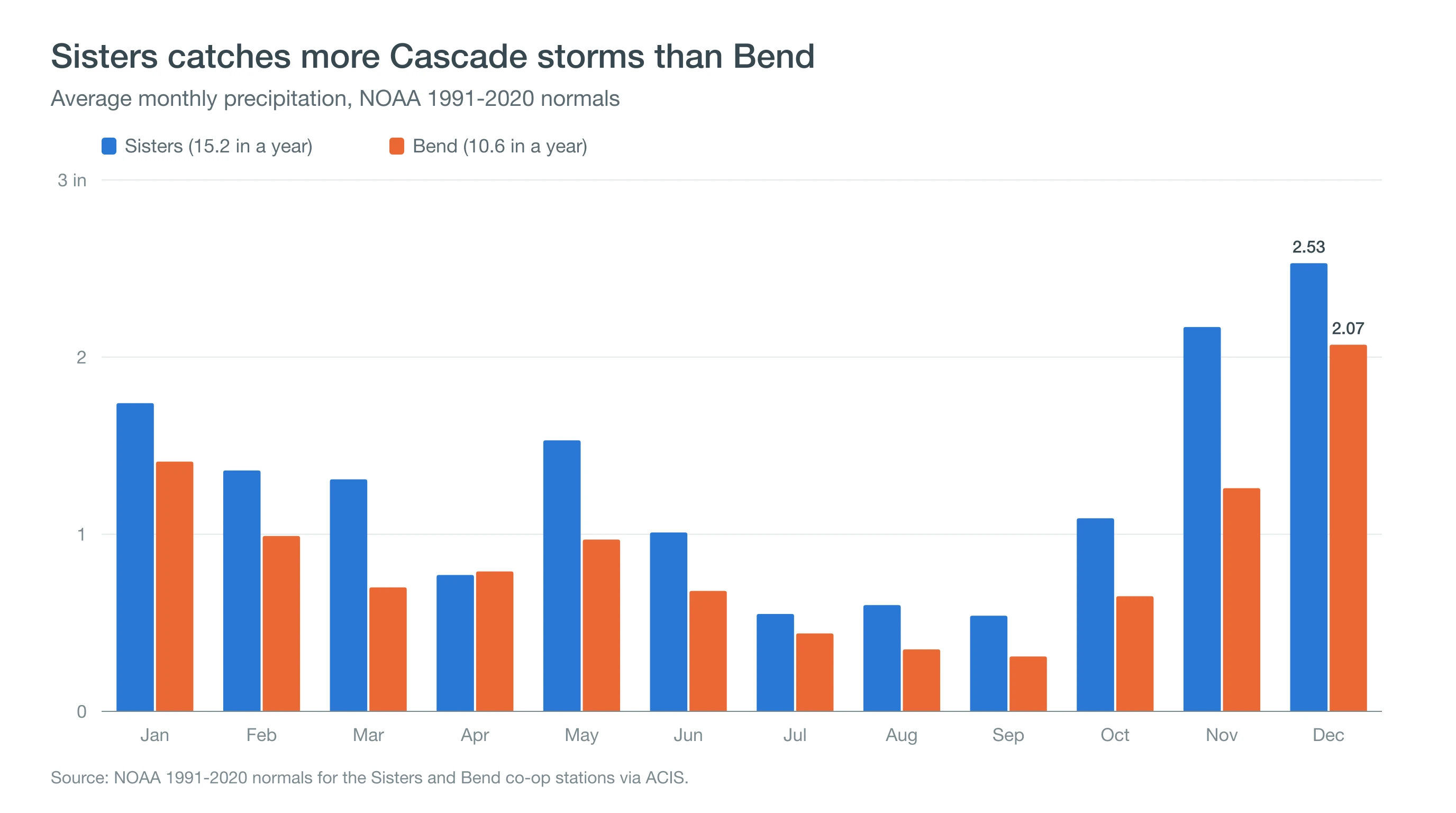
Sisters averages 15.2 inches of precipitation a year to Bend's 10.62, and the gap is widest in the storm season. November brings 2.17 inches to Sisters and 1.26 to Bend. At night the order flips the usual rule that lower means warmer: December lows average 19.8°F in Sisters and 23.3°F in Bend. By afternoon the desert side wins again, and July highs reach 85.6°F in Sisters against Bend's 83.8°F. See how the Cascade rain shadow dries the land farther east, and how inversions trap cold air in valleys. The difference shows up most in winter.
Does Sisters, Oregon Get Snow?
Yes. Sisters averages about 30 inches of snow a year, computed from the station's 1991-2020 records, compared with 21.6 inches in Bend. December is the snowiest month, at about 11 inches, followed by February and January at about 7 inches each. Snow covers the ground on about 9 days in an average January and 6 in December.
Big winters bury the town. The January 2017 storms left 35 inches of snow on the ground at the Sisters station on January 12, 2017, the deepest in its record. Nights are cold enough to keep that snow around: December averages 28 nights at or below freezing, and about two mornings in a typical December drop to 0°F or lower. The station's coldest reading was -28°F on January 22, 1962.
Winter in Sisters also means winter driving. US 20 climbs to Santiam Pass, 4,817 feet, about 20 miles west of town, and chains or traction tires are often required. Read our guide to Cascade passes in winter, the Central Oregon snow guide and where it snows in Oregon.
Spring is short and changeable before event season starts. March still brings snow showers and frost on about 26 nights, April warms to about 57°F in the afternoon, and May turns wet again, with 1.53 inches of rain as the first thunderstorms build over the mountains. Trails at lower elevations dry out by May, while high trailheads such as Three Creek Lake stay snowbound into early summer.
What Weather Should You Expect at the Sisters Rodeo and Quilt Show?
Expect warm afternoons, cold mornings and a chance of a thunderstorm at the Sisters Rodeo, which is held in June, and hot, sunny weather at the Sisters Outdoor Quilt Show, held on the second Saturday of July.
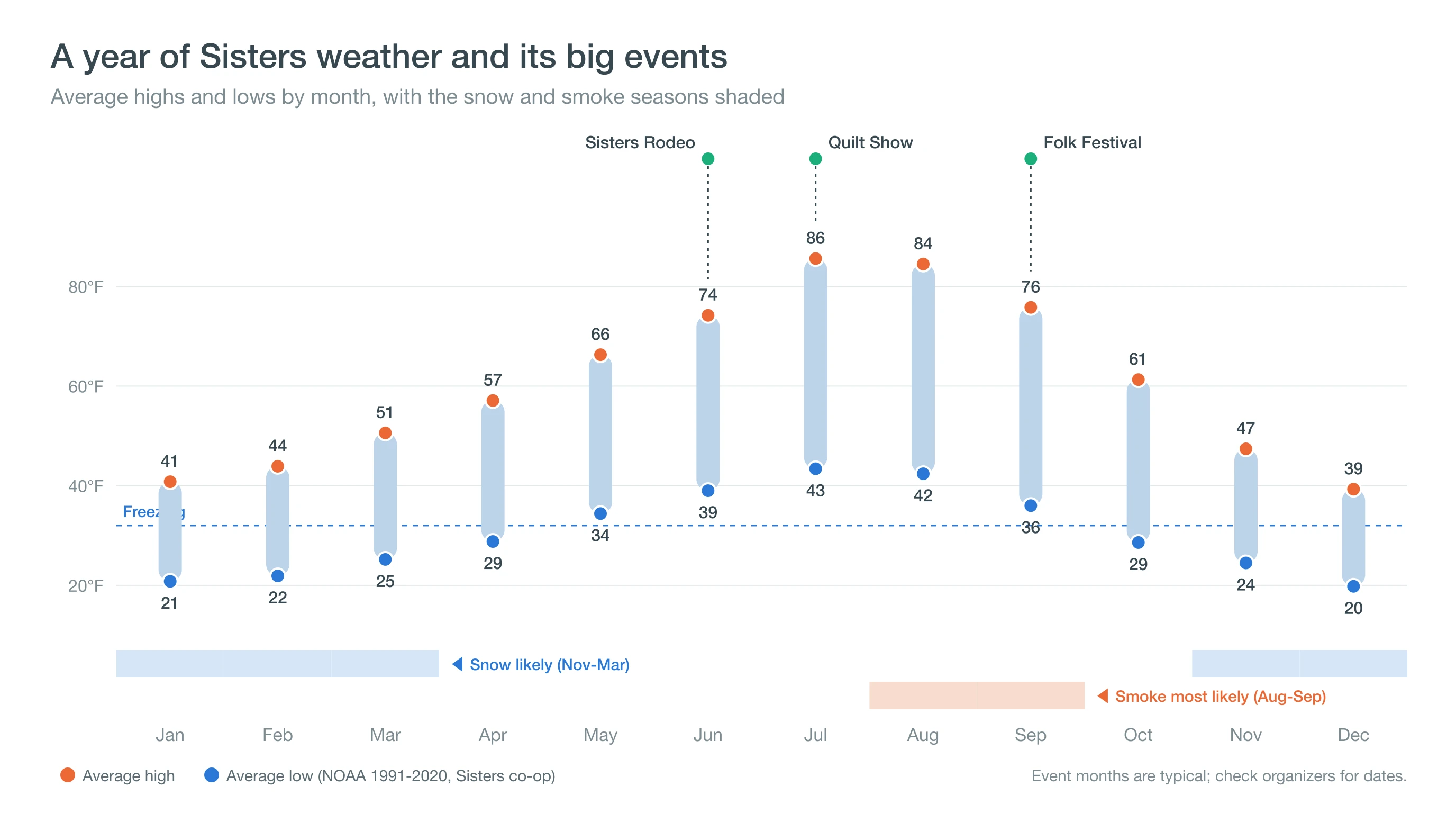
June averages 74.2°F by day and 39.0°F by night, and frost still forms on about 5 nights in an average June. May and June are the stormiest months of the warm season, with about an inch of rain or more each. For rodeo weekend, pack sun protection and a warm layer for evening performances, plus a rain shell for a passing storm.
By the quilt show in July, highs average 85.6°F, and about 12 days in a typical July reach 90°F or hotter. The quilts hang outdoors through the day, so the best viewing is in the morning, when it is cool. Even July can bring frost: the station averaged about one night at or below freezing in July. Our guide on sudden summer thunderstorms explains the afternoon storms. By late summer the bigger concern is smoke.
When Is Smoke Most Likely in Sisters?
Smoke is most likely in Sisters in August and early September. Sisters has no airport weather station of its own, but Redmond Airport, about 20 miles east, reported smoke on an average of 5.8 days in August and 3.3 in September from 2000 to 2025, and the pattern is similar across the region.
Sisters sits at the edge of the Deschutes National Forest, so fires in the nearby Cascades can bring heavy smoke as well as evacuation alerts in bad seasons. Check the Central Oregon smoke forecast before late-summer trips, read about where Central Oregon's smoke comes from, and follow AirNow and Deschutes County alerts on smoky days. September usually clears and cools in time for the folk festival.
What Is Fall Like in Sisters?
Fall in Sisters starts warm and ends wet. September averages 75.8°F by day and 36.0°F at night, with frost on about 9 nights, so the Sisters Folk Festival in late September usually brings sunny afternoons and cold evenings. Pack a jacket and a hat for evening concerts.
October cools quickly to 61.3°F highs and 28.6°F lows, with aspens and vine maples turning in the nearby mountains. November flips the switch back to storm season, with 2.17 inches of precipitation, the year's second-wettest month, and often the season's first snow. Bend's October guide covers fall color across the region.
Deep Dive: How Far Does Cascade Snow Spill Past the Crest?
Cascade snow spills tens of miles east of the crest because snowflakes fall slowly while strong west winds carry them downwind, and Sisters sits inside that spillover zone.
How Fast Does Precipitation Fall Off East of the Crest?
NOAA normals trace the rain shadow station by station. Santiam Junction, on the wet west side of Santiam Pass, averages about 70 inches of precipitation a year. Sisters, about 15 miles east of the crest, gets 15.2 inches. Bend, about 25 miles east, gets 10.6, and Redmond, about 35 miles east, 8.5. Most of the drop happens in the first 15 miles, which is why Sisters keeps much more moisture than the towns farther out.
Put as percentages, the first step is by far the largest. From Santiam Junction to Sisters, yearly precipitation falls by about 78%. From Sisters to Bend it falls another 30%, and from Bend to Redmond about 20% more. The steep first drop marks where the mountains wring most of the water out of Pacific storms, and Sisters sits just past it, still inside the zone that catches the leftovers.
Why Does Snow Land Downwind of the Mountains?
Rising air over the Cascades builds snow crystals high above the crest. Unrimed snowflakes fall at only about 1 meter per second, roughly 2 mph, according to classic measurements by Locatelli and Hobbs (1974). A flake that forms 2 kilometers above the ground takes about half an hour to land. Riding a 40 mph west wind, it can drift about 20 miles in that time, carrying snow well past the crest to places like Sisters. The IMPROVE field campaign studied storms over the Oregon Cascades in late 2001 and tracked how snow grows and falls as it crosses the range.
Why Are Sisters Nights So Cold?
On clear, calm nights, the ground radiates heat away and the air touching it cools and grows denser. That cold air drains off the Cascade foothills and Black Butte and collects on the low valley floor around Sisters. If air cooled with height at the standard rate of about 3.6°F per 1,000 feet, Sisters would be about 2°F warmer than the Bend station, which sits about 480 feet higher. Instead, its December lows average 3.5°F colder, at 19.8°F against 23.3°F.
The cold extends through the whole year. The Sisters station averaged about 200 nights a year at or below freezing, compared with about 168 in Bend and 182 at Redmond Airport, and it recorded frost in every month, including about one night in July and about five in June. That is the signature of a cold-air drainage site rather than of elevation, since Sisters sits lower than Bend.
How Should You Plan Around Sisters' Weather?
Plan for both sides of Sisters' weather: mountain moisture and snow from November to March, desert sun, heat and smoke in late summer, and big day-to-night swings all year. Check the live forecast and comfort score on the Sisters destination page, nearby Suttle Lake and Black Butte Ranch, and the Central Oregon snow forecast before winter trips over Santiam Pass.