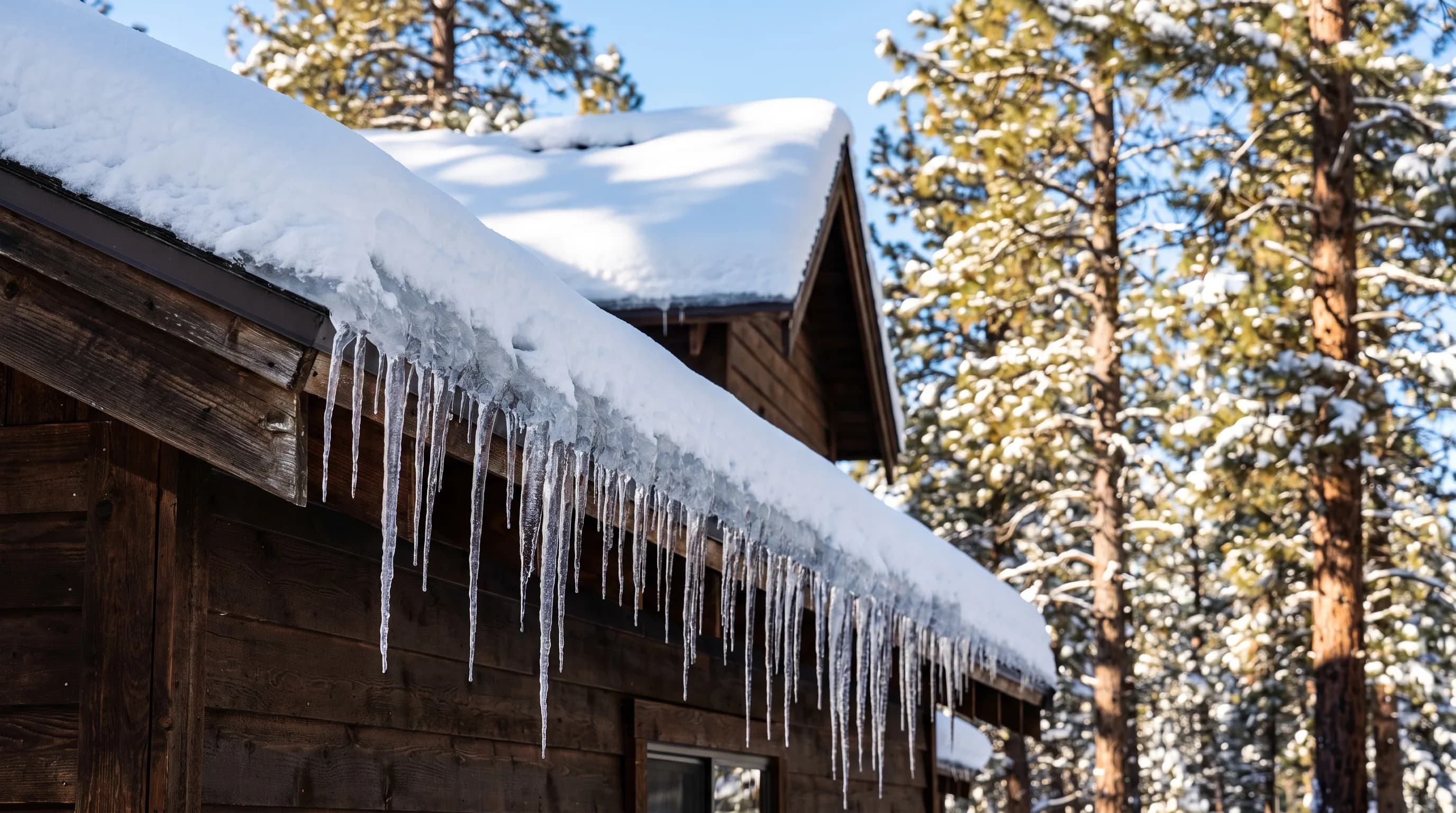
An ice dam is a ridge of ice at a roof's edge that blocks meltwater, which then backs up under shingles. It forms when heat from the house or the sun melts roof snow and the water refreezes at the cold eaves. Central Oregon's snowy, sunny winters with hard night freezes create those conditions, especially in Sunriver and La Pine.
In January 2017, the National Weather Service measured 24 inches of snow on the ground at Bend's Public Works yard near Pilot Butte, breaking the date's snow-depth record, and roofs gave way across the region, including a school gym in Bend. Ice dams come from heat and cold meeting on the same roof. This guide follows the meltwater from the warm middle of the roof to the frozen edge, then looks at where in Central Oregon that cycle repeats most.
What Is an Ice Dam?
An ice dam is a band of ice that builds along the lower edge of a snow-covered roof. Snow higher on the roof melts, the water runs down under the snow, and it freezes again when it reaches the cold overhang. The ridge grows a little with each cycle until it holds back a pool of water.
Shingles are designed to shed water running downhill, not to hold back standing water. When the pool behind an ice dam rises, water can work its way up under the shingles and into the roof deck, insulation, walls and ceilings. Long icicles hanging from a thick ridge of ice are the most visible sign. The ice forms through a daily cycle.
How Do Ice Dams Form?
Ice dams form when part of a roof is above freezing while its edge is below freezing. Heat escaping from the living space into the attic warms the roof deck under the snow; the snow at the bottom of the layer melts, even when the outside air is in the 20s; and the water runs down to the eaves, which hang outside the heated walls and stay as cold as the air.
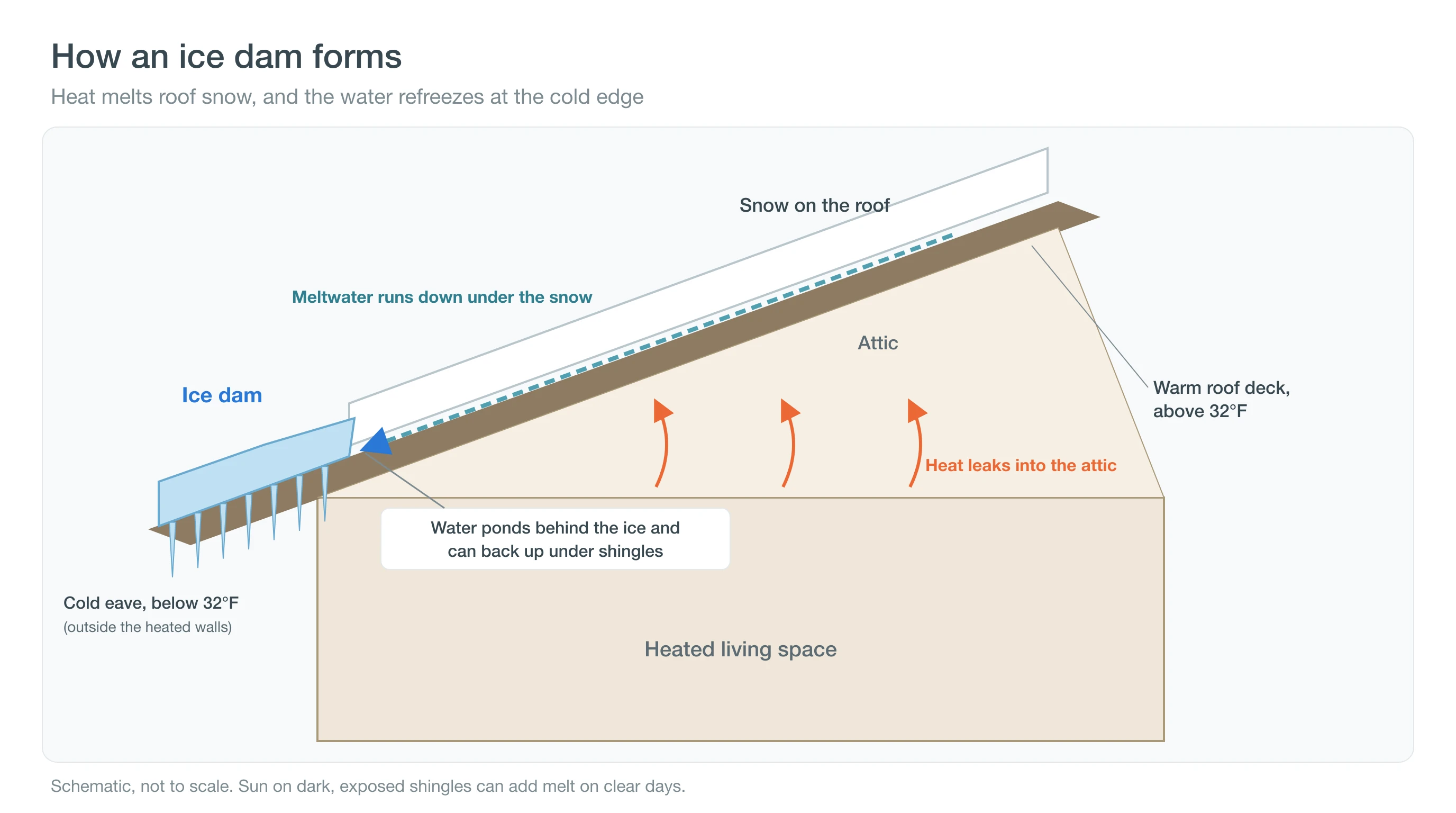
Sunshine adds to the melt. On a clear afternoon, sun on dark, exposed shingles near the roof edge can start melt even on a well-insulated house. At night the temperature drops well below freezing, the meltwater at the eave turns to ice, and the next day the cycle repeats. That combination of snow cover, sunny days and hard nights is exactly what Central Oregon's winters deliver.
Why Does Central Oregon Get So Many Ice Dams?
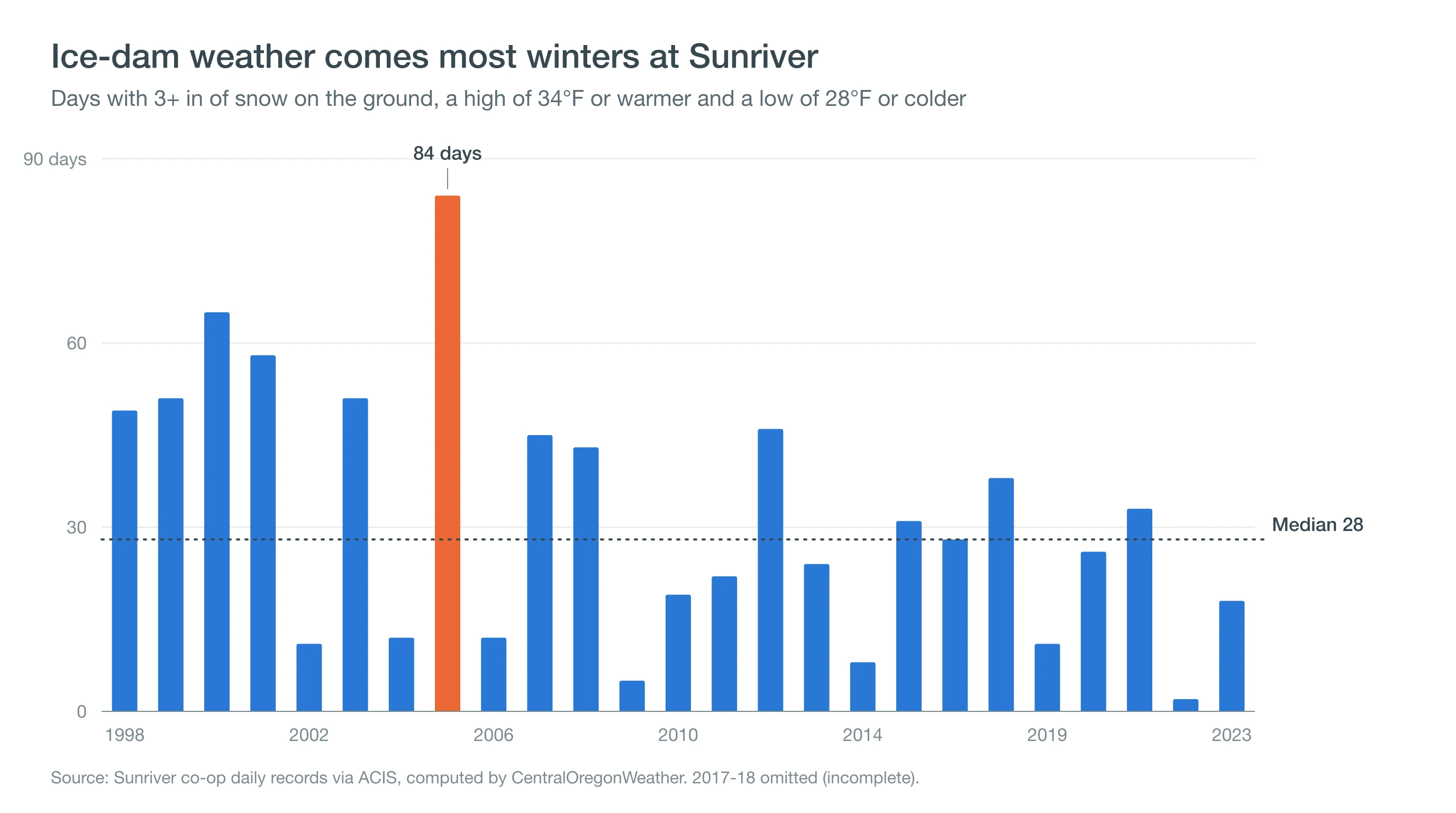
Central Oregon gets ice dams because its winters combine lasting snow cover, strong sunshine at elevation and hard freezes almost every night. The higher, colder towns run the cycle most. We counted days that fit the ice-dam recipe: at least 3 inches of snow on the ground, a high of 34°F or warmer and a low of 28°F or colder.
| Station | Elevation | Median freeze-thaw days with snow, per winter | Range | January days with snow on the ground |
|---|---|---|---|---|
| Wickiup Dam (near La Pine) | 4,359 ft | About 40 | 8-85 | 26.3 |
| Sunriver | 4,158 ft | About 28 | 2-84 | 25.6 |
| Bend | 3,660 ft | Not computed (record gaps) | 9.0 | |
| Redmond Airport | 3,049 ft | Not computed | 4.3 |
Computed by CentralOregonWeather from NOAA co-op and airport daily records. Freeze-thaw days with snow: 3 inches or more of snow on the ground, a high of at least 34°F and a low of 28°F or colder. Sunriver 1998-99 to 2023-24; Wickiup Dam 1990-91 to 2023-24. January snow-cover days (1 inch or more) are 1991-2020 averages. Bend's snow-depth record has too many gaps to count freeze-thaw days reliably.
The basin towns stand out. Sunriver and the La Pine area keep snow on the ground for most of December, January and February, so every sunny thaw has snow to melt and every cold night refreezes it. Bend usually loses its town snow within days, which limits the cycle, though west-side neighborhoods hold snow longer. Our guides to La Pine weather, Sunriver weather and big day-to-night swings explain why. The worst years combine ice with sheer weight.
What Happened in the January 2017 Snowstorms?
A series of storms in early January 2017 buried Central Oregon under some of its deepest snow in decades. The National Weather Service recorded 24 inches on the ground at Bend Public Works on January 11, breaking the date's previous record of 16 inches from 1993. The Sunriver weather station measured 44 inches on the ground that day, and Sisters 35 inches the next.
The weight was the main problem. On January 12, the gym roof at Highland Magnet at Kenwood School in Bend collapsed with no one inside, and Bend-La Pine Schools closed for district-wide roof inspections. Other roofs were damaged around Bend, and on January 18 much of the roof of a former grocery store on Century Drive came down. Snow load and ice dams are different problems, but heavy winters bring both: the deeper the snow, the more there is to melt and refreeze at the eaves. See how much snow Bend gets winter by winter. Prevention is mostly about the attic, not the roof.
How Can You Prevent Ice Dams?
The most effective way to prevent ice dams is to keep the roof deck cold, so snow does not melt from below. University extension services and building-science guides recommend three steps, in this order:
- Air-seal the ceiling. Much of the heat that reaches an attic leaks through gaps around light fixtures, attic hatches, plumbing and chimneys. Sealing them stops warm, moist air from reaching the roof deck.
- Insulate the attic floor. Enough insulation keeps the living-space heat where it belongs.
- Ventilate the attic. Soffit and ridge vents let cold outside air flow under the roof deck, keeping it close to outdoor temperature.
After a big storm, pulling snow off the lower few feet of the roof with a long-handled roof rake, while standing safely on the ground, removes the snow that would feed an ice dam. Heat cables can help in trouble spots but must be installed to the manufacturer's instructions and local code. A qualified energy auditor or contractor can find where a particular house leaks heat. And if an ice dam has already formed?
What Should You Do If You Already Have an Ice Dam?
Put safety first. Do not climb onto an icy, snow-covered roof, and do not chop at the ice with axes or hammers, which can injure you and damage the roof. Professionals usually remove ice dams with low-pressure steam that melts channels through the ice without harming shingles; hire an insured contractor.
Inside, watch for water stains on ceilings and walls near exterior walls, peeling paint or damp insulation in the attic. After unusually heavy storms, ask your city or county building department about snow-load concerns for your building, and contact a structural professional if you notice sagging, cracking or doors that suddenly stick.
Deep Dive: Where Does the Heat That Builds an Ice Dam Come From?
The heat that builds an ice dam comes from below, from a house leaking warmth into its attic, and from above, from sunshine on the roof, while the eave stays out in the cold.
How Does Snow Act as Insulation?
Snow is mostly trapped air, so it conducts heat poorly. Its thermal conductivity ranges from roughly 0.05 to 0.5 watts per meter per kelvin depending on density, according to field measurements such as Sturm and others (1997, Journal of Glaciology), compared with about 2 for solid ice. A foot of snow on a roof works like a blanket over heat leaking from the attic. If the roof deck under the snow climbs above 32°F while the air is in the 20s, the bottom of the snow layer melts.
A quick calculation shows how strong that blanket is. A foot of light snow, about 0.3 meters thick with a conductivity near 0.1, has a thermal resistance of about 3 square-meter kelvins per watt, roughly the same as R-17 in U.S. building terms. That is comparable to about five inches of fiberglass insulation sitting on top of the roof, holding in whatever heat leaks up from the attic.
How Much Can the Sun Add?
Even in December, Bend's noon sun stands about 22° above the horizon. Under a clear high-desert sky, a south-facing roof can receive several hundred watts of sunlight per square meter at midday. Clean snow reflects most of it, but where the snow thins near the edges or slides off, dark shingles absorb most of what arrives and warm well above freezing, starting melt on sunny days.
Why Does the Water Refreeze at the Eave?
The overhang sits outside the heated envelope of the house, so it is as cold as the air around it. Meltwater that reaches it at dusk or overnight freezes, the ridge grows with each freeze-thaw cycle, and water ponds behind it. That is why freeze-thaw days with snow on the ground, about 28 in a typical Sunriver winter and about 40 near La Pine, are the local risk signal.
The count varies enormously from winter to winter. At Sunriver it ranged from 2 days in 2022-23 to 84 in 2005-06, and at Wickiup Dam it reached 85 days in three different winters, 2001-02, 2005-06 and 2007-08. The worst ice-dam winters tend to combine an early, lasting snowpack with long, sunny high-pressure spells, such as a snowy December followed by a dry, bright January.
How Can You Tell When Ice-Dam Weather Is Coming?
Watch for the sequence: a big snowfall, then several sunny days with highs in the 30s or 40s and nights in the teens or 20s. That is when heat meets cold at the eaves. Check the Central Oregon snow forecast and the Sunriver and La Pine forecasts, and clear the lower roof from the ground before the melt starts.