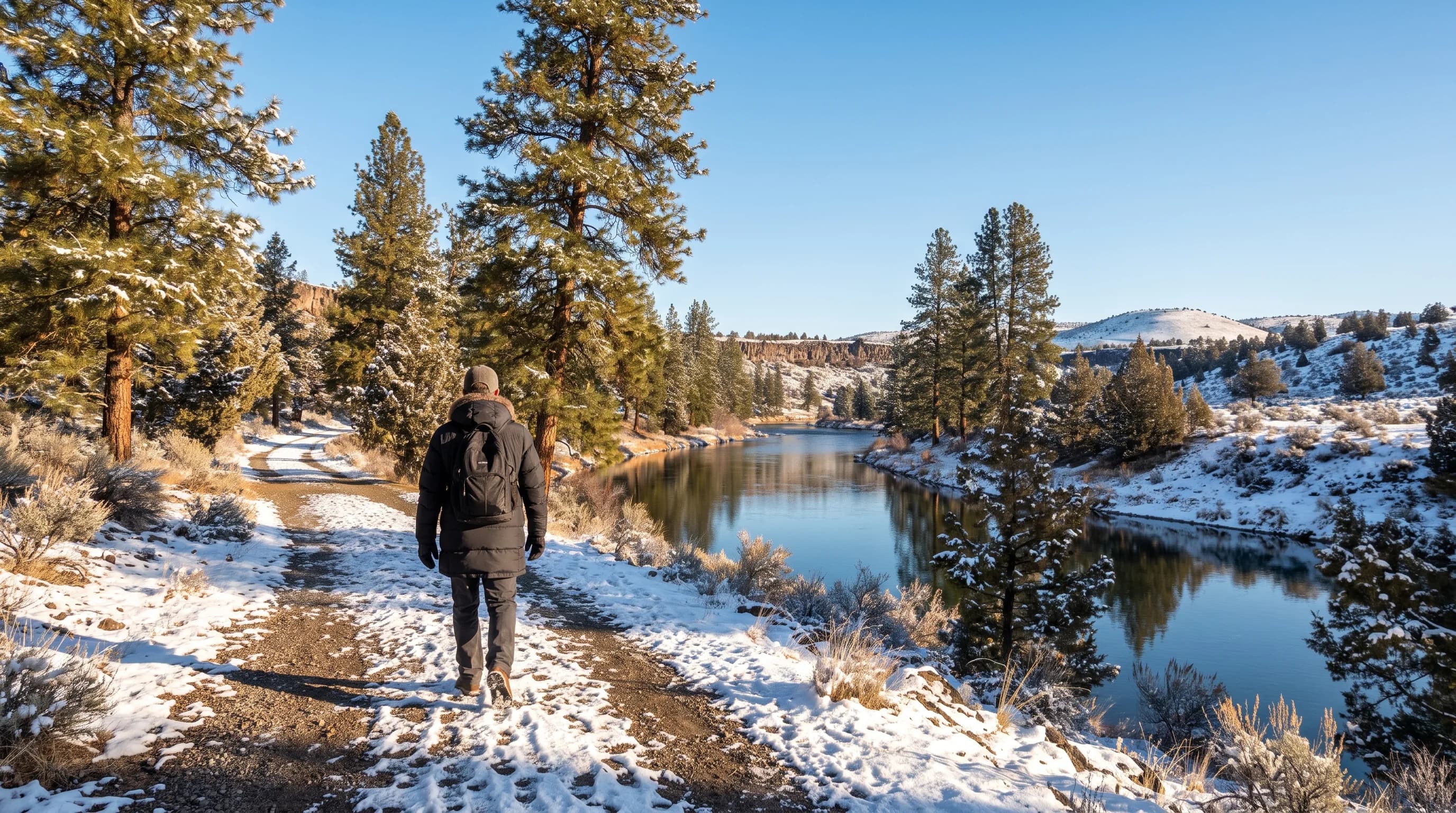
Winters in Bend, Oregon are cold but rarely harsh. NOAA's 1991-2020 normals give December through February highs of 41°F to 46°F and lows near 24°F, with about 17 inches of snow across the three months. Snow usually melts within days in town, while freezing fog and icy mornings are common. Deep, lasting snow is a short drive up the hill at Mt. Bachelor.
People tend to picture a Bend winter as either a snow globe or a sunny desert. In practice, the season swings among three kinds of days: fresh-snow days, bright cold days and gray inversion days. Knowing which kind is coming is most of the trick to enjoying the season.
What Are Winters Like in Bend, Oregon?
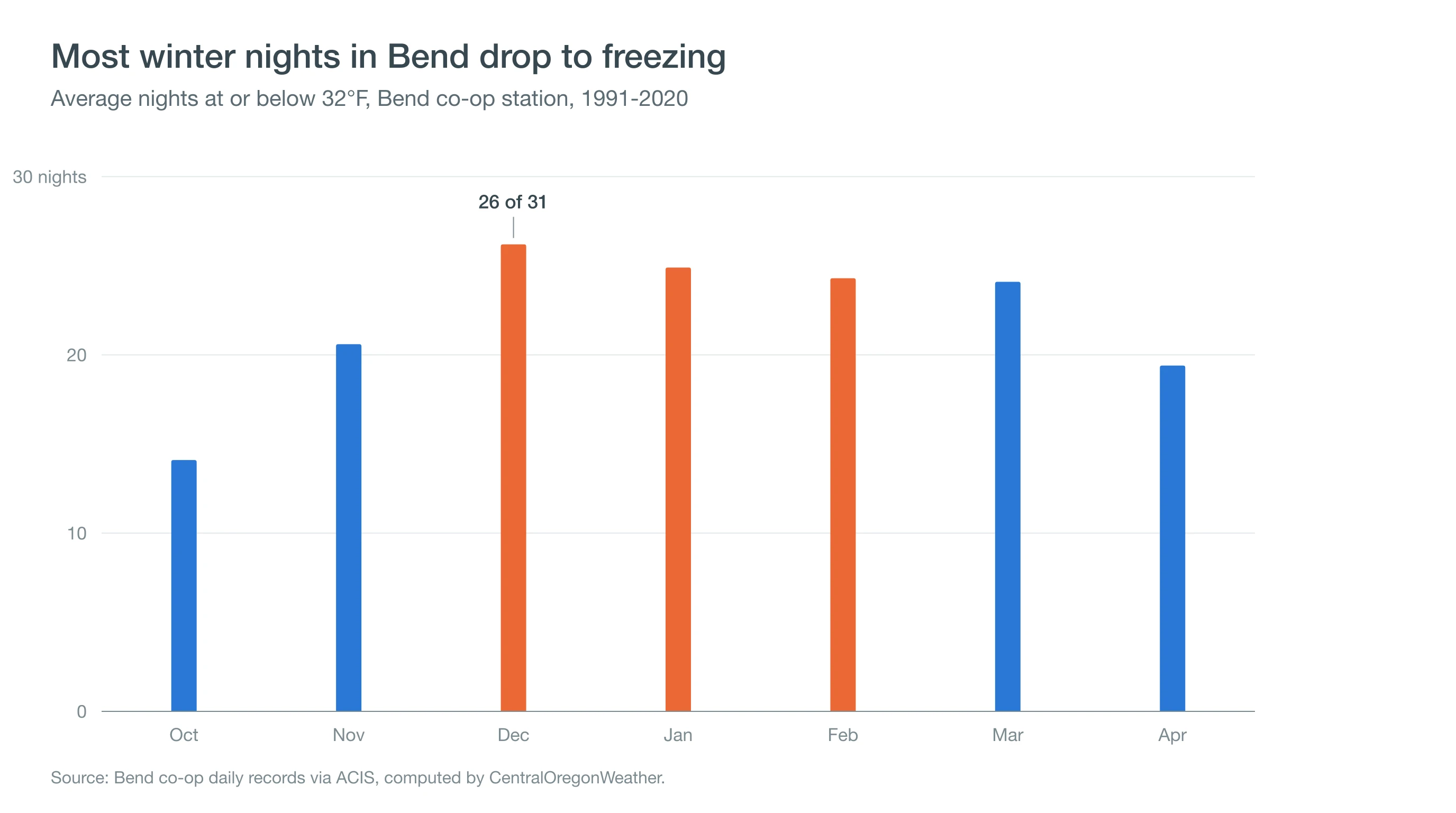
A typical Bend winter day starts in the 20s and warms into the low 40s. The temperature drops to freezing or below on about 75 of the 90 nights from December through February, yet the high stays below freezing on only about 12 days. That combination, cold nights and mild afternoons, is the signature of the high desert.
| December | January | February | |
|---|---|---|---|
| Average high | 41.0°F | 42.5°F | 45.7°F |
| Average low | 23.3°F | 24.6°F | 24.3°F |
| Snowfall | 5.3 in | 6.4 in | 5.5 in |
| Nights at or below 32°F | 26 | 25 | 24 |
| Days that stay below 32°F | 4.7 | 4.5 | 2.4 |
| Days with snow on the ground | 8.3 | 9.0 | 5.6 |
| Freezing-fog days (Redmond Airport) | 4.6 | 3.8 | 2.2 |
Temperatures and snowfall are NOAA 1991-2020 normals for the Bend co-op station. Day counts are computed by CentralOregonWeather from the station's daily records, 1991-2020. Freezing-fog days are days with at least one freezing-fog report at Redmond Airport, 2000-2025.
December is the coldest month, by a hair over January. February brings slightly longer days and the first hints of spring warmth, though snow is just as likely as in December. The first kind of day, the one most visitors hope for, is the snow day.
How Often Does It Snow in Bend in Winter?
Bend gets about 17 inches of snow from December through February in an average year, and about 22 inches over the whole season. It falls on a handful of storm days, and snow covers the ground on only about 23 days of an average winter in town, because the sun and mild afternoons melt it between storms.
Winters vary enormously. The January 2017 storms left about two feet on the ground in Bend, while winter 2025-26 brought only 3 to 5 inches to several Bend gauges. The west side of town, closer to the mountains and a few hundred feet higher, usually gets noticeably more snow than the east side. Our guide to how much snow Bend gets has the winter-by-winter totals, and does it snow in Bend covers driving on snow days. Between storms come the bright, cold days.
Not every winter storm is a snow storm. December is Bend's wettest month, with 2.07 inches of precipitation on average, but when a mild Pacific storm pushes the snow level above town, that water arrives as rain or slush while the mountains get the snow. Measurable precipitation falls on about 8 to 9 days a month in winter, so even a snowy month has more dry days than wet ones.
How Cold Does Bend Get in Winter?
Bend's winter nights average in the low to mid 20s, and a few mornings each winter fall to 10°F or lower. On average, about 1.6 mornings per winter reach 0°F or below in town, and colder basins such as Sunriver and La Pine see more: Sunriver's December low averages 19.0°F, and it averages about two subzero mornings that month. Afternoons, though, usually climb above freezing, and on sunny days the strong high-elevation sun makes 40°F feel milder than it would in a damp climate.
Bright cold days are when Bend's day-to-night swing shows best: a 20°F morning can turn into a 45°F afternoon. Wind matters more than the thermometer on breezy days; our explainer on wind chill shows how much colder it feels. The guide to day-to-night swings explains why the high desert cools so fast after sunset.
Why Are Some Winter Days Gray, Foggy and Icy?
Some winter days are gray because cold air gets trapped near the ground under a layer of warmer air, an inversion, and fog or low cloud forms in the trapped layer. Inversions can hang on for days in December and January, keeping Bend in the 20s and 30s under a gray lid while the buttes and mountains bask in sunshine.
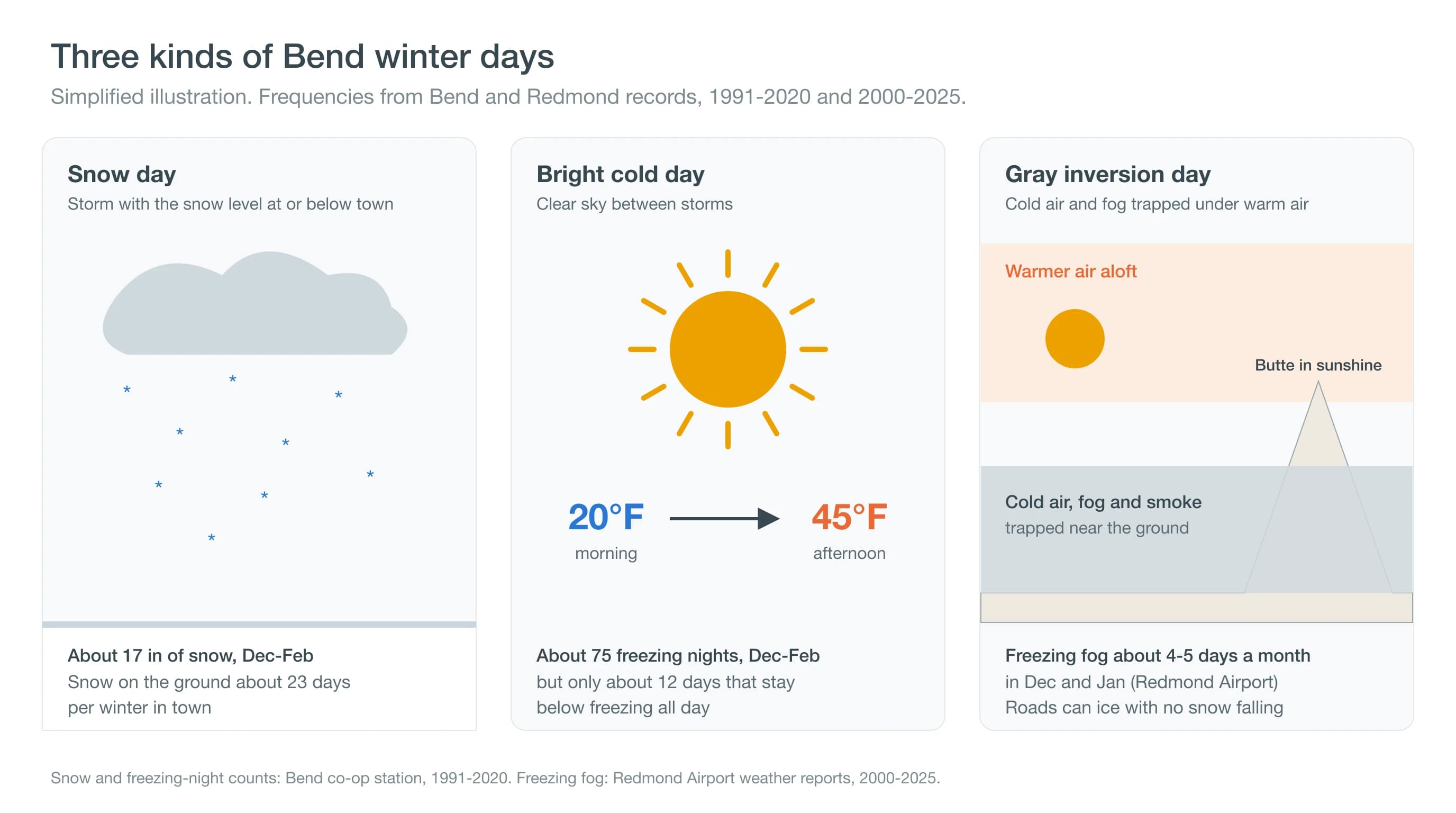
These are the days of freezing fog, when supercooled fog droplets freeze on contact with roads, cars and trees. Redmond Airport reports freezing fog on about 4 to 5 days in an average December and January, and roads can glaze with no precipitation at all. Wood smoke and exhaust also collect under the lid, which is why winter air quality can dip on inversion days. Read more about inversions in Central Oregon and freezing fog.
What Should You Do in Bend on Each Kind of Winter Day?
Match the plan to the day. Locals do not fight the weather; they move to where it is better.
- Snow days: head uphill. Mt. Bachelor and Hoodoo have lift-served snow once they open, and the Sno-Parks along the Cascade Lakes Highway, such as Virginia Meissner, are within about 30 minutes for snowshoeing and cross-country skiing. See when Mt. Bachelor opens.
- Bright cold days: stay low and get outside in the afternoon. Pilot Butte, the Deschutes River Trail, Shevlin Park and Smith Rock are often dry enough to walk when the mountains are buried.
- Inversion days: climb out of the gray. A drive up the Cascade Lakes Highway often breaks into sunshine above the fog, and even the summit of Pilot Butte, nearly 500 feet above the city, can sit above the murk.
Plan for short days whichever kind you get. At the winter solstice, Bend has about 8 hours and 53 minutes of daylight, and the sun sets around 4:30 p.m. in mid-December.
What Should You Pack for a Winter Trip to Bend?
Pack for a swing of 20°F or more in a single day. Bring a warm insulated jacket for mornings and evenings, layers you can shed by afternoon, a hat and gloves, and waterproof boots with good tread for icy sidewalks. Sunglasses and sunscreen matter more than visitors expect, because snow reflects the strong high-elevation sun. For walking on icy trails in town, slip-on traction cleats are worth the space in your bag.
If you are driving, carry chains or use traction tires, especially for trips over the Cascade passes or up to the ski area. Our guide to Cascade passes in winter covers the rules, and what to pack for Bend by month has a full checklist.
Deep Dive: Why Does Bend Get Stuck Under Gray Inversions?
Bend gets stuck under inversions because the winter sun is too weak to stir the air, while long, clear nights let the ground cool the air above it. Once a lid of warm air forms, it can take a storm to remove it.
How Weak Is the December Sun?
At the winter solstice, Bend's noon sun stands only about 22.5° above the horizon: 90° minus Bend's latitude of 44.06° minus Earth's 23.44° tilt. Sunlight arriving at that low angle spreads over more than twice the ground area it would cover at the June noon angle of about 69°, and the day lasts under nine hours. Snow reflects most of what does arrive. The ground simply cannot heat the air enough to start the rising currents that mix the lower atmosphere on a summer afternoon.
How Does an Inversion Lock In?
On long, clear, calm nights, the ground radiates heat to space and chills the air touching it. That cold, dense air drains downhill into low ground and settles beneath warmer air above, the reverse of the normal pattern in which air cools with height. If fog or low cloud forms in the cold layer, it reflects the little sunlight that reaches it, so the layer stays cold the next day too. A high-pressure ridge overhead, which brings sinking, warming air aloft, can hold the lid in place for days until a Pacific storm or strong wind mixes it out.
Why Is It Sometimes Sunnier and Warmer on the Buttes?
The top of an inversion may sit only a few hundred feet above town. Higher ground, such as Pilot Butte, Awbrey Butte or the west-side hills, can poke through into sunshine and air that is warmer than the valley floor, a reversal of the usual rule that higher means colder. The trapped layer also traps whatever is emitted into it, from wood stoves to tailpipes, which is why air quality can drop on the grayest days.
How Can You Tell Which Kind of Day Tomorrow Will Be?
Read the forecast for the three kinds of days. Snow in the forecast with a snow level near or below 3,600 feet means a snow day. A clear, calm forecast after a storm means a bright cold day, or, if it stays calm for several days, the start of an inversion and a freezing-fog morning. Check tomorrow on the Bend destination page and the Central Oregon snow forecast, and plan to go uphill for snow, out for sun, or above the fog.