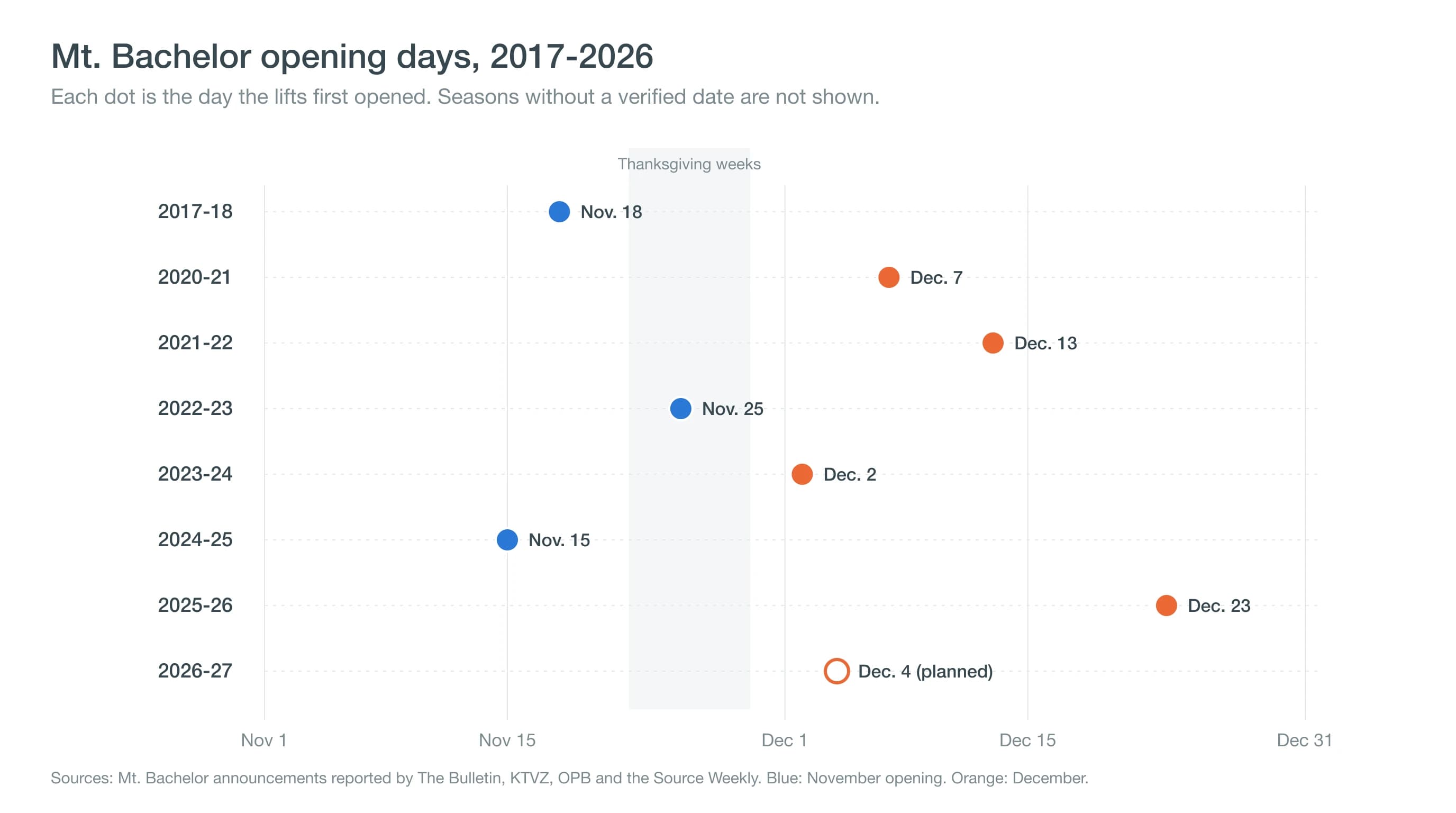
Mt. Bachelor usually opens between mid-November and mid-December, once natural snow builds a base of at least two feet. Since 2017, opening day has ranged from Nov. 15, 2024 to Dec. 23, 2025. The resort has set Dec. 4 as its planned opening for the 2026-27 season and says the date can move earlier or later with the snow.
Opening day is a snow-depth question, not a calendar question. A snow sensor 18 miles southwest of the mountain shows it plainly: in most recent seasons, Mt. Bachelor opened within a couple of days of the moment that sensor first measured two feet of snow on the ground.
When Does Mt. Bachelor Usually Open?
Mt. Bachelor usually opens between mid-November and mid-December. Of the seven recent seasons with verified opening dates, three opened in November and four waited until December. The earliest was Nov. 15, 2024, the resort's earliest start since 1998; the latest was Dec. 23, 2025, after the weakest early-season snowpack in decades.
In September 2026, Mt. Bachelor announced Dec. 4 as this season's planned opening, citing about 18 inches of snow that had already fallen on the mountain in early September. Resort president John Merriman told The Bulletin that the mountain needs at least two feet of snow on the ground plus a forecast of more snow or below-freezing temperatures before it can open. That rule explains almost every date in the table below.
| Season | Opening day | First 24 in of snow at Irish Taylor | Note |
|---|---|---|---|
| 2017-18 | Nov. 18 | Nov. 16 | Earliest opening in a decade |
| 2020-21 | Dec. 7 | Nov. 14 | Opened under a scaled-back operating plan |
| 2021-22 | Dec. 13 | Dec. 12 | Dry, mild start to winter |
| 2022-23 | Nov. 25 | No sensor data | Opened the day after Thanksgiving |
| 2023-24 | Dec. 2 | Dec. 2 | Delayed from a planned Nov. 24 opening |
| 2024-25 | Nov. 15 | Nov. 17 | Earliest opening since 1998 (pass holders first) |
| 2025-26 | Dec. 23 | Jan. 7 | Record-low snowpack |
| 2026-27 | Dec. 4 (planned) | To come | Announced in September; can move with snow |
Opening dates from Mt. Bachelor announcements as reported by The Bulletin, KTVZ, OPB and the Source Weekly. Snow depth from the NRCS Irish Taylor SNOTEL site (5,540 feet, about 18 miles southwest of the mountain). Seasons without a verified published opening date are not shown.
How Much Snow Does Mt. Bachelor Need to Open?
Mt. Bachelor needs at least two feet of snow on the ground, by the resort's own rule, plus a forecast that will keep that snow in place. The two-foot figure is not a ski-industry constant. It is enough snow to cover rocks and stumps on groomed runs once the snow settles and grooming machines pack it.
You can watch for that threshold from home. The Irish Taylor snow sensor, run by the federal Natural Resources Conservation Service, sits at 5,540 feet, about 800 feet below Mt. Bachelor's main base. Its snow depth is a good stand-in for what is building on the lower mountain.
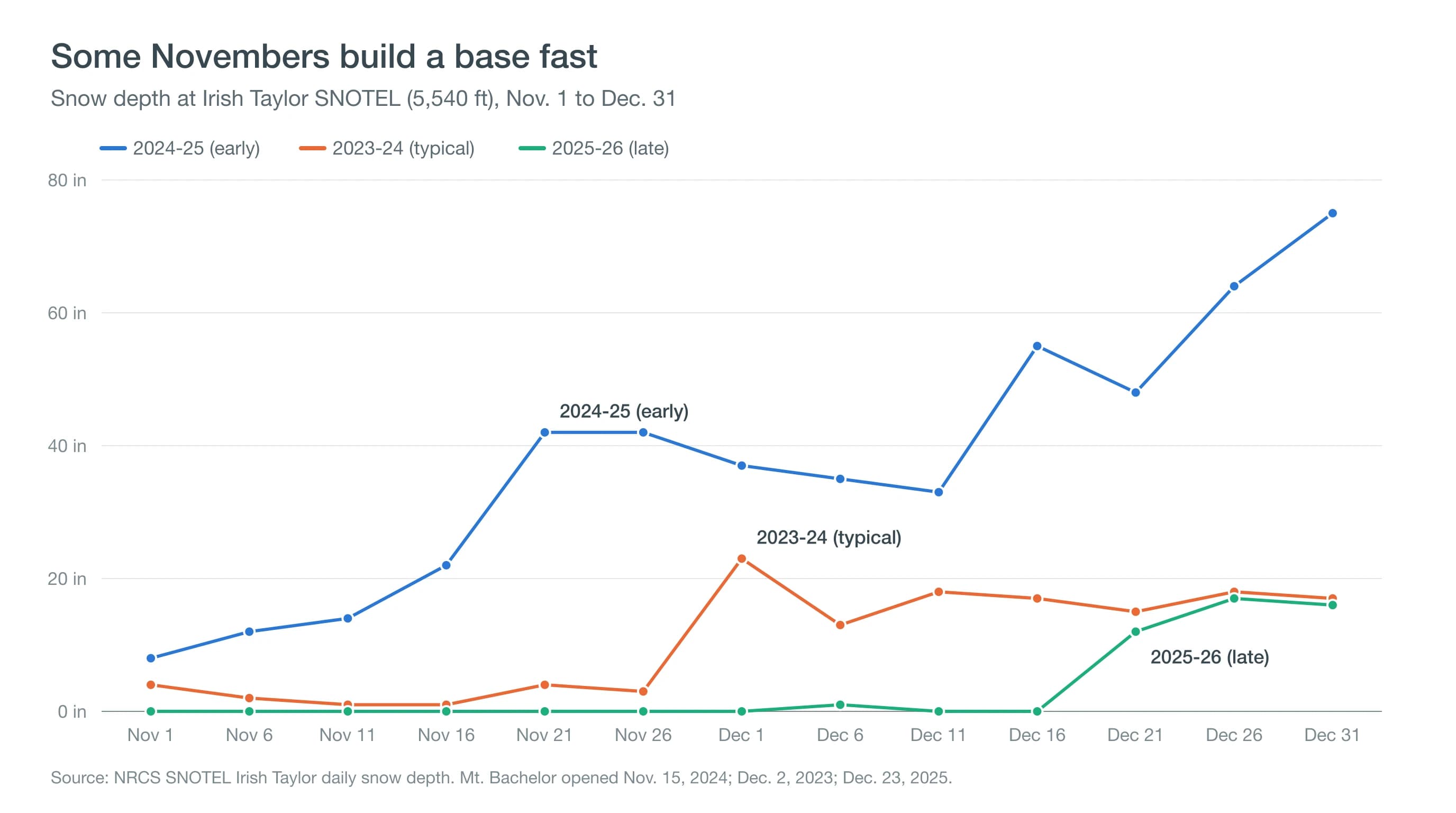
Two seasons broke the pattern, and both are instructive. In 2020, the sensor reached two feet on Nov. 14 but the mountain did not open until Dec. 7, under a scaled-back operating plan that season. In 2025, the opposite happened: the resort opened on Dec. 23 with only about 10 inches at the sensor, because the higher terrain on the mountain itself had enough snow while the lower sensor did not. Snow depth sets the floor, but the mountain and the people running it make the call. The NRCS snow and water map posts these sensor readings daily.
Why Do Some Seasons Open Late?
Seasons open late when November storms run warm, run dry, or both. A warm storm can bring rain or heavy wet snow to the base area at 6,300 feet while the summit gets powder, and rain on a thin early snowpack melts it down. A dry November simply never delivers the two feet. The snow level is usually the deciding number: when it hovers above the base, storms add water but not depth.
The 2025-26 season is the extreme case. Mild, wet storms through November and December fell as rain on the lower mountain, and the resort ended the season with about 140 inches of snow, which Merriman called the lowest total in 50 years against a typical season of more than 400 inches. The 2023-24 season shows the milder version: a low November snowpack pushed a planned Nov. 24 opening to Dec. 2, when a series of storms finally added the last foot the mountain needed. For the same storm dynamics closer to town, see why it can rain in Bend but snow at Mt. Bachelor.
What Could El Niño and Last Winter's Snow Drought Mean for 2026-27?
Neither one sets the opening date. A very strong El Niño is developing for winter 2026-27, but past strong El Niño winters produced both good and poor seasons near Mt. Bachelor. At Irish Taylor, April 1 snowpack was 123% of the median after the 1982-83 event, 37% after 1991-92, 88% after 1997-98, 81% after 2009-10, 107% after 2015-16 and 119% after 2023-24. El Niño shifts the odds toward a milder winter; it does not decide whether November storms come in cold.
Last winter's snow drought does not carry over either. Snow does not accumulate from one season to the next at Mt. Bachelor's elevation, so the 2026-27 opening depends entirely on this autumn's storms. The early September snow that prompted the Dec. 4 target rarely lasts at that time of year; it signaled an active pattern, not a head start on the base. Our El Niño outlook for Central Oregon covers the seasonal picture in detail.
How Can You Tell When Opening Day Is Close?
Opening day is close when cold storms start stacking up back to back. Three signs matter most:
- Snow levels below about 5,000 feet. When forecasts put the snow level below the base area, every storm adds depth instead of slush.
- Irish Taylor near two feet. NRCS posts the sensor's snow depth daily. Once it passes 20 inches with more storms coming, opening is usually days away.
- No warm rain in the forecast. A single atmospheric river with a high snow level can erase a week of progress.
The resort announces its date as the snow arrives, so its own announcements are the final word. Our Central Oregon snow forecast shows expected totals and snow levels for the mountain over the next several days.
What Is Early-Season Weather Like at Mt. Bachelor?
Early-season weather at Mt. Bachelor is cold, windy and changeable. The summit, at about 9,065 feet, sits above treeline and takes the full force of Pacific storms, so upper lifts often stay closed in high wind and the summit is often among the last terrain to open. Fog and rime ice coat lift towers and trees during storms, and visibility on the open upper slopes can drop to almost nothing.
Cover is thin at first. Opening day typically runs a few lifts on lower and mid-mountain terrain, with rocks and stumps still close to the surface off the groomed runs. Driving matters too: the Cascade Lakes Highway is plowed to the ski area, but storms that build the base also bring snow and ice to the road. Our Mt. Bachelor weather guide explains base-to-summit differences once the season is underway.
Deep Dive: How Does Fluffy Snow Become a Skiable Base?
A skiable base forms when new snow settles, bonds and packs into a dense layer that can bear weight. Depth alone overstates it: two feet of fresh powder can shrink to a few inches of firm snow within days.
Why Does New Snow Shrink?
Freshly fallen snow is mostly air. Typical new snow is only about 5% to 15% ice by volume. As soon as it lands, the delicate branches of each crystal begin to round off, because water molecules move from sharp points, where they evaporate more easily, to hollows, where they deposit. Neighboring grains fuse at their contact points, a process called sintering, and the weight of later storms compresses everything below. A foot of light powder often settles by a third or more within a day or two of a storm.
How Dense Is the Early-Season Snowpack Near Mt. Bachelor?
Dividing a snow sensor's water content by its depth gives the snowpack's bulk density. At Irish Taylor, the median density is about 26% water on Dec. 1, 30% on Jan. 1 and 36% by April 1, based on 2007-2025 days with at least 6 inches of snow on the ground. In other words, by the time a December base forms, it is roughly two to five times denser than the snow that fell. That density, not just depth, is what lets a groomed run hold up under thousands of skiers.
Can Rain Help or Hurt an Early Base?
Both. A light rain or a brief thaw followed by a hard freeze can bind the snowpack into a strong crust that grooming machines can build on. Heavy rain does the opposite: liquid water percolates through thin snow, carries heat with it and melts the pack from within, and on a shallow base it can open bare patches in a single storm. That is why a warm atmospheric river in November is the classic cause of a late opening, even when the storm delivers plenty of water.
So When Will Mt. Bachelor Open This Season?
Mt. Bachelor plans to open Dec. 4, 2026, and history says the real date will follow the snow. If cold storms build two feet of snow at the mountain early, the date can move up; if November runs warm, it can slide toward mid-December. Watch snow levels and storm totals on the Central Oregon snow forecast, check current conditions on the Mt. Bachelor destination page, and rely on the resort's own announcement for the final date. Once the lifts are spinning, the drive up is the next challenge; our guide to Cascade passes in winter covers chains and road checks.