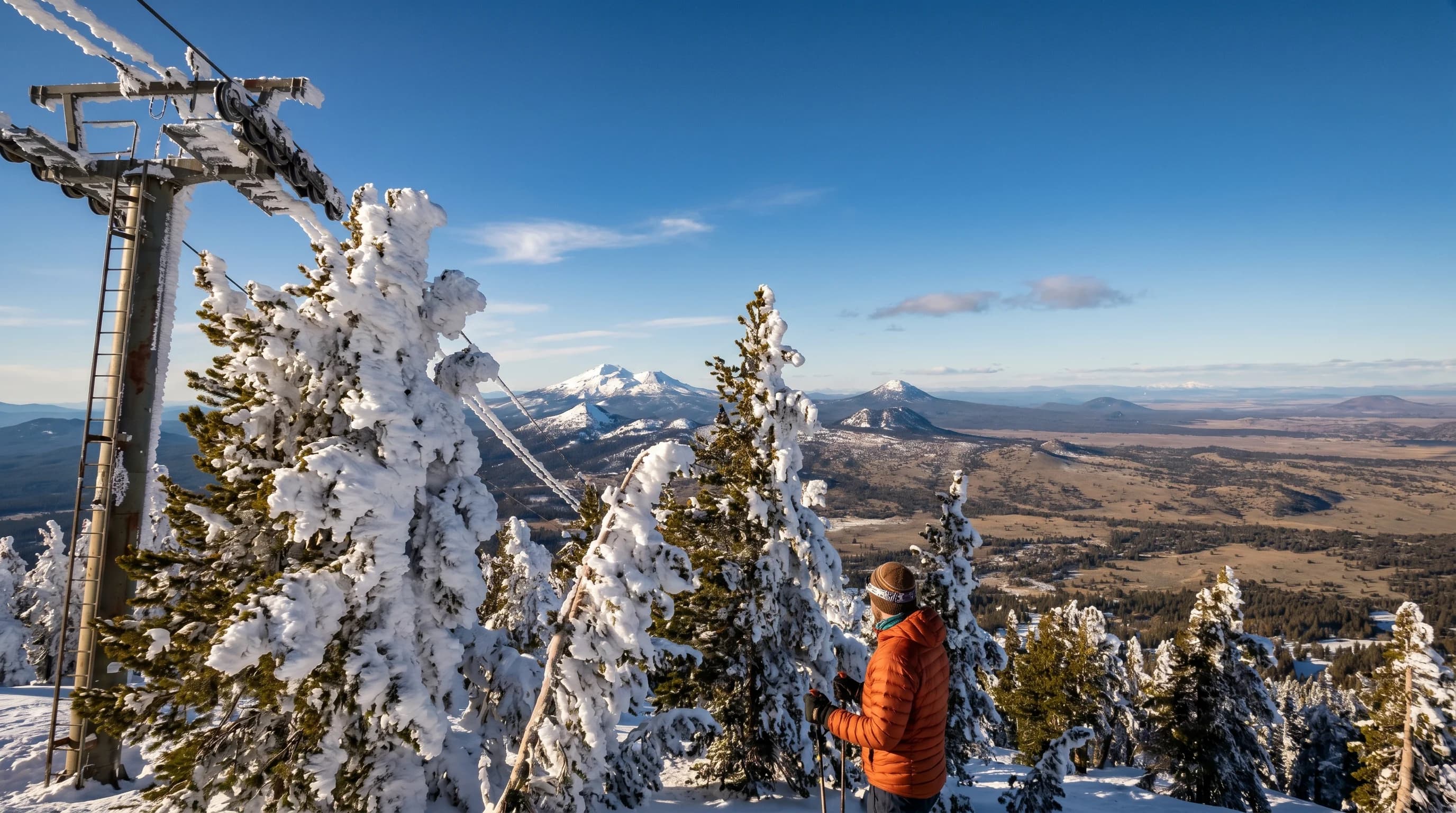
Rime ice is the rough, white, opaque coating that builds up on trees, fences, lift towers, and signs during freezing fog, growing into the wind on the windward side of everything it touches. It forms when supercooled fog droplets, liquid water that is colder than freezing but has not yet turned to ice, freeze the instant they hit a cold surface. Rime is the frozen fingerprint of freezing fog, and in Central Oregon it is a signature of cold, foggy mornings in the basins and a dramatic feature of the high Cascades around Mt. Bachelor.
What Is Rime Ice?
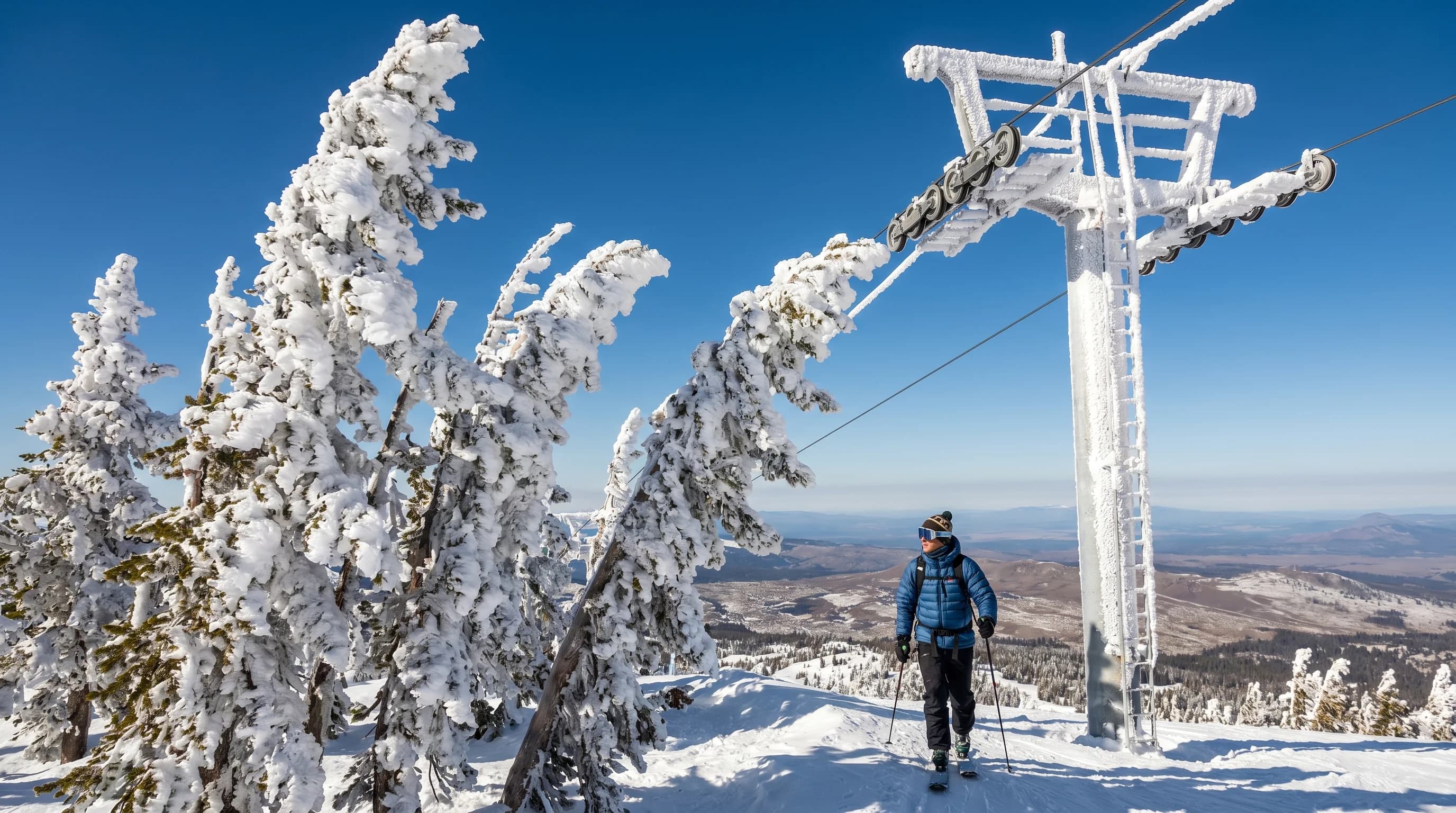
Rime ice is a deposit of frozen fog droplets, and its texture sets it apart from other winter ice. It is rough, white, and opaque, full of trapped air, and it accumulates as a crusty, sometimes feathery buildup rather than a smooth glaze. Because it grows where the wind drives the droplets, it piles up on the windward side of objects, often forming long, comb-like extensions pointing into the wind. On a cold, foggy ridge, every branch, wire, and post can end up coated and one-sided, giving the whole landscape a frosted, sculpted look.
Meteorologists distinguish soft rime and hard rime. Soft rime forms in light wind and is feathery, fragile, and easily brushed off. Hard rime forms in stronger wind and colder, denser conditions, building a tougher, more granular coating that clings hard to surfaces. Both come from the same basic process, supercooled droplets freezing on contact, but the wind and temperature at the time decide which texture you get.
How Does Rime Ice Form?
Rime ice forms when freezing fog, which is made of supercooled water droplets, drifts against a surface that is at or below freezing, and the droplets freeze on impact one after another. Supercooling is the key: tiny, pure water droplets can remain liquid well below 32 degrees because they lack the surface they need to start freezing. When they finally touch a solid object, they freeze almost instantly, and because each droplet freezes the moment it lands, the ice traps air and builds outward as a rough, white crust rather than a clear sheet.
Wind drives the whole process, which is why rime is so distinctly one-sided. The droplets are carried by the wind, so they strike and freeze onto the upwind face of objects, and the rime grows steadily into the wind as more fog blows through. The longer and thicker the freezing fog, and the stronger the wind, the heavier the buildup, which is how lift towers and summit trees can disappear under inches of rime. Rime is, in effect, freezing fog made visible and solid, which is why it always accompanies a freezing-fog event.
Temperature shapes the result as much as wind. The colder the droplets and the faster they freeze, the more air gets trapped and the whiter and more brittle the rime, while slightly warmer conditions let droplets spread a little before freezing, producing a denser, harder coating. This is the same family of process that meteorologists and pilots call icing, and it is why rime is studied closely in aviation: the rate of buildup depends on the fog's droplet size, the wind speed, and the temperature, all of which can change quickly as fog thickens or a ridge cools through the night.
What Is the Difference Between Rime Ice and Hoar Frost?
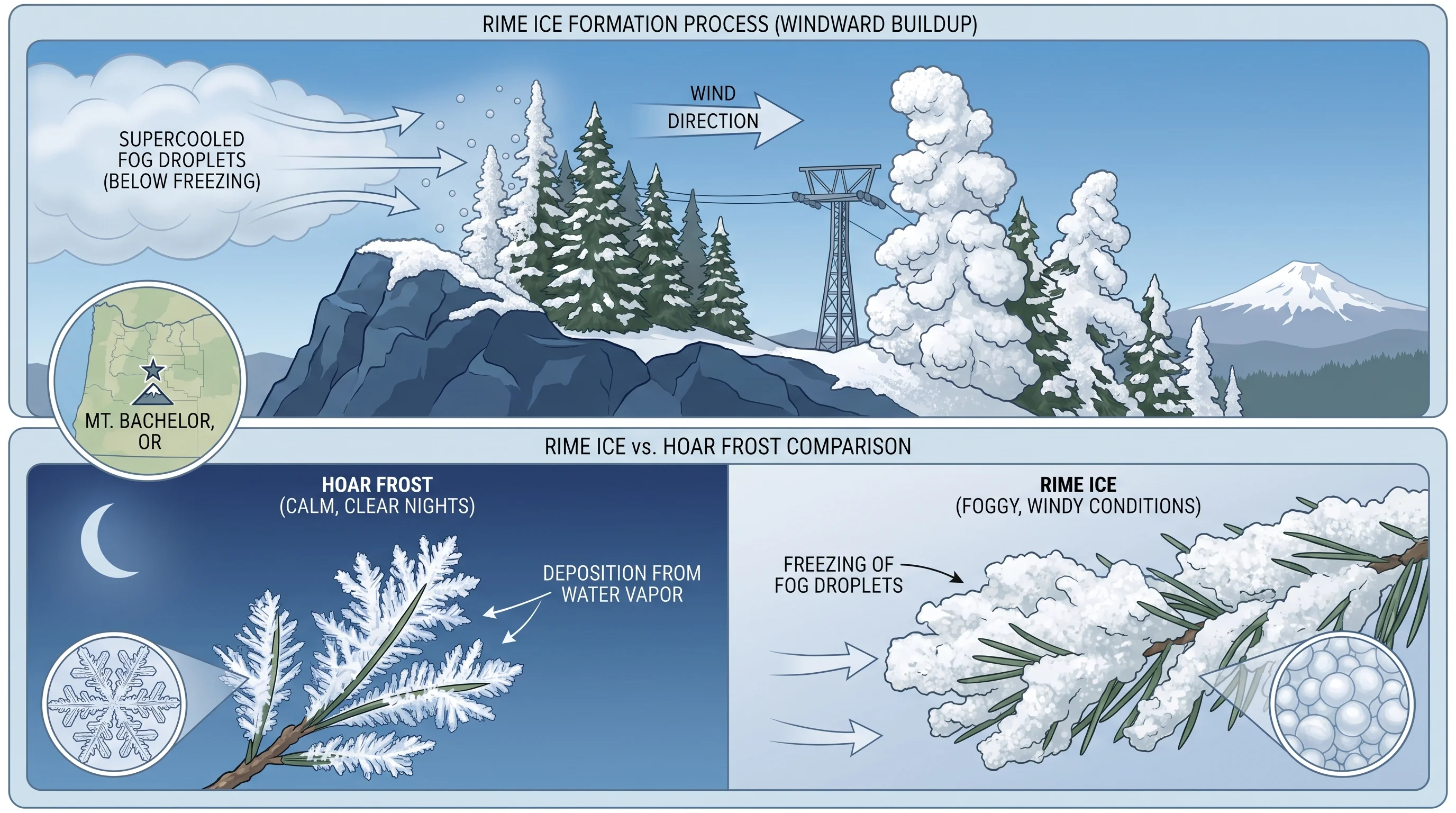
Rime ice and hoar frost are easy to confuse, but they form in opposite ways. Rime comes from supercooled liquid fog droplets freezing on contact, so it needs fog and it builds rough and one-sided into the wind. Hoar frost comes from water vapor depositing directly as ice on a clear, calm night, with no fog and no liquid stage, so it grows as delicate, evenly distributed, feathery crystals.
The practical test is the overnight weather. If there was freezing fog, the coating is rime, and you can usually confirm it by the rough texture and the way it favors the windward side. If the night was clear and calm with no fog, the coating is hoar frost, finer and spread evenly over all surfaces. Both are common in Central Oregon winters, but they tell you different things: rime means the basin or ridge was socked in freezing fog, while hoar frost means it was a clear, still, radiatively cold night.
Where Do You See Rime Ice in Central Oregon?
Rime ice is a signature of cold, foggy mountains, which makes Mt. Bachelor and the high Oregon Cascades classic places to see it at its most dramatic. When freezing fog and cloud envelop the upper mountain, lift towers, signs, and the gnarled whitebark pines near the summit can vanish under thick, wind-sculpted rime, one of the more striking winter sights in the region. Skiers and riders on a foggy day are often moving through a fully rimed world.
Down in the Deschutes Basin, rime appears whenever freezing fog settles over Bend, Redmond, and the surrounding high desert on cold winter mornings. Junipers, fences, and grasses take on the same rough white coating, and the rimed landscape can persist until the fog lifts and the sun finally warms things above freezing. Wherever you see it, rime is a reliable sign that supercooled fog has been hanging in the cold air.
Is Rime Ice Dangerous?
Rime ice is a hazard in several ways, even though the coating itself is just frozen fog. Heavy rime adds significant weight to branches and power lines and can snap them, and it is a serious concern for aviation, where ice accreting on wings and surfaces changes how an aircraft flies. Wind turbines and other exposed equipment have to manage it too. The buildup can be surprisingly fast and substantial during a long freezing-fog event.
For most people, though, the real danger is on the road, and it comes from the same freezing fog that makes the rime. While rime is coating the junipers, those supercooled droplets are also freezing onto the pavement as a clear glaze, producing black ice that is far harder to see than the white rime on the trees. So when you notice rime building on surfaces, take it as a clear warning that the roads may be icing too, and drive accordingly. The pretty white coating on the branches is the visible half of a hazard whose dangerous half is invisible underfoot.