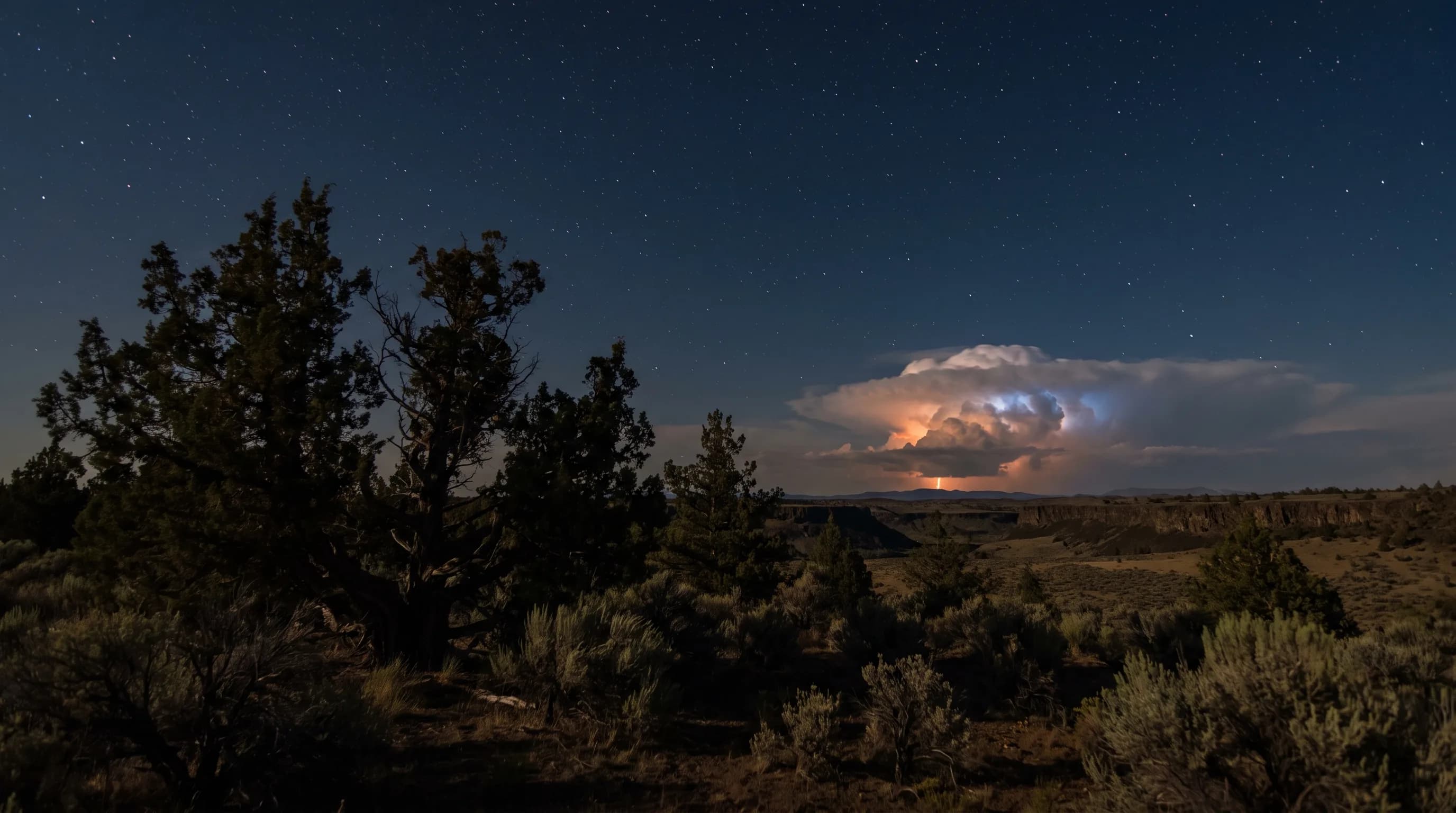
Heat lightning is ordinary lightning from a thunderstorm too far away for its thunder to be heard. Thunder rarely carries more than about 10 miles, but lightning can be seen from much farther on a clear night. In Central Oregon, dry air and wide views make distant storms over the Cascades and Ochocos easy to see.
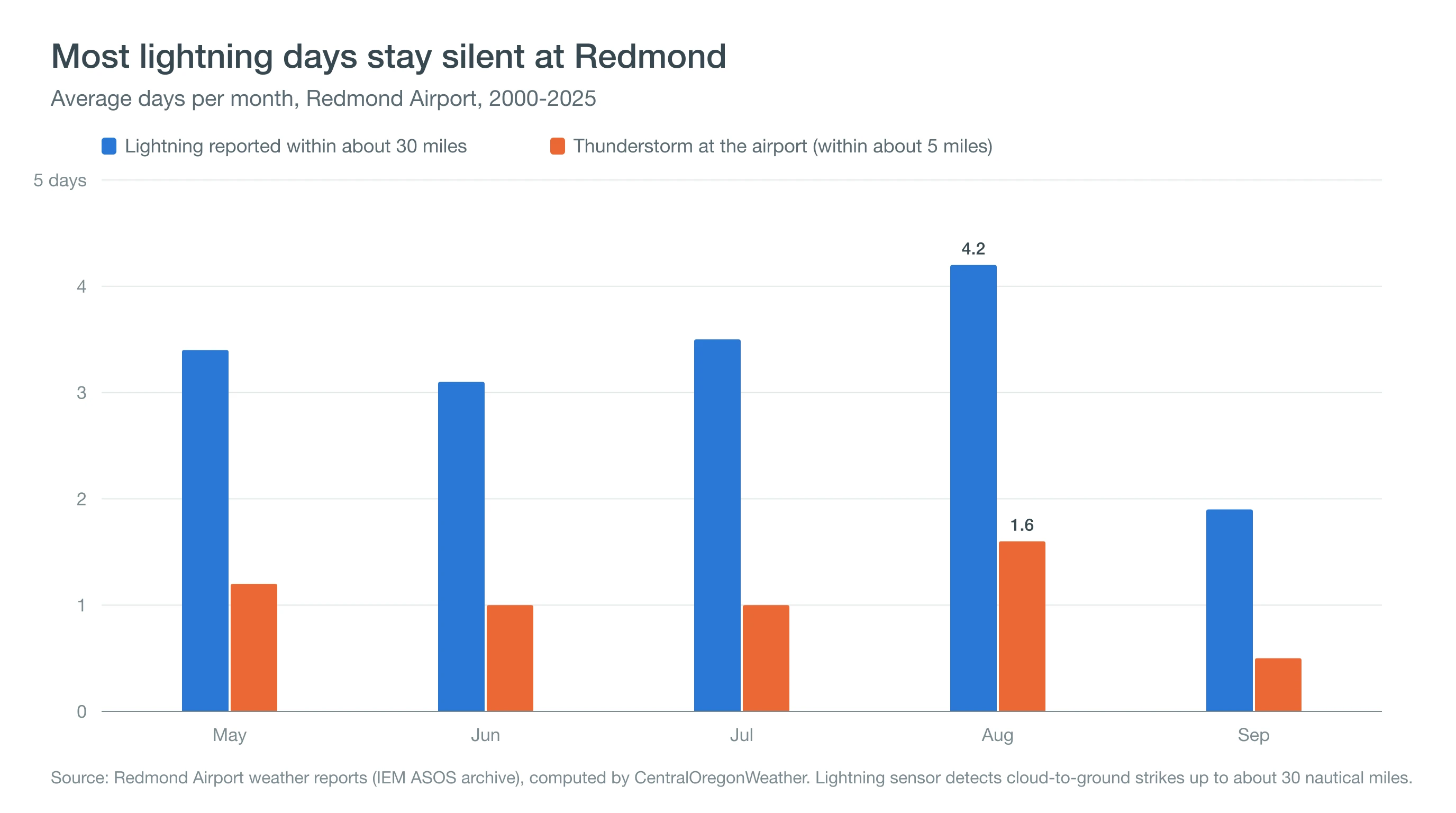
On summer nights in Bend and Redmond, people watch the horizon flicker with no thunder at all and call it heat lightning. Redmond Airport's records show how common those silent storms are: from 2000 to 2025, lightning was detected within about 30 miles of the airport on an average of 4.2 days in August, but a thunderstorm was reported at the airport on only about 1.6. Light travels much farther than sound, and every section of this guide turns on that gap.
Is Heat Lightning Real?
Heat lightning is real lightning with a misleading name. The National Weather Service describes it as lightning from a thunderstorm too far away for its thunder to be heard. There is no special kind of lightning caused by heat; the storm producing it is simply beyond the range of your ears.
If you could stand under that distant storm, you would hear thunder and probably see rain and gusty wind. The name comes from when people usually see it: on warm summer evenings.
What Causes Heat Lightning?
Heat lightning is caused by a thunderstorm that is far away: beyond about 10 miles, and sometimes many tens of miles away. Its flashes, both bolts to the ground and flashes inside and between clouds, light up the cloud tops and the sky above the horizon, while its thunder fades out long before it reaches you.
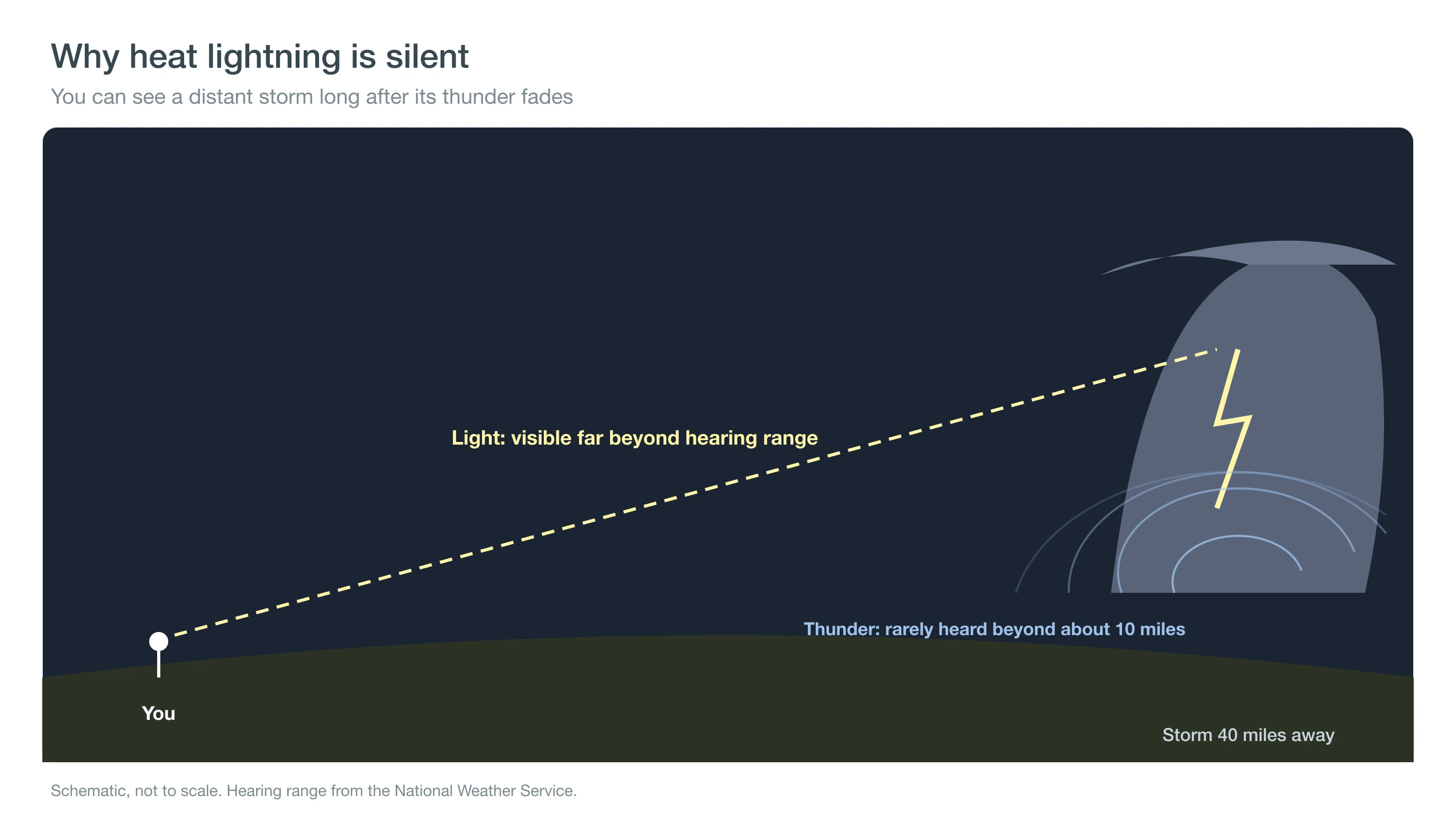
The "heat" part is a coincidence of season. Thunderstorms are most common on hot summer days, and their lightning is easiest to see at night, so people link the silent flashes with warm evenings. The storm itself may be in much cooler air, over the mountains. The high desert gives that sight line an unusual reach.
Why Does Central Oregon See So Much Heat Lightning?
Central Oregon sees a lot of heat lightning because its summer air is dry and clear and its views are long. Storms build over the Cascades and the Ochocos on summer afternoons and often drift or linger into the evening, when people in Bend, Redmond and Prineville can watch them flicker across open country.
| Month | Days with lightning within about 30 miles | Days with a thunderstorm at the airport | Days with lightning at night (9 p.m.-5 a.m.) |
|---|---|---|---|
| May | 3.4 | 1.2 | 0.6 |
| June | 3.1 | 1.0 | 0.7 |
| July | 3.5 | 1.0 | 0.9 |
| August | 4.2 | 1.6 | 1.1 |
| September | 1.9 | 0.5 | 0.4 |
Average days per month at Redmond Airport, 2000-2025, computed by CentralOregonWeather from airport weather reports (IEM ASOS archive). The automated lightning sensor detects cloud-to-ground strikes, reporting "distant" lightning about 10 to 30 nautical miles away and a thunderstorm when strikes come within about 5 miles. It does not count flashes inside clouds, so these numbers understate what people see.
Clear nights help too, the same skies that make summer stargazing so good. In ERA5 model data for 2011-2025, about 78% of July nights near Bend were mostly clear, so there is usually nothing overhead to block the view of a storm on the horizon. See why Central Oregon gets sudden summer thunderstorms. Silent does not mean harmless.
Is Heat Lightning Dangerous?
Heat lightning is not dangerous where you are as long as it stays silent, but the storm producing it is real and can move closer. If you start to hear thunder, you are within striking distance, about 10 miles, and should get indoors or into a hard-topped vehicle. The National Weather Service's rule is "When thunder roars, go indoors," and to wait 30 minutes after the last thunder before going back out.
Distant lightning also matters for fire. Strikes far from you can still start wildfires where they land, especially in dry storms that produce little rain. Many summer fires in Central Oregon begin this way. See lightning safety for hikers and lakes. That fire link is why locals watch the flicker closely.
What Is the Difference Between Heat Lightning and Dry Lightning?
Heat lightning describes distance: lightning too far away for you to hear. Dry lightning describes rain: lightning from a storm whose rain mostly evaporates before reaching the ground. They can be the same storm. A dry thunderstorm over the Ochocos can look like heat lightning from Bend while it starts fires where it strikes.
Dry storms are common in Central Oregon because cloud bases sit high above the dry ground, and rain falling through that air evaporates as virga. The National Weather Service in Pendleton issues red flag warnings when dry lightning is expected. Read why Central Oregon storms can be dry and dangerous, what virga is and red flag warnings. So how do you read a flickering horizon?
How Can You Tell If a Distant Storm Is Coming Your Way?
- Count the thunder: once you hear it, count the seconds from flash to thunder and divide by 5 for the distance in miles. A shrinking count means the storm is approaching.
- Watch radar: the CentralOregonWeather map with radar on shows where storms are and which way they are moving.
- Watch the clouds: flashes lighting the full height of a towering cloud, and a cloud that grows taller or closer, signal an active storm.
- Feel the wind: a sudden cool, gusty wind often arrives ahead of a storm's rain, sometimes carrying the smell of rain, or petrichor.
Deep Dive: Why Does Thunder Fade While the Flash Travels On?
Thunder fades because sound spreads out, gets absorbed and bends upward away from the ground, while light from the flash travels in nearly straight lines limited mainly by the curve of the Earth.
How Far Away Can You See a Storm?
Line of sight to the top of a thunderstorm is limited by Earth's curvature. A handy formula gives the distance in miles as about 1.22 times the square root of the height in feet. A storm top at 40,000 feet is geometrically visible from about 240 miles away, ignoring haze and terrain. Real-world views are shorter, but on clear high-desert nights, flashes inside a distant storm can light up the sky from far beyond the reach of its thunder.
Why Does Thunder Die Out So Quickly?
Thunder spreads out in all directions and loses energy with distance, and the air absorbs its high-pitched crack first, which is why distant thunder rumbles. When temperature falls with height, as it usually does on a warm afternoon, sound travels more slowly in the cooler air above. That bends sound waves upward, away from the ground, leaving a zone at the surface where little thunder arrives. The result, described in lightning references such as Martin Uman's The Lightning Discharge, is that thunder is rarely heard beyond about 10 miles.
Sound is slow by comparison with light. It travels about 1,125 feet per second in warm air, close to 1 mile every 5 seconds, which is where the flash-to-bang rule comes from. Light covers the same distance almost instantly, at about 186,000 miles per second. Even if thunder from a storm 30 miles away could reach you, it would arrive more than two minutes after the flash, long after anyone would connect the two.
What Does the Airport's Lightning Sensor See?
Redmond Airport's automated station receives cloud-to-ground strike data from a lightning detection network. A strike 10 to 30 nautical miles away adds a "distant lightning" remark to the weather report, strikes within 5 to 10 nautical miles a "thunderstorm in the vicinity" remark, and strikes within about 5 nautical miles a thunderstorm report. Because cloud-to-ground strikes 10 to 30 miles away are mostly too far to hear, the gap between the two counts is a fair stand-in for heat lightning, but it misses flashes inside clouds and storms beyond 30 miles, so the true number of silent-lightning nights is higher.
What Should You Do When You See Heat Lightning?
Enjoy the show, but remember what you are seeing: real lightning whose sound never reached you. Track storms on the CentralOregonWeather map with radar on, head indoors if you start to hear thunder, and follow National Weather Service red flag warnings when dry thunderstorms are forecast. Any open spot with a clear view toward the mountains, away from city lights, makes a good viewpoint.