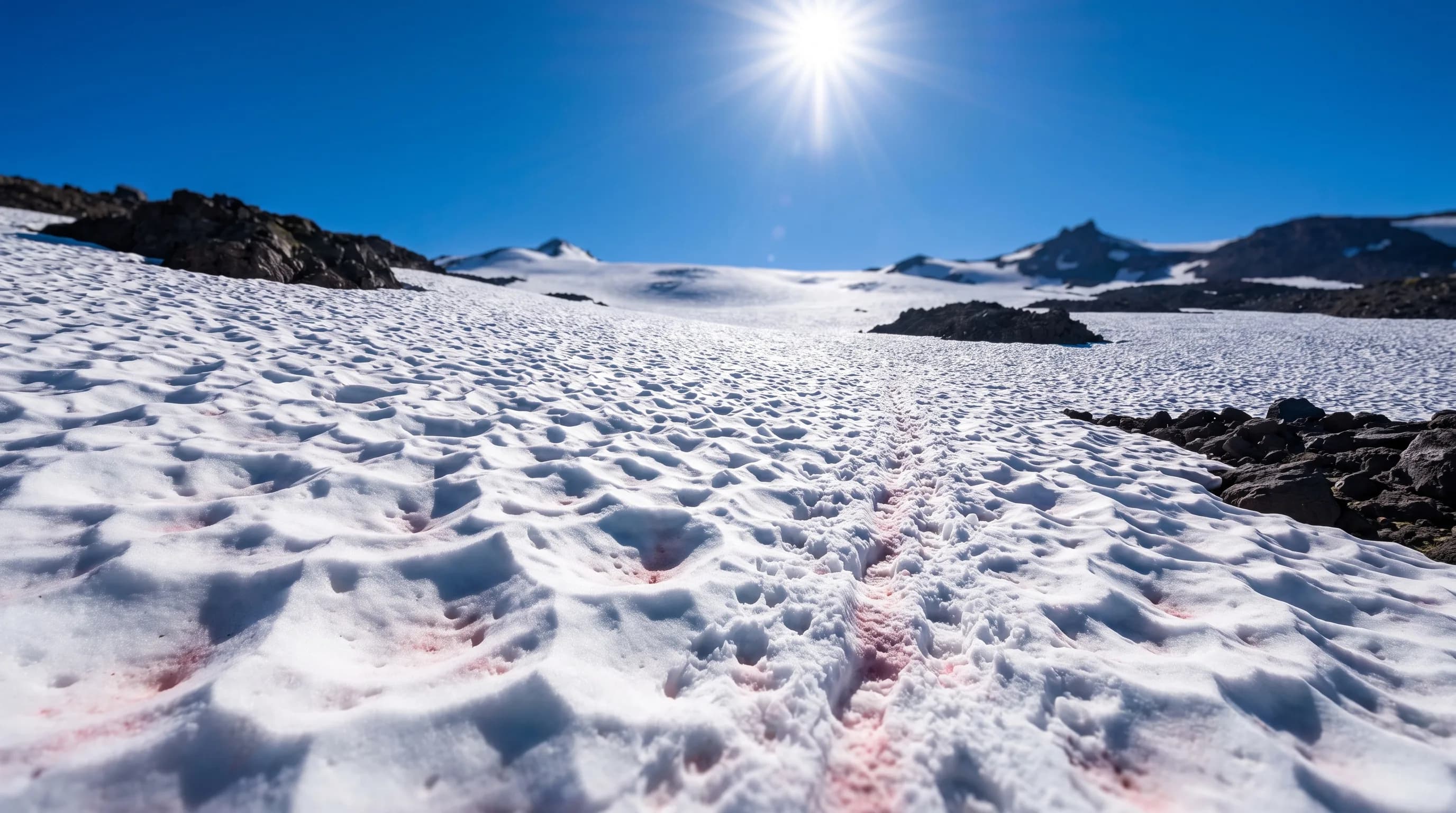
Watermelon snow is pink or red snow colored by a cold-loving green alga, Sanguina nivaloides, that makes a red pigment to shield itself from sunlight. Suncups are bowl-shaped hollows carved into old snow by strong sun in dry air. Both appear on Central Oregon's high Cascade snowfields from late June into August.
Hikers who reach the snowfields around Broken Top, Green Lakes and the Three Sisters in July often find two surprises: snow stained pink as if someone spilled juice, and a surface carved into a field of knee-deep cups. Central Oregon's summer sun does unusual work on old snow. It wakes up algae that turn the surface pink, and it sculpts the surface into cups. This guide follows a snowfield from melt-out at lower elevations to its last late-summer patches high on the peaks.
What Is Watermelon Snow?
Watermelon snow, also called pink snow or red snow, is a bloom of microscopic algae living in the top few centimeters of a summer snowfield. Seen up close, the snow looks dusted with pink or red, and the color is often strongest in footprints and in the hollows of suncups, where the algae collect.
The alga responsible was long called Chlamydomonas nivalis. In 2019, a team led by Lenka Procházková reclassified the main red-snow species into a new genus, naming it Sanguina nivaloides, from the Latin for blood. The common name, watermelon snow, comes from its color, not its taste. The color comes from a survival strategy.
What Causes Pink Snow?
Pink snow is caused by algae that spend part of their life as green, swimming cells in the film of meltwater between snow grains, then turn into red resting cells. The red comes from astaxanthin, a carotenoid pigment that acts as a sunscreen against intense ultraviolet and visible light.
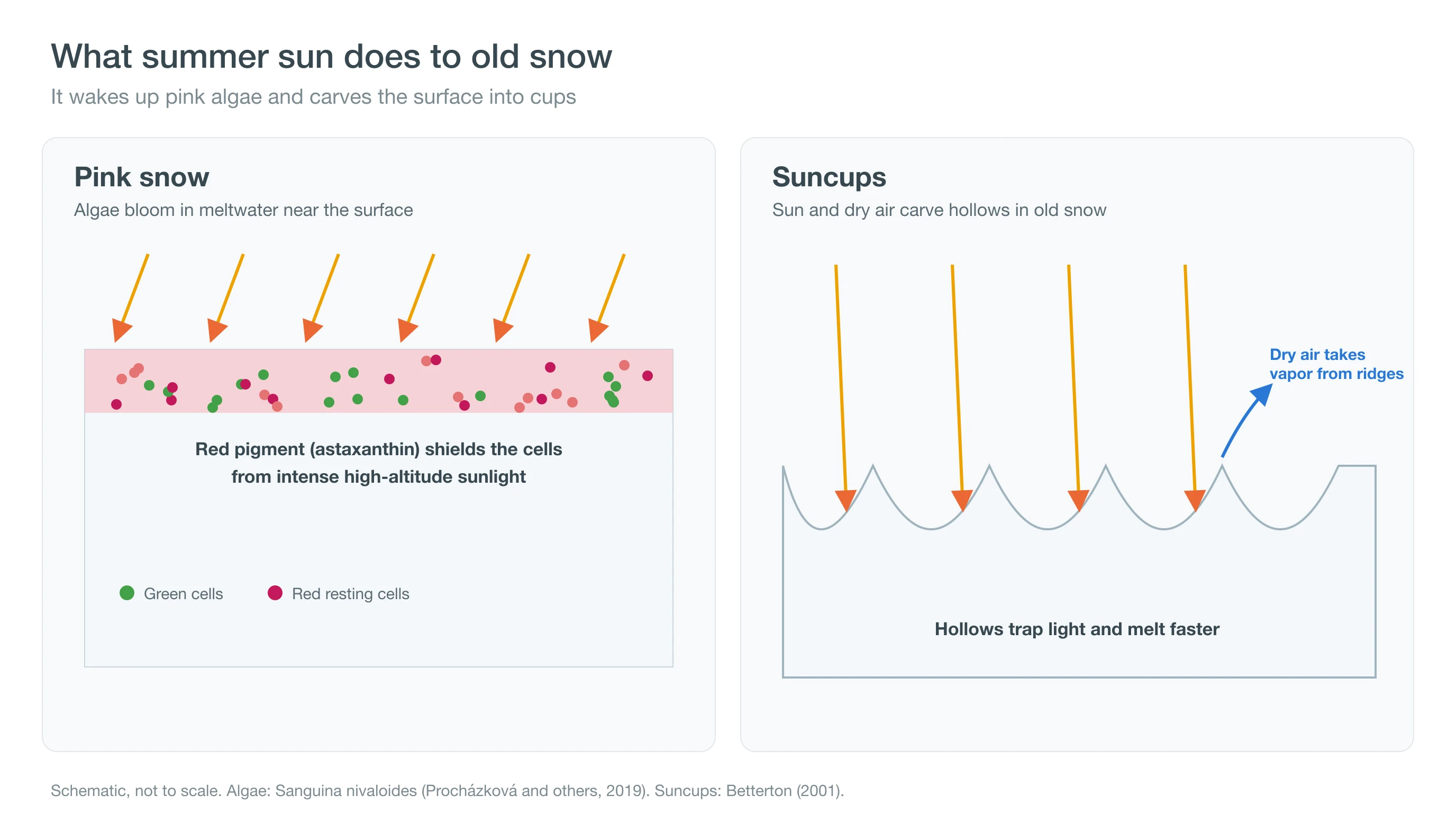
That sunscreen is needed. High Cascade snowfields sit 6,000 to 10,000 feet up, where ultraviolet light is stronger than at sea level, and fresh snow reflects much of it back up through the algae. The pigment lets the cells survive on the surface, where there is light for photosynthesis. Our guide to the high-desert UV index explains why the sun is so strong here. The same sun shapes the snow surface.
What Are Suncups and How Do They Form?
Suncups are bowl-shaped hollows, often tens of centimeters deep, that form on old snow under strong sun. They spread across a snowfield in a honeycomb pattern of sharp ridges and round dips, making it look like an egg carton.
They form when snow melts and evaporates unevenly. A small dip traps more reflected sunlight than the snow around it and melts faster, while the ridges between dips lose mass mostly by evaporating into dry air, which is slower. Over days of clear weather, small dips deepen and organize into a regular pattern. Wet, cloudy or rainy weather softens them, which is why they are most dramatic during Central Oregon's dry summer spells. Our guide to snow water equivalent covers the snowpack these features form on. Both need lingering snow, so timing matters.
| Watermelon snow | Suncups | |
|---|---|---|
| What it is | Snow colored pink or red by algae | Bowl-shaped hollows in old snow |
| Cause | Sanguina nivaloides and its red pigment | Strong sun and dry air melting and evaporating snow unevenly |
| Where in Central Oregon | Old snowfields high in the Cascades | The same snowfields, especially sunny slopes |
| When | Late June to August | June to August |
| What to do | Look and photograph; do not eat | Step on the ridges, use poles, watch your footing |
Sources: Procházková and others (2019) on Sanguina; Betterton (2001, Physical Review E) on suncup formation. Timing is typical for Central Oregon and varies with the winter's snowpack.
When and Where Can You See Watermelon Snow in Central Oregon?
Look for watermelon snow on lingering high snowfields from late June through August, after the lower trails have melted out. At the Irish Taylor snow sensor southwest of Mt. Bachelor (5,540 feet), the snow is usually gone by late June, with a median melt-out of June 23 from 1991 to 2020. Snowfields thousands of feet higher, on shaded slopes and in bowls, last into August.

Good places to look include the Green Lakes basin and the slopes of Broken Top, the snowfields below Tam McArthur Rim, and the upper slopes of South Sister. Hikers often report pink snow in these areas, though it varies from year to year. The timing shifts with the winter: in a snow-drought year like 2026, when the Irish Taylor sensor melted out by April 8, the high snowfields shrink early too. Check Green Lakes, Broken Top and Tam McArthur Rim conditions, and confirm road and trailhead access with the Deschutes National Forest. Getting there means walking on cupped snow.
How Do You Hike Safely on Suncups and Pink Snow?
- Footing: step on the ridges between suncups rather than in the hollows, and use trekking poles. Algae-stained snow can be slick.
- Traction: early-morning snow can be hard and icy; light traction devices help on slopes.
- Sun protection: snow reflects sunlight onto your face and under your chin; wear sunglasses, sunscreen and a hat.
- Water: do not eat pink snow, and treat any snowmelt before drinking it.
- Storms: start early; afternoon thunderstorms build over the Cascades in summer. See lightning safety for hikers.
By late August, the show is ending.
What Happens to the Snowfields by Late Summer?
By late August, only the highest, shaded, north-facing patches remain, and much of the pink fades as the snow melts and the algae wash into meltwater. The algae themselves help speed the ending: pink snow is darker than clean snow, absorbs more sunlight and melts faster, so the most colorful snowfields are often among the first to shrink.
Central Oregon's clear summer weather keeps the process going. Redmond Airport's evening skies are free of broken or overcast cloud below 12,000 feet on about 94% of July evenings, and Bend averages about 22 days of 80°F or warmer in July, so the snowfields get weeks of strong sun. See Mt. Bachelor weather for conditions on the high slopes. The Deep Dive explains why the pink and the cups speed that ending.
Deep Dive: How Do Algae and Sun Speed Up a Snowfield's Melt?
Algae and sun speed a snowfield's melt through a darkening feedback, and dry air shapes where that melt happens, carving the surface into cups.
What Is Albedo, and How Much Do Algae Change It?
Albedo is the share of sunlight a surface reflects. Clean summer snow reflects most of it, roughly 70% to 90%. An algal bloom darkens the surface, so it absorbs more sunlight, melts faster, and frees more liquid water for the algae, which grow and darken it further. On Alaska's Harding Icefield, a study led by Gerard Ganey (Nature Geoscience, 2017) found that algae were responsible for about a sixth of the snowmelt in algae-rich areas. That figure comes from Alaska; Oregon's snowfields have not been measured the same way.
A simple example shows the scale. If clean snow reflects 80% of sunlight and absorbs 20%, while algae-darkened snow reflects 60% and absorbs 40%, the darker patch takes in twice as much energy under the same sky. On a clear July day in the Cascades, when the sun can deliver several hundred watts per square meter for many hours, that difference adds up to centimeters of extra melt. The numbers here are for illustration; real albedo varies with grain size, dust and the density of the bloom.
Why Do Suncups Grow Instead of Smoothing Out?
A slight hollow traps reflected light from its own walls and shelters its floor from dry wind, so it melts faster than its surroundings. The ridges, exposed to the dry breeze, lose more of their mass to evaporation, which absorbs heat and keeps them cooler. That difference amplifies small dips into a regular pattern, an instability that physicist Meredith Betterton modeled in Physical Review E in 2001.
Why Does Dry Air Matter So Much?
Turning ice directly into vapor, called sublimation, takes about 2,834 joules per gram, about 8.5 times the 334 joules needed to melt it. In dry air, ridges lose snow mostly by slow, energy-expensive evaporation and sublimation, while hollows melt quickly, sharpening the relief. In humid or rainy weather, melting dominates everywhere and the cups soften. Central Oregon's dry summers make for sharp suncups.
Per centimeter of snow water lost, the difference is large. Sublimating 1 centimeter of water from a square meter of snow takes about 28 megajoules, while melting the same amount takes only about 3.3. A ridge that loses its mass mostly to dry air therefore shrinks far more slowly, and stays cooler, than a hollow that loses its mass by melting, which is exactly what keeps the cups deepening.
How Can You Plan a Trip to See Pink Snow?
Central Oregon's summer sun is what makes the snow pink and cupped, so plan for clear midsummer weeks, high snowfields and an early start. Check trail and road status with the Deschutes National Forest, the Green Lakes forecast for afternoon thunderstorm risk, and catch the same peaks glowing at dawn with our guide to alpenglow over the Three Sisters.