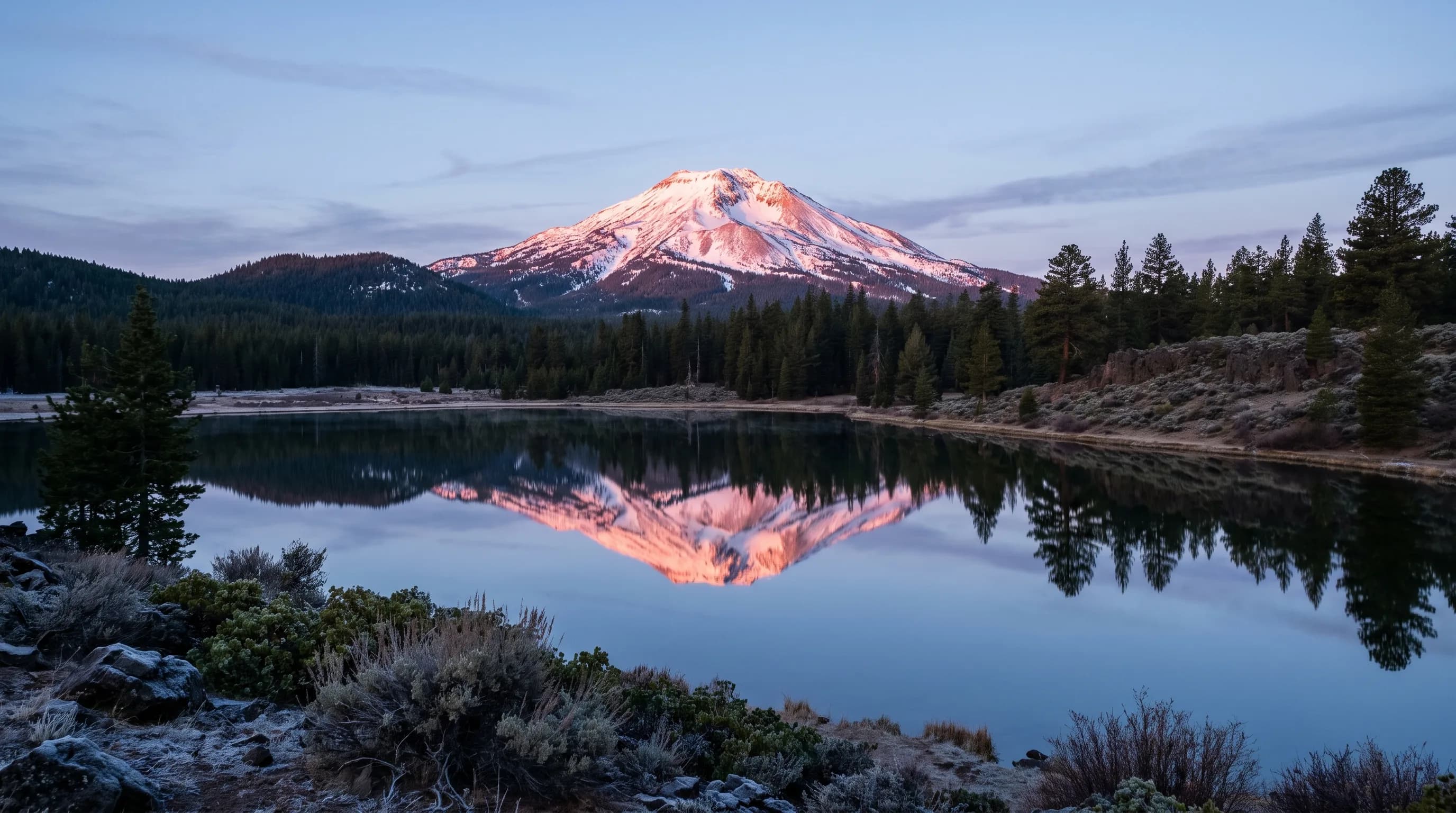
Alpenglow is the pink or orange glow on snowy mountains around sunrise or sunset, when the peaks catch reddened light that does not reach the valley. In Central Oregon, the Three Sisters, Broken Top and Mt. Bachelor glow above Bend at sunrise on clear mornings, most reliably from May to June and in October, when snow and clear skies overlap.
The Cascades stand west of Bend, so the town has a front-row seat at dawn: the first sunlight lands on summits more than 10,000 feet high while the streets below are still in shadow. Alpenglow needs three ingredients at once: snow on the peaks, a clear sky between the peaks and the sun, and the last or first red light of the day. This guide explains each ingredient and finds the months, times and places where Central Oregon has all three.
What Is Alpenglow?
The American Meteorological Society's Glossary of Meteorology defines alpenglow narrowly, as a return of sunset colors to a mountain summit after the first colors have faded into shadow, or a similar glow just before sunrise. In everyday use, it means any pink, orange or red glow on high mountains at either end of the day.
Snow and pale rock show it best because they reflect most of the colored light that reaches them. Dark, forested slopes show little. The first ingredient is the light itself.
Why Do the Peaks Turn Pink While Bend Is in Shadow?
The peaks turn pink because, when the sun is very low, its light crosses a long path through the atmosphere that scatters away most of the blue and leaves orange and red. The summits, 5,000 to 7,000 feet above Bend, sit high enough to catch that light while the valley floor is still below the horizon's edge.
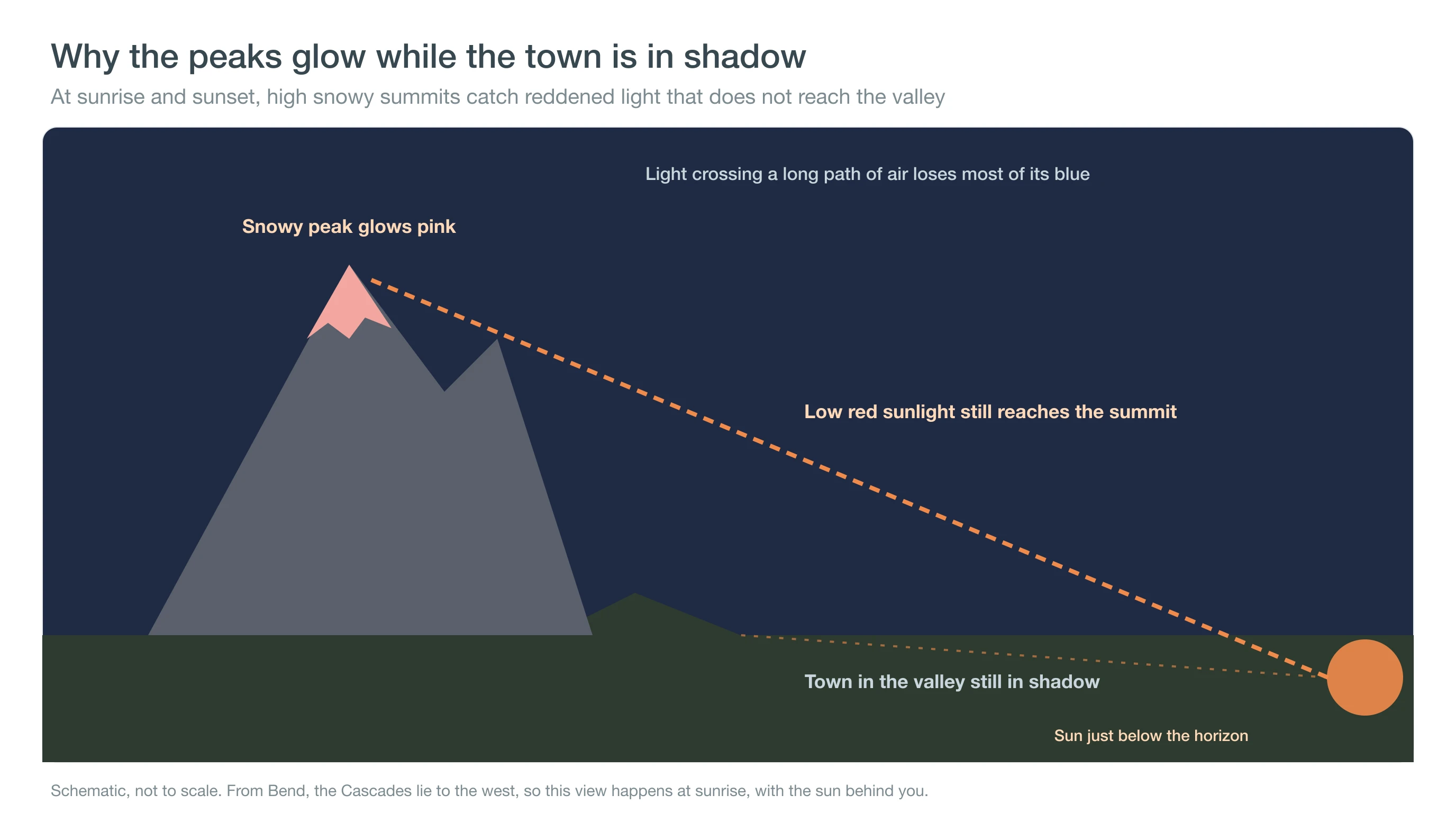
Which end of the day matters depends on where you stand. From Bend, Redmond, Sunriver and the town of Sisters, the Cascades are to the west, so the sunrise sun lights the faces you see: at dawn, the snowy east sides of the Three Sisters, Broken Top and Mt. Bachelor glow pink, then gold. At sunset, the sun sits behind the peaks from Bend, so they appear as dark silhouettes against a bright sky. For evening alpenglow on the Sisters, go where the low evening sun lights the side facing you, such as the McKenzie Pass lava fields north of the peaks. See why the low sun turns red. The second ingredient is a clear sky.
Which Months Have the Clearest Central Oregon Skies at Dawn and Dusk?
Summer is clearest. At Redmond Airport from 2000 to 2025, the observation nearest sunset showed no broken or overcast cloud below 12,000 feet on 94% of July evenings and 92% of August evenings, against only 57% to 61% from December through March.
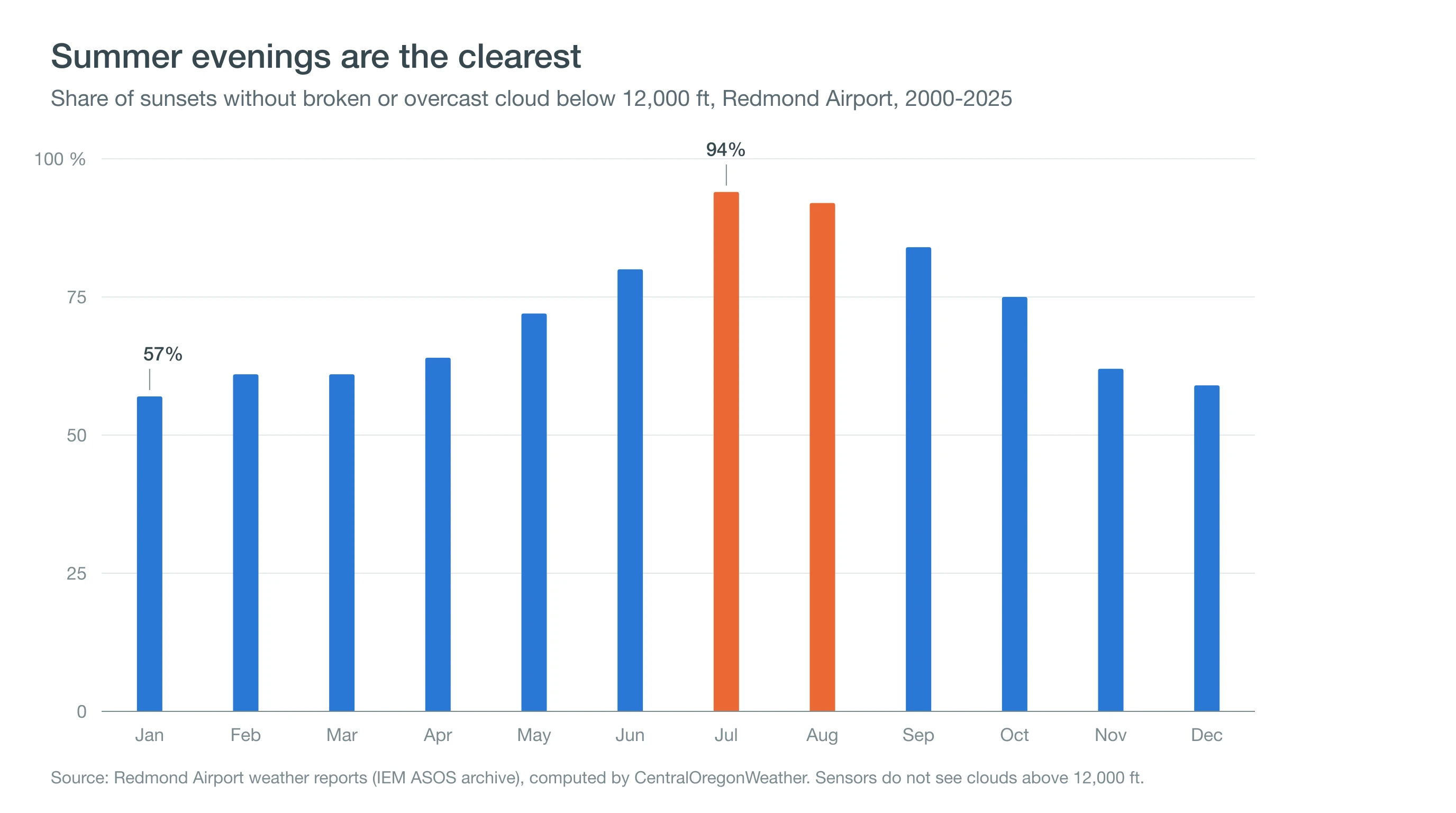
Mornings are often clearer still in summer, because the clouds that build over the mountains on hot afternoons usually fade overnight. High, thin cirrus, which the airport sensors cannot see, can actually help, catching pink light of its own. But July's peaks have lost much of their snow, which brings in the third ingredient.
When Is the Best Time of Year to See Alpenglow in Central Oregon?
The best overlap of snow and clear skies comes from May through June and again in October and early November, after the first snows whiten the peaks. Winter mornings after a storm clears can be spectacular, with deep snow to the treeline, but clear spells are less frequent.
| Month | Sunrise in Bend | Sunset in Bend | Clear sunsets | Snow on the peaks | Alpenglow odds |
|---|---|---|---|---|---|
| January | 7:37 a.m. | 4:51 p.m. | 57% | Deep | Clear mornings after storms |
| March | 7:19 a.m. | 7:11 p.m. | 61% | Deep | Changeable; good between storms |
| May | 5:39 a.m. | 8:23 p.m. | 72% | Full on the peaks | Very good |
| June | 5:21 a.m. | 8:50 p.m. | 80% | Melting but bright | Best overlap |
| July | 5:36 a.m. | 8:47 p.m. | 94% | Patchy | Clear but less snow |
| August | 6:09 a.m. | 8:11 p.m. | 92% | Little | Watch for smoke |
| October | 7:19 a.m. | 6:23 p.m. | 75% | First snows | Very good after early storms |
| December | 7:33 a.m. | 4:28 p.m. | 59% | Deep | Short days, clear spells |
Selected months. Sunrise and sunset for the 15th of each month in downtown Bend, computed with NOAA solar equations, local time. Clear sunsets: Redmond Airport, 2000-2025, no broken or overcast cloud below 12,000 feet. Snow on the peaks is a general guide; it varies by year.
In August and September, wildfire smoke can redden the light but also hide the peaks entirely. Check the smoke season guide before planning a dawn trip. Timing within the morning matters as much as the month.
What Is the Belt of Venus?
The Belt of Venus is the pink band that appears low in the sky opposite the sun at twilight, just above a darker blue-gray band, which is Earth's own shadow cast on the atmosphere. It is the same reddened light that makes alpenglow, scattered back by the air instead of by snow.
From Bend, look east over the high desert and the Ochocos at sunset to see it rise, and west over the Cascades at dawn, where it sits just above the peaks as they start to glow. Watching both directions turns a sunset or sunrise into a much bigger show. Then pick a place to stand.
Where Are the Best Places to Watch Alpenglow Near Bend?
- Pilot Butte (sunrise): a short drive or walk to a summit view of the whole Cascade skyline, lit by the first sun. See Pilot Butte.
- Sparks Lake (sunrise and evening side light): reflections of South Sister and Broken Top; the Cascade Lakes Highway is usually open from late spring to fall. See Sparks Lake.
- Dee Wright Observatory (summer evenings): on McKenzie Pass, north of the Sisters, where the setting sun lights their northern and western slopes. OR 242 is open only from about June to November; see Dee Wright Observatory and our passes guide.
- Tumalo Mountain and Smith Rock: high vantage points for dawn light on the peaks; see Tumalo Mountain.
Deep Dive: Why Is Twilight Light Red, and How Long Do the Peaks Keep It?
Twilight light is red because the low sun's rays cross dozens of times more air than at midday, and the peaks keep it longer because their height lets them see past the curve of the Earth.
Why Does the Low Sun Turn Red?
Air molecules scatter short wavelengths far more strongly than long ones, a process called Rayleigh scattering, which varies with one over the wavelength to the fourth power. Violet light scatters roughly nine times more than deep red. Near the horizon, sunlight passes through about 38 times as much atmosphere as when the sun is overhead, so most of the blue and green is scattered out along the way, leaving orange and red to light the snow.
How Long After Sunset Do the Summits Stay Lit?
A higher point sees farther over the curve of the Earth, so its horizon dips lower. The dip is roughly the square root of twice the height divided by Earth's radius. South Sister's summit, at 10,358 feet, has a horizon about 0.7° lower than downtown Bend's at 3,623 feet. Near sunset at Bend's latitude, the sun sinks roughly 0.18° per minute, so the summit keeps direct sunlight about 4 minutes longer from height alone, and the reddest light arrives in those final minutes. The same geometry works in reverse at dawn: the summit lights up about 4 minutes before the valley.
The season changes which faces light up. At Bend's latitude, the sun rises at an azimuth of about 57°, in the northeast, in mid-June, and about 123°, in the southeast, in mid-December. Summer dawns light the northeast-facing slopes and glaciers of the Three Sisters, while winter dawns light their southeast faces. The color also lasts longer in summer, because the sun climbs at a shallower angle near the solstice, stretching twilight at this latitude to more than half an hour.
What Is the Earth's Shadow?
Opposite the low sun, the dark blue band rising from the horizon is the shadow of the Earth itself, cast onto the atmosphere. Above it, the pink Belt of Venus is sunlight scattered back toward you. As the sun sinks further, the shadow climbs and swallows the pink band, the same moment the alpenglow fades from the peaks.
Twilight comes in stages that line up with the show. Civil twilight runs until the sun is 6° below the horizon; alpenglow and the Belt of Venus are strongest in its first half. By nautical twilight, when the sun is 6 to 12° below, the shadow has risen high in the sky, the pink has faded and the brightest stars appear.
How Can You Catch Alpenglow Over the Three Sisters?
Line up the three ingredients: snowy peaks, a clear sky toward the sun and the first or last light of the day. From Bend, that means being in place about 15 minutes before sunrise on a clear morning in late spring or fall. Check cloud cover on the CentralOregonWeather map and smoke on the smoke forecast the night before, and look for lenticular clouds, which can glow too. In summer, the snowfields that hold the color may also be tinted by watermelon snow.