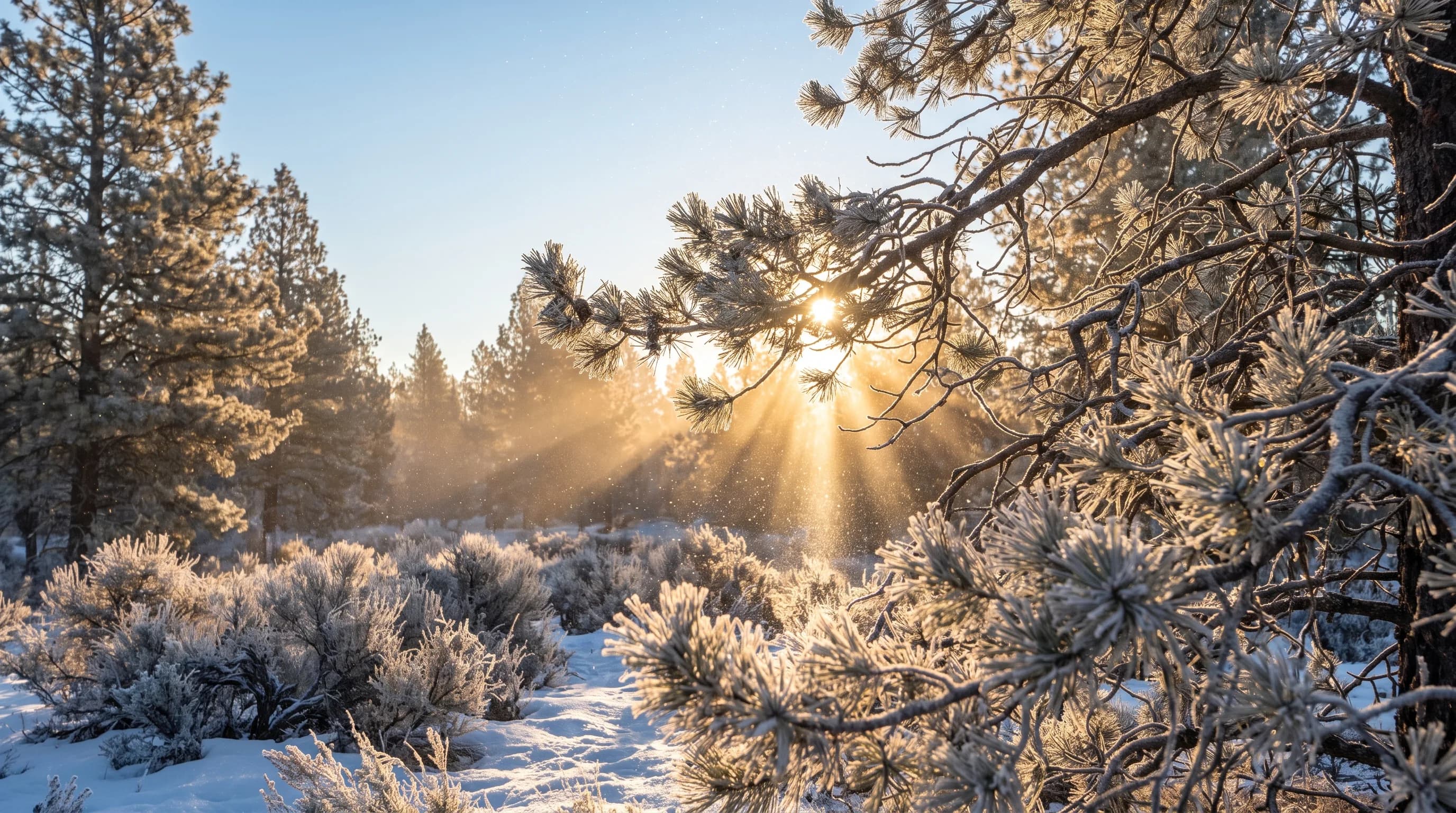
Ice fog is fog made of ice crystals instead of liquid droplets, and it needs extreme cold: the National Weather Service notes it is rare at temperatures warmer than -22°F. Diamond dust is tiny ice crystals falling from a mostly clear sky on very cold, calm mornings. Frost flowers are thin ribbons of ice that grow from plant stems or new lake ice. Central Oregon's coldest basins see the last two a few mornings each winter; most local "ice fog" is really freezing fog.
Each of these is water skipping the liquid step in very cold, still air. The page moves from the common to the rare: freezing fog made of supercooled droplets, then true ice fog and diamond dust, and finally frost flowers, which grow from the ground up.
What Is Ice Fog?
Ice fog is a fog of suspended ice particles, mostly 12 to 20 microns across, that forms when tiny water droplets freeze almost as soon as they condense. According to the National Weather Service glossary, it is rare at temperatures warmer than -30°C (-22°F) and becomes almost constant near -45°C (-49°F) wherever there is a source of water vapor, such as a town's chimneys and car exhaust. It is a classic sight in places like Fairbanks, Alaska.
Central Oregon rarely gets that cold. Sunriver's coldest reading since its record began in 1998 is -27°F, on Dec. 8, 2013, and Bend's all-time low is -26°F, set in 1933. So when Bend residents say "ice fog," they almost always mean something else.
Is Ice Fog the Same as Freezing Fog?
No. Freezing fog is made of liquid droplets that stay liquid below 32°F, a state called supercooled, and freeze the instant they touch something solid: a windshield, a tree branch, a road. Ice fog is already frozen in the air. The difference matters on the road: freezing fog glazes pavement with ice, while true ice fog mostly just lowers visibility.
| Freezing fog | Ice fog | Diamond dust | |
|---|---|---|---|
| Made of | Supercooled water droplets | Ice crystals | Tiny ice crystals falling |
| Typical temperature | About 32°F down to the teens | Rare above -22°F | Very cold, calm air |
| Sky | Fog, low visibility | Fog, low visibility | Mostly clear, sparkling |
| Ices roads? | Yes, often | Little | No |
| In Central Oregon | Several mornings each winter month | Rare | A few mornings in cold snaps |
Definitions from the National Weather Service glossary. Central Oregon frequency based on Redmond Airport weather reports (2000-2025) and co-op station temperature records.
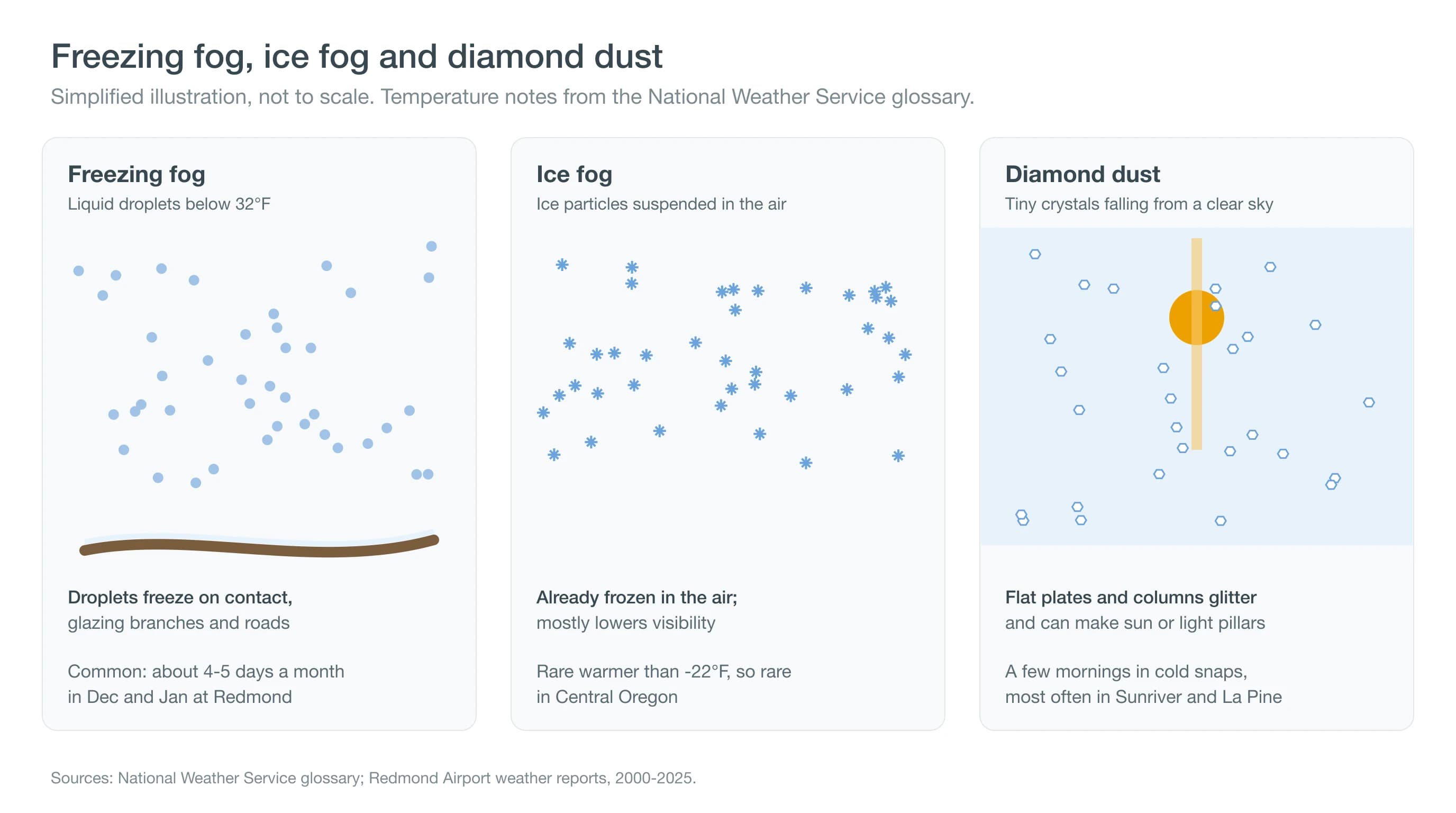
Freezing fog is common here. Redmond Airport reports it on about 4.6 days in an average December, 3.8 in January and 2.2 in February, and it is the main reason roads can ice up with no snow or rain falling. Our freezing fog guide covers the driving hazard, and black ice explains why the glaze is so hard to see. On the very coldest mornings, though, the fog can clear and the air itself still sparkles.
What Is Diamond Dust?
Diamond dust is a fall of tiny, unbranched ice crystals, shaped like needles, columns or flat plates, from a clear or nearly clear sky. The crystals form directly in very cold, calm air near the ground, often after a clear night when the temperature has plunged. They are too small and sparse to accumulate like snow, but in low morning sunlight they glitter as they drift, which is how the phenomenon got its name.
Because the crystals are flat and fall slowly, many of them drift with their faces level, like tiny mirrors. That orientation creates the optical effects that often accompany diamond dust: vertical beams of light above streetlights, called light pillars, and rings and bright spots around the sun, such as a sun halo. If you see a pillar over a streetlight on a frigid night, diamond dust is almost certainly in the air.
Where and When Does Central Oregon Get Cold Enough?
The cold-air basins of the upper Deschutes, around Sunriver, La Pine and Wickiup Reservoir, are the coldest places people live in Central Oregon, and they are where these sights are most likely. On clear, calm nights, cold, dense air drains off the surrounding slopes and pools on the flat basin floor. Sunriver averages about 6.6 mornings at or below 10°F in December and about two at or below 0°F, more than Bend or Redmond.
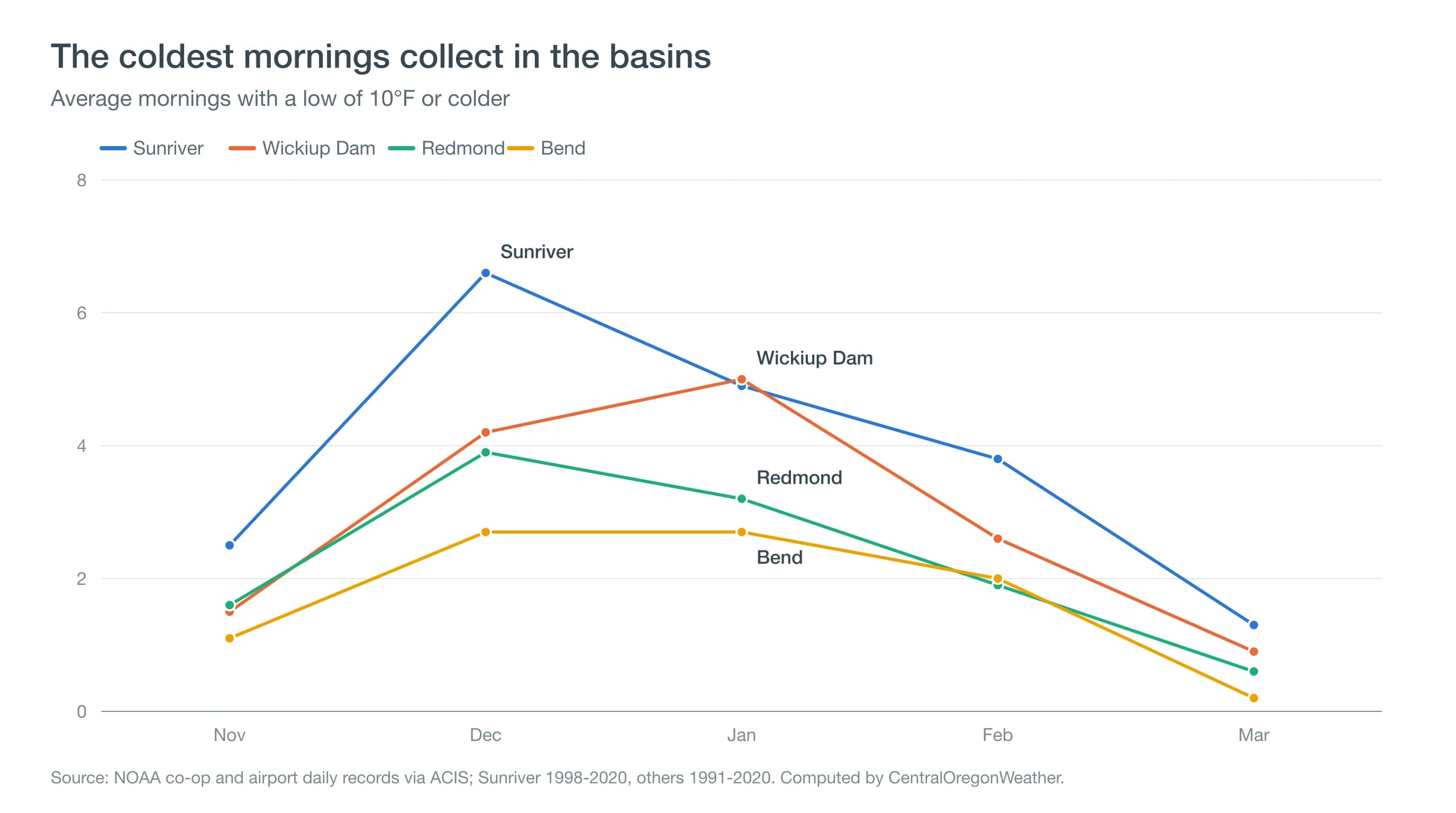
The best setups follow a fresh snowfall and a clearing sky. Snow cover lets the ground radiate heat away quickly while insulating it from the warmer soil beneath, and a calm, dry high-pressure ridge keeps the cold air in place. These are the same conditions that build temperature inversions. Our Sunriver weather guide covers the basin's cold winters month by month. The same mornings also grow ice from the ground up.
What Are Frost Flowers?
Frost flowers are thin, curling ribbons and petals of ice. The name covers two different things. On plants, frost flowers grow from the base of certain stems when the air freezes but the soil is still moist and unfrozen. Water drawn up from the ground freezes inside the stem, splits it, and is pushed out through the crack as a paper-thin sheet of ice that curls as it grows, like toothpaste from a tube. They form most often early in winter, before the ground freezes, and melt as soon as the sun hits them.
On water, frost flowers are feathery ice crystals that grow upward from thin new ice on a calm, very cold night, when the air above is far colder than the freshly frozen surface. They are best known from polar sea ice but can appear on new ice on lakes and ponds too. Both kinds are fragile and short-lived, and both are cousins of hoar frost, the feathery frost that grows on twigs and fences on clear, cold nights.
How Can You See and Photograph These on a Cold Morning?
Timing is everything. Diamond dust shows best in the first hour after sunrise, when low sunlight backlights the crystals; stand with the sun ahead of you, shielded behind a tree or building, and look toward it. Light pillars need darkness and a bright light source, so look at streetlights or distant town lights before dawn; from a dark spot outside Sunriver or La Pine, the lights of town can send up pillars that reach well into the sky. Frost flowers and hoar frost are close-up subjects; bring a macro lens or phone macro mode and shoot before the sun reaches them.
Dress for the cold you are chasing: subzero mornings in the basins call for real winter gear. And remember that the same mornings that sparkle can glaze roads, especially where fog lingers near rivers and bridges.
Deep Dive: Why Can Water Stay Liquid Below Freezing?
Water can stay liquid below 32°F because freezing needs a starting point. Without one, small droplets can stay liquid far below the freezing point, which is the hidden "liquid step" these phenomena skip.
What Is Supercooled Water?
For water to freeze, molecules must lock into the ordered lattice of an ice crystal, and the first tiny cluster of ice is unstable unless something helps it form. Pure droplets in a cloud or fog have no such help, so they can remain liquid well below 32°F. Only near -40°F, which is also -40°C, do they freeze on their own, a process called homogeneous freezing. That is why most Central Oregon fog at 20°F is still liquid, and why it becomes freezing fog that coats whatever it touches.
What Makes Ice Crystals Form Instead?
Certain particles, called ice nuclei, give water a template to freeze on. Some mineral dusts and even some bacteria work as ice nuclei, but most become active only at temperatures well below freezing, typically colder than about 5°F to 14°F (-15°C to -10°C). Once a few ice crystals exist among supercooled droplets, they grow quickly at the droplets' expense, because air that is just saturated relative to liquid water is oversaturated relative to ice. Meteorologists call this the Wegener-Bergeron-Findeisen process; on a frigid morning it can turn a liquid fog into a shower of glittering crystals.
Why Does Diamond Dust Sparkle?
Crystals that grow slowly in calm, very cold air form simple shapes: flat hexagonal plates and slender columns. Plates fall face-down, like leaves, and columns tend to fall with their long axes level. Millions of these aligned crystals act as mirrors and prisms. Mirror reflections from plates stack into light pillars, and refraction through the crystals' 60° prism angles bends sunlight into halos and sun dogs. The sparkle you see is each crystal catching the sun for an instant as it tumbles.
When Should You Watch for Diamond Dust and Frost Flowers?
Watch for the setup that makes water skip the liquid step: a fresh snowfall, a clearing sky, calm wind and a forecast low near or below 0°F in the basins. When the overnight forecast on the Sunriver or La Pine destination pages drops toward single digits, set an alarm for sunrise, look for pillars over the streetlights before dawn, and check the ground and new lake ice for frost flowers before the sun reaches them. Drive carefully on the way: if there is fog in the low spots, there may be ice on the road.