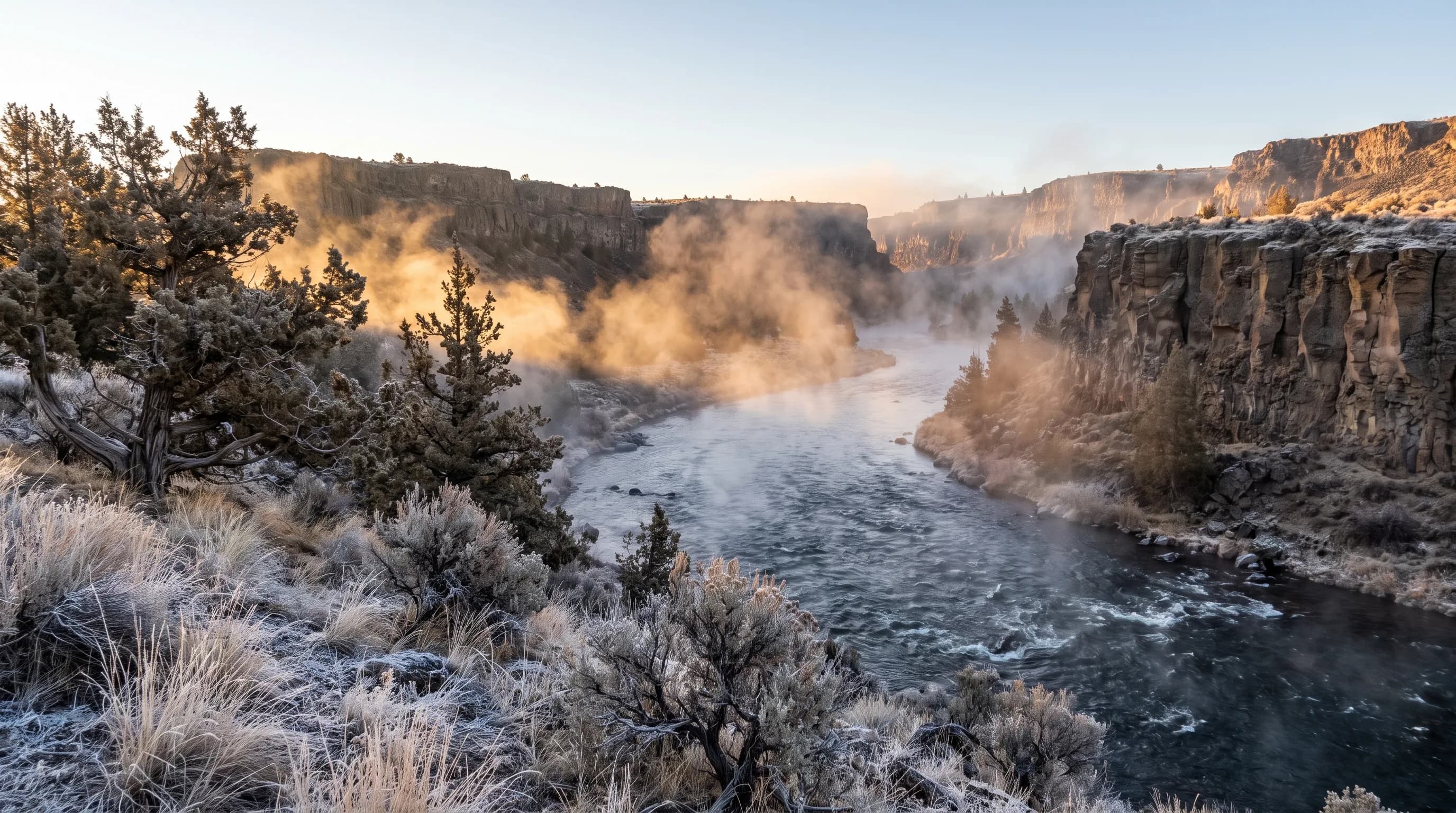
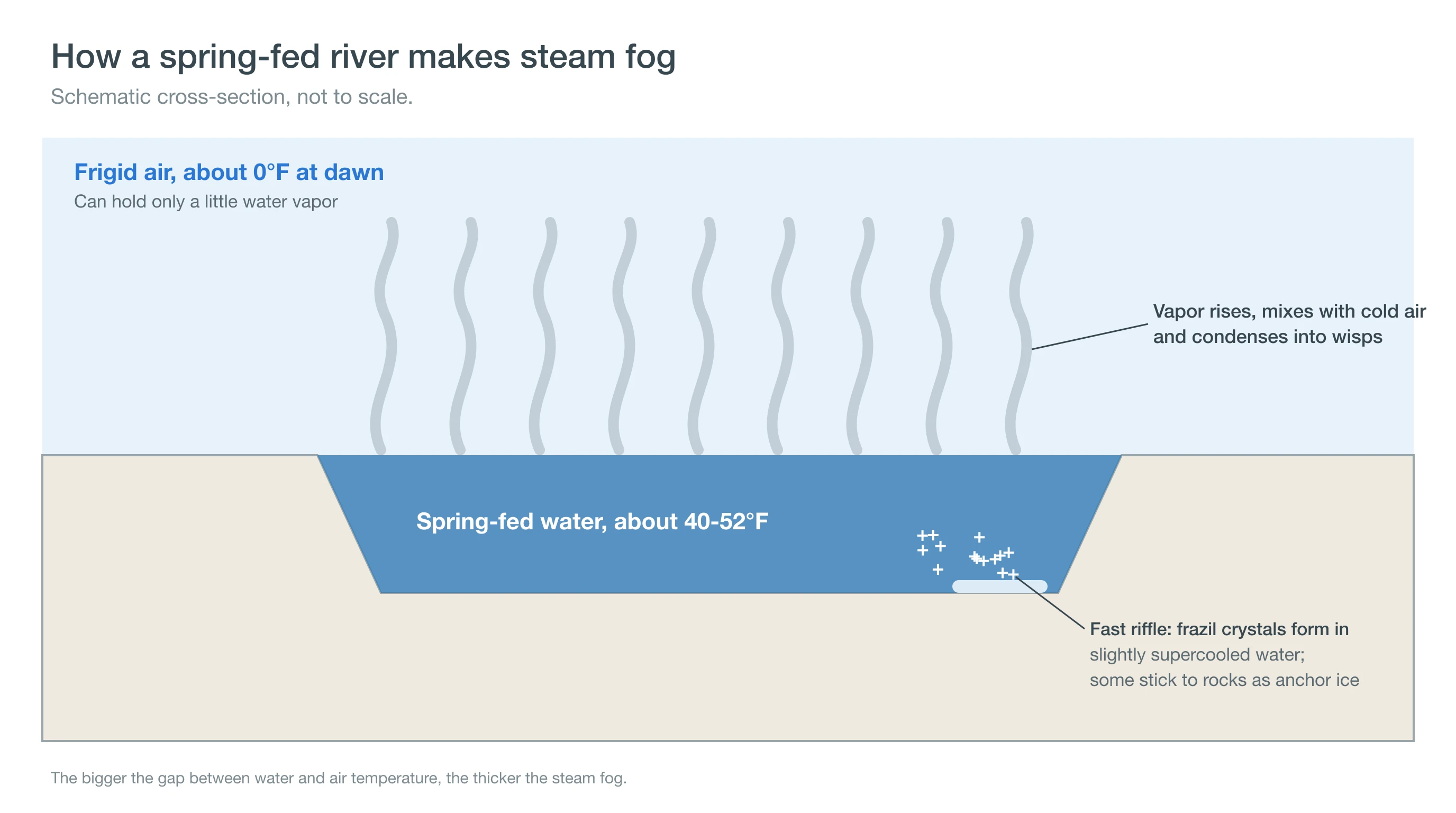
Steam fog forms when very cold air moves over much warmer water. The water evaporates into the frigid air, which can hold only a little vapor, so the excess instantly condenses into rising wisps. Central Oregon's spring-fed rivers stay about 40°F to 52°F through winter, so on subzero mornings they look like they are boiling. Frazil ice is the slushy ice that forms in fast, supercooled river water on those same mornings.
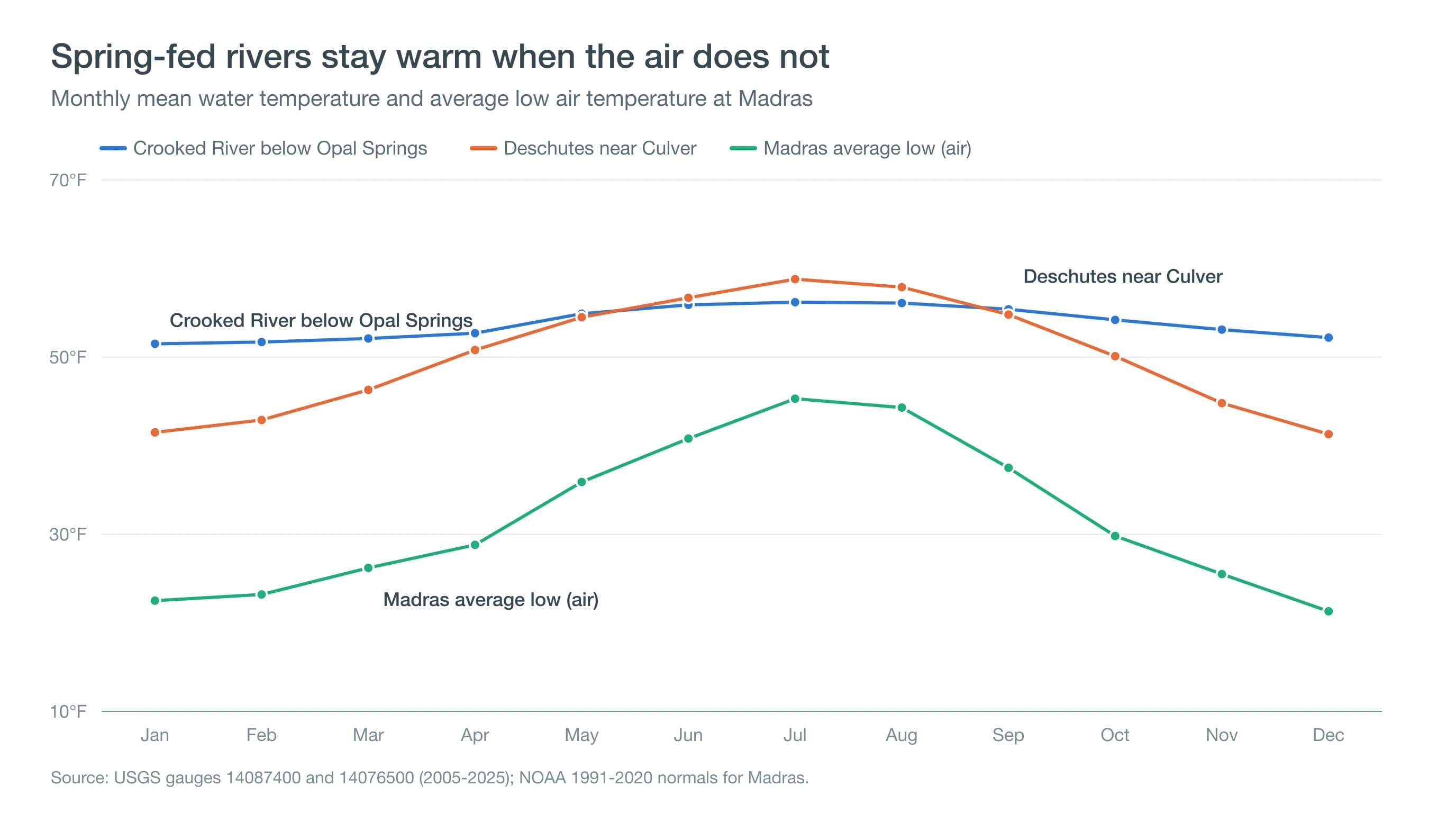
The bigger the gap between water and air, the bigger the show. In January, the Crooked River below Opal Springs averages about 52°F, warmer than Bend's average January afternoon of 42.5°F, while the air above it often sits in the teens or single digits at dawn.
Why Does the River Steam on Cold Mornings?
The river steams because it is putting water vapor into air that cannot hold it. Warm water evaporates quickly, and the vapor mixes into the bitterly cold air just above the surface. Cold air can hold only a small amount of water vapor, so the mixture becomes oversaturated and the extra vapor condenses into tiny droplets: fog. Rising warmth from the water carries the droplets upward in curling wisps that look like smoke or steam.
Meteorologists call it steam fog, or evaporation fog. Over the ocean, sailors call it sea smoke. It is the same thing you see when you breathe out on a cold day, on the scale of a whole river.
Central Oregon's rivers bring their own warmth to that meeting.
Why Do Central Oregon's Rivers Stay Warm in Winter?
Many of Central Oregon's rivers stay warm in winter because they are fed by springs. Rain and snowmelt sink into the porous volcanic rock of the Cascades and the high plateau, can travel underground for years, and emerge at springs at a nearly constant temperature. Large springs such as Opal Springs, in the lower Crooked River canyon, hold the river near 52°F all winter.
| River | January water temperature | Nearby January low | Typical gap |
|---|---|---|---|
| Crooked River below Opal Springs | 51.5°F | Madras 22.5°F | About 29°F |
| Deschutes River near Culver | 41.5°F | Madras 22.5°F | About 19°F |
| McKenzie River at Clear Lake outlet | 39.3°F | No nearby station | Not computed |
Water temperatures are monthly means of USGS daily records at gauges 14087400 and 14076500 (2005-2025) and 14158500 (2017-2025). Air temperature is the NOAA 1991-2020 normal January low at Madras. On the coldest mornings the gap is far larger than the average.
The middle Deschutes picks up spring water too as it flows north from Bend toward Lake Billy Chinook, and it averages about 41°F near Culver in January. The McKenzie River leaves Clear Lake at about 39°F all winter. Rivers fed mostly by snowmelt or by shallow reservoirs run much colder and can freeze along their edges, so they steam far less.
When Is Steam Fog Strongest?
Steam fog is strongest on clear, calm mornings after an arctic cold front, when the air in the canyons drops into the single digits or below zero while the river stays in the 40s or 50s. A light breeze helps by moving fresh cold air over the water, but strong wind mixes the fog away. The show peaks around sunrise, when the air is coldest, and fades as the sun warms the canyon.
The December 2013 cold snap shows how extreme the gap can get. On the morning of Dec. 8, 2013, the co-op station 7 miles northeast of Bend fell to -23°F and Sunriver to -27°F. A spring-fed river near 50°F under air like that has a gap of more than 70°F, enough to fill a canyon with steam. Most winters bring nothing that cold, but a 30°F to 40°F gap on an ordinary single-digit morning is plenty for a good show.
Canyons help. Cold air drains into the deep river canyons overnight and settles there, the same process that builds temperature inversions, so the air right above the water is often the coldest air around. In Central Oregon, Bend averages only about 2.7 mornings at or below 10°F in December and January, so the best steam-fog mornings come a handful of times each winter. They can look like more: January in Bend also brings plenty of ordinary fog.
Is Steam Fog the Same as Freezing Fog?
No. Steam fog gets its moisture from warm water and forms right over rivers and lakes. Freezing fog forms over land when moist air cools overnight, and its supercooled droplets freeze on contact with roads and trees. Steam fog usually stays over the water and rises, while freezing fog can blanket a whole valley.
The two can meet. Steam fog drifting off a river can coat nearby bridges, railings and trees with rime, and bridge decks over rivers are among the first places to ice. Our freezing fog guide and our explainer on black ice cover the road hazard. Sometimes, on the coldest mornings, the water itself starts to freeze.
What Is Frazil Ice?
Frazil ice is a soup of tiny ice crystals that forms inside fast, turbulent water when the whole flow cools a hair below freezing. Instead of a smooth sheet forming on the surface, as on a calm pond, crystals form throughout the water at once, clump into slush, and drift downstream. Some stick to rocks on the riverbed and build into anchor ice, which can lift off later in the day and float away in chunks.
Frazil and anchor ice need water that has lost its warmth, so they are rare on Central Oregon's spring-fed reaches and more likely on colder, snowmelt-fed streams and in riffles during long cold snaps. Where they form, they can raise water levels, clog intakes and build ice jams. River ice of any kind is unpredictable: never walk on it.
Where Can You See Steam Fog Near Bend?
Look where warm water meets a cold canyon. The Crooked River arm of Lake Billy Chinook and the viewpoints of The Cove Palisades overlook water fed by the Opal Springs area. The Deschutes canyon near Steelhead Falls and Crooked River Ranch, where the middle Deschutes is gaining spring water, is another good bet. In Bend, the Deschutes through the Old Mill District and riverside parks can steam on the coldest mornings too.
Go at sunrise, when the air is coldest and low light makes the wisps glow. Be careful on the drive: canyon roads and bridges are where fog and ice gather first.
Deep Dive: Why Does Warm Water Make Fog in Cold Air?
Warm water makes fog in cold air because the amount of vapor air can hold rises steeply with temperature, so vapor that warm water gives off easily is far more than the frigid air above it can keep.
How Much Vapor Can Warm and Cold Air Hold?
Scientists measure this with saturation vapor pressure, the vapor pressure at which air is saturated. It rises by about 7% for every 1°C of warming, a relationship described by the Clausius-Clapeyron equation. Water at 50°F supplies vapor at a pressure of about 12.3 hectopascals at its surface. Air at 0°F becomes saturated at only about 1.5 hectopascals. The warm water is offering roughly eight times more vapor than the cold air can hold.
Why Does Mixing Make Fog?
Right at the water's surface, a thin layer of air is warm and saturated. As turbulence mixes it with the frigid air above, the mixture cools quickly but still carries most of the warm layer's vapor, so it ends up supersaturated. The excess condenses onto tiny particles as fog droplets. Because the curve is so steep, a mixture of two unsaturated or just-saturated air masses can produce fog even though neither one alone would. The bigger the temperature gap, the more excess vapor and the thicker and taller the fog; heat from the water also makes the mixed air buoyant, so the fog rises in columns and wisps.
How Does Fast Water Freeze From the Inside?
On a frigid night, turbulent water loses heat to the air quickly, and the mixing spreads that cooling through the whole flow. The water can cool a few hundredths to about a tenth of a degree Celsius below freezing before ice forms, a slight supercooling. Then ice crystals appear everywhere in the flow at once, seeded by snowflakes, bubbles or tiny particles. These are frazil crystals. They are sticky while the water is supercooled, so they cling to each other and to cold rocks on the bed, which is how slush and anchor ice build up in riffles even while the river's surface stays open.
When Should You Watch for Steaming Rivers?
Watch the gap. When the forecast low near the river canyons drops into the single digits after a clear, calm night, the spring-fed Crooked and Deschutes rivers will be 30°F to 40°F warmer than the air, and the show should be good. Check overnight lows on the Redmond and Madras destination pages, plan to arrive at sunrise, and check ODOT TripCheck for icy roads and bridges on the way.